


India has tightened the screws on deepfakes, ordering social media platforms to pull down AI-generated impersonations much faster and to clearly label synthetic audio and video. The government’s amended IT Rules now require platforms to act within hours, raising the stakes for global tech firms that rely on India’s massive user base and increasingly find themselves at the center of AI-enabled manipulation.
What Changed in the IT Rules for Deepfakes and Labels
The updated Intermediary Guidelines bring deepfakes squarely under a formal compliance regime. Any service that hosts or shares audio-visual content must ask uploaders to disclose when media is AI-generated, verify those claims with technical tools, and apply visible labels. The rules call for traceable provenance metadata embedded in files, aiming to help investigators and users tell what’s real and what is synthetic.
- What Changed in the IT Rules for Deepfakes and Labels
- The New Timelines and What They Mean for Platforms
- Safe Harbor Stakes and Compliance Load for Platforms
- Global Ripples and Industry Readiness Amid New Rules
- Free Speech and Privacy Concerns Under Faster Takedowns
- Deepfakes in India Are Not Theoretical, Recent Cases Show
- What Platforms Should Do Now to Meet India’s Rules

The government’s red lines are explicit: deceptive impersonations, non-consensual intimate imagery, and synthetic content tied to serious crimes are prohibited outright. Platforms that fall short, especially after being notified by authorities or users, risk losing safe-harbor protections under Indian law—exposing them to greater legal liability for user posts.
The New Timelines and What They Mean for Platforms
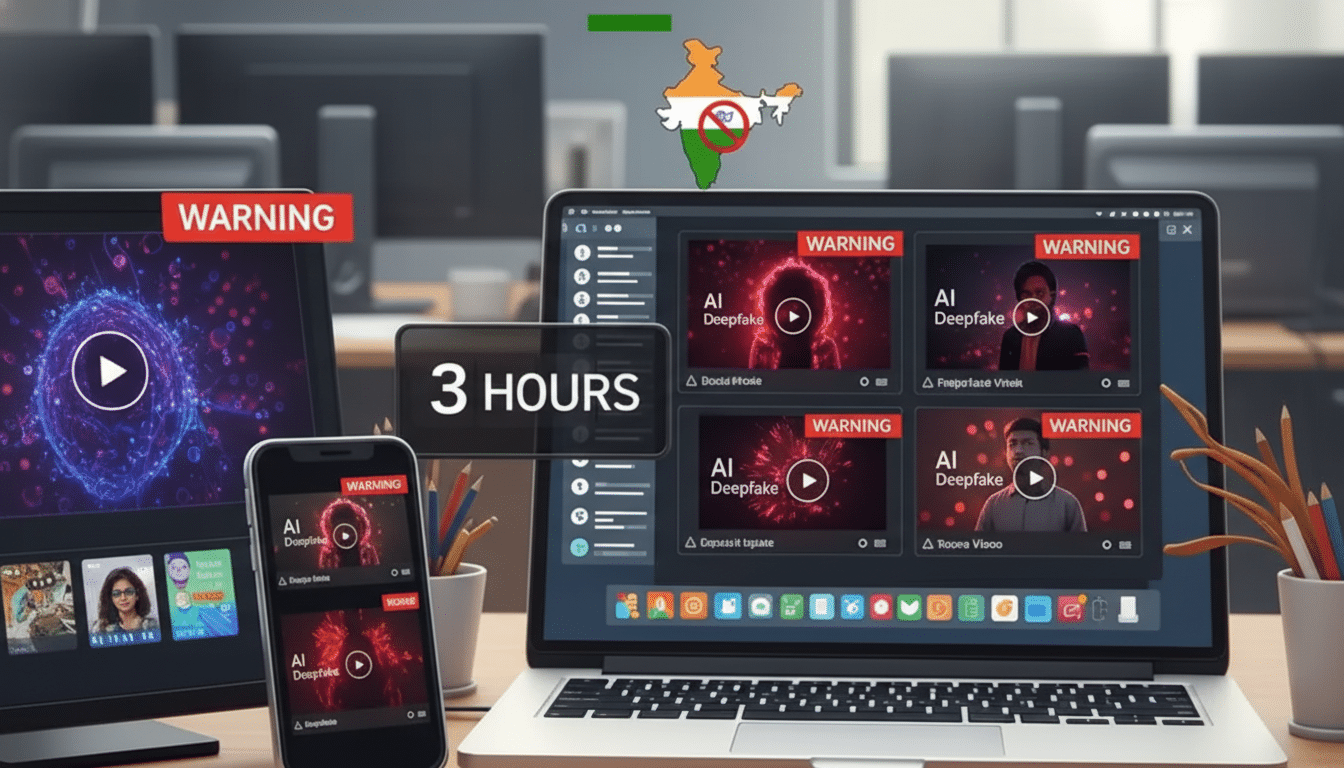
The amendments compress compliance windows dramatically. Platforms face a three-hour deadline to execute official takedown orders and as little as two hours to address certain urgent user complaints. That’s a step-change from prior practice and leaves little room for prolonged internal review or cross-functional escalation, especially across time zones.
These deadlines are geared toward fast-moving harms—think viral impersonations of public figures, weaponized deepfakes during elections, or intimate-image abuse. India’s election watchdog and law enforcement have repeatedly warned about AI-enabled misinformation; the new timelines reflect a crisis-response mindset rather than a traditional content moderation cadence.
Safe Harbor Stakes and Compliance Load for Platforms
For platforms, the biggest risk lies in the link between speed and liability. Missing a three-hour clock could endanger safe-harbor status under Section 79 of the IT Act, a bedrock protection that shields intermediaries from being treated as publishers. Corporate counsel in Delhi say the operational impact will be immediate: 24/7 incident teams, automated detection pipelines, and pre-cleared escalation playbooks to avoid legal exposure.
The traceability and provenance push will likely accelerate adoption of standards such as C2PA-style content credentials and watermarking across images, audio, and video. But it will also test encrypted services. India already requires “first originator” traceability for significant messengers; extending provenance expectations to synthetic media could renew tensions with apps that rely on end-to-end encryption.
Global Ripples and Industry Readiness Amid New Rules
India’s scale—over a billion internet users—means its enforcement norms tend to travel. When the country tightened takedown procedures previously, companies retooled global workflows. Expect a repeat: short-fuse queues for deepfake flags, faster automated removals, and wider labels for “AI-generated” across feeds. Meta and YouTube have already begun rolling out synthetic-content disclosures; India’s rulebook will pressure them to verify labels and back them with tamper-resistant provenance.
Smaller platforms could struggle. Deepfake detection at platform scale requires costly compute, video forensics expertise, and rapid legal triage. Industry estimates suggest that high-accuracy multimodal classifiers can cost multiples of standard moderation pipelines. Without pooled tooling or government-certified reference datasets, compliance could be uneven.
Free Speech and Privacy Concerns Under Faster Takedowns
Digital rights groups warn that ultra-short deadlines are a recipe for over-removal. The Internet Freedom Foundation has argued that trimming review windows to mere hours all but guarantees automated takedowns will outpace human judgment, chilling lawful speech. Civil society lawyers are also uneasy about provisions that allow intermediaries to share user identity details with private complainants without a court order, calling it a blow to anonymity and due process.
The backdrop is a years-long tug-of-war over state takedown powers. Platforms and activists have criticized opaque removal orders, and one major social network has challenged the breadth of directives in court. The government has since narrowed who can issue removal instructions, but the deepfake surge has given regulators fresh urgency to act.
Deepfakes in India Are Not Theoretical, Recent Cases Show
Recent viral incidents—like AI-fabricated videos of Bollywood actors and synthetic voice clones in political campaigns—have shown how quickly manipulated media can erode trust. Security researchers at Indian Institutes of Technology report rapid gains in generative video quality, while detection benchmarks improve more slowly. That asymmetry explains the government’s insistence on provenance, not just post-hoc detection.
Transparency reports from large platforms already show India among the top countries for content restrictions and user data requests. Add deepfake-specific enforcement to that mix, and moderation volumes are poised to climb further, particularly during election cycles and high-profile events.
What Platforms Should Do Now to Meet India’s Rules
Compliance teams will need to harden three areas fast: intake, verification, and response. That means mandatory AI-content disclosures at upload, automated provenance checks and watermark detection, crisis queues staffed around the clock, and clear pathways to label, demote, or remove content within the new clocks. Proactive hashing of known-abusive deepfakes, partnerships with fact-checkers, and rapid user notification workflows will also be essential.
For policymakers, the next test is implementation. Clear guidance on what counts as “routine or cosmetic” AI use, standardized label formats, and redress for wrongful takedowns could balance speed with rights. Without that, the race to beat the clock may fix the deepfake problem only to create a new one: platforms that moderate by default, and appeal by exception.