


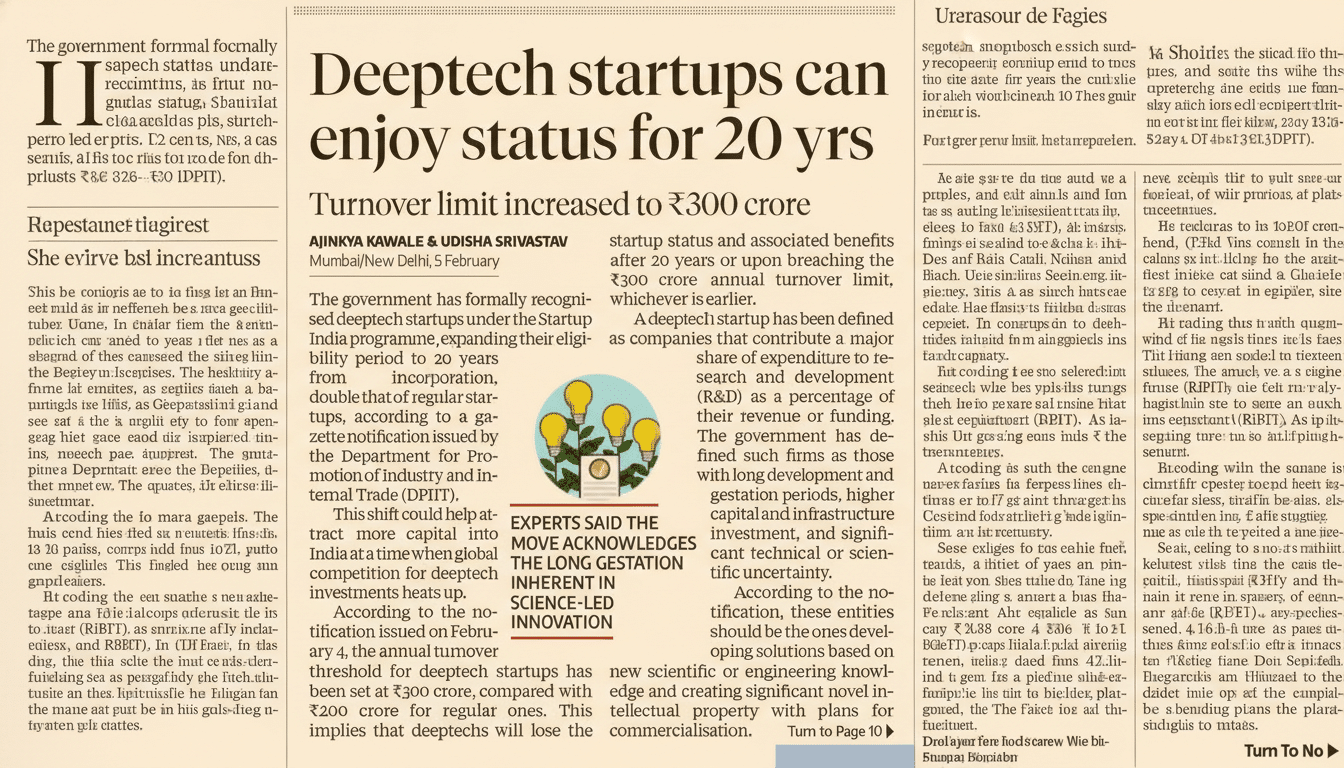
India has overhauled its startup framework for deep tech, extending recognition to 20 years and lifting the revenue ceiling for incentives to ₹3 billion. The move acknowledges that science-led companies in areas like space, semiconductors, and biotech take far longer to reach market readiness and need patient policy support to match.
The updated framework is designed to preserve access to tax, grant, and regulatory benefits through lengthy R&D and certification cycles, and it slots into a broader push to channel more public capital into long-horizon technologies through a ₹1 trillion Research, Development and Innovation Fund.

What Changed and Why It Matters for Deep Tech Startups
By doubling the recognition period for deep tech startups to 20 years and raising the turnover threshold from ₹1 billion to ₹3 billion, policymakers are aligning benefits with the realities of engineering-heavy development. Hardware tape-outs, clinical trials, and spaceflight qualification rarely fit into traditional 5–10 year venture timelines; the previous rules often cut companies off while they were still pre-commercial.
Under the new approach, founders can advance through pilots, regulatory approvals, and iterative productization without losing “startup” status purely due to time or early revenue spikes. The Department for Promotion of Industry and Internal Trade, which oversees recognition, is effectively signaling that deep tech should be judged on technical progress and validation milestones rather than a one-size-fits-all clock.
For sectors such as launch vehicles and satellite platforms, fabless chip design, quantum devices, advanced materials, and synthetic biology—where capex, compliance, and safety testing dominate early years—this is a practical reset. It removes a structural pressure point that previously forced premature pivots or overseas re-incorporation to sustain financing.
Public Capital to Bridge the Middle for Long-Horizon Tech
The policy change arrives alongside the government’s ₹1 trillion RDI Fund, crafted to widen the pool of capital for early and growth stages. Officials have indicated the capital will be deployed through professional fund managers, mirroring private market tenors and diligence so that public money complements, rather than distorts, venture decisions.
Private investors are also organizing. The India Deep Tech Alliance—a coalition topping $1 billion that includes Accel, Blume Ventures, Celesta Capital, Premji Invest, Ideaspring Capital, Qualcomm Ventures, and Kalaari Capital, with Nvidia advising—aims to coordinate follow-on funding and technical guidance. Together, the framework and funding vehicles are intended to reduce the “valley of death” between prototypes and commercial scale.
The Funding Gap in Numbers Across India, the U.S., and China
India remains an emerging player by capital deployed. According to Tracxn, Indian deep tech startups raised $1.65 billion in 2025, rebounding from $1.1 billion in each of the prior two years after a $2 billion peak in 2022. Cumulative funding stands at roughly $8.54 billion.
Contrast that with the U.S., where deep tech companies drew about $147 billion in 2025, and China at roughly $81 billion, per Tracxn. The gap highlights why domestic patient capital and policy clarity matter, especially for capital-intensive categories aligned with national priorities such as advanced manufacturing, defence technologies, climate solutions, and semiconductor ecosystems.
Signals From Founders and Investors on Deep Tech Policy Shift
Indian deep tech specialists view the longer runway as correcting a misalignment that penalized companies still in R&D. Venture partners focused on the category note that the biggest constraint has been depth of follow-on funding at Series A and beyond; they see the RDI framework’s fund-of-funds model as a way to expand capacity without overriding commercial discipline.
Industry bodies such as the Indian Venture and Alternate Capital Association have argued against a “graduation cliff” that strips support just as companies begin scaling; the revised framework addresses that concern. Early steps to select fund managers for the RDI program, according to people familiar with the process, suggest operationalization is underway.
Global investors interpret the move as a signal of policy intent. Deep tech typically plays out over 7–12 year horizons; recognition that spans those cycles reduces perceived policy risk mid-journey. While it will not reset allocation models overnight, it strengthens the case for building in India, especially as domestic public markets grow more receptive to venture-backed listings.
What to Watch Next as India Implements Deep Tech Reforms
Execution will determine impact. Key markers include how quickly RDI capital is deployed through vetted managers, whether procurement paths (for example, defence innovation programs and space-sector reforms under IN-SPACe) translate into anchor customers, and if the changes slow the trend of startups moving headquarters overseas for access to capital and markets.
Real-world traction will be visible in more flight-proven space systems, validated chip tape-outs, certified medtech, and scaled climate hardware—areas where firms like Agnikul, Skyroot, and a growing set of fabless and biotech startups are pushing ahead. Success, as several investors put it, will look like a pipeline of Indian deep tech companies competing globally and a domestic funding stack that can support them from lab to IPO.
For now, the policy shift gives founders time—arguably the scarcest resource in deep tech—and a clearer map for assembling capital across the long road from prototype to product.