


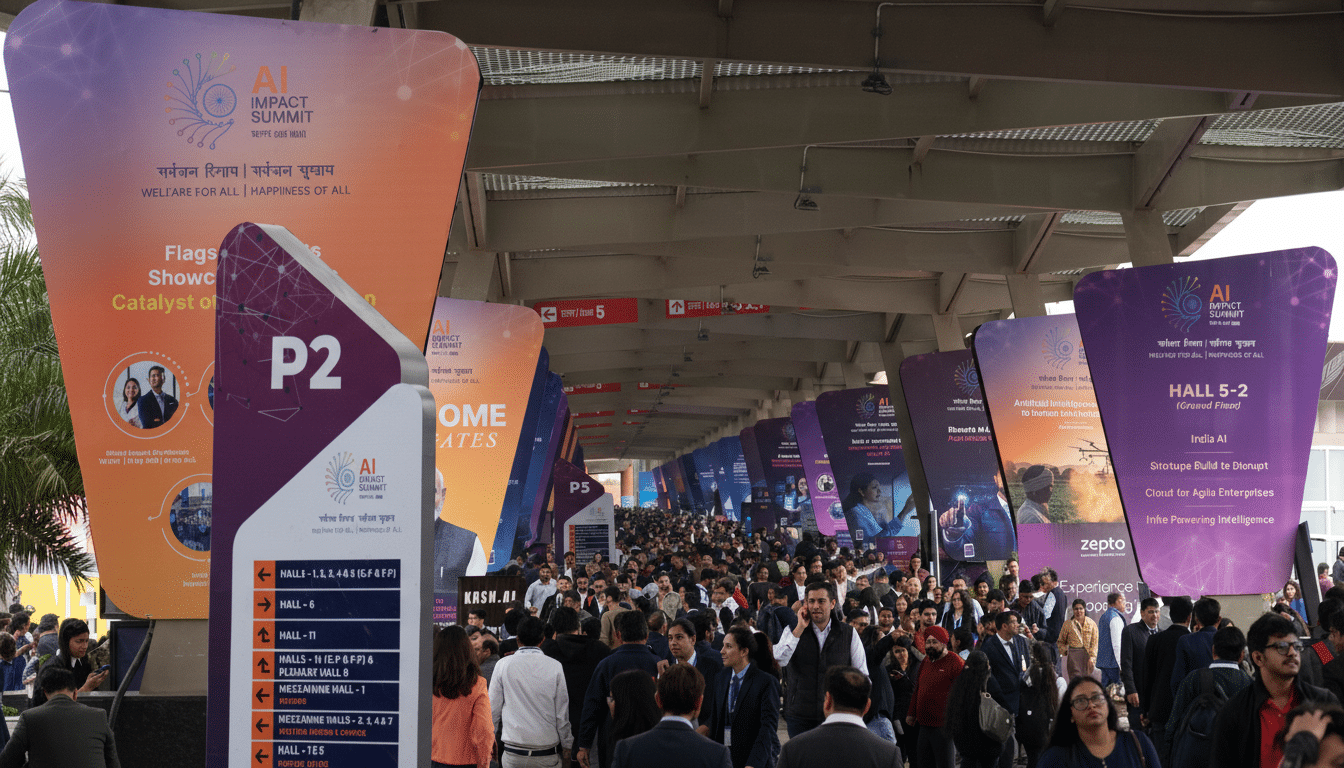
India’s AI Impact Summit has opened with heavyweight momentum, drawing leaders from OpenAI, Anthropic, Nvidia, Microsoft, Google, and Cloudflare alongside heads of state. Organizers expect 250,000 attendees across four days, signaling the country’s intent to court AI capital, build advanced compute, and position itself as a global hub for multilingual and responsible AI.
Alphabet’s Sundar Pichai, OpenAI’s Sam Altman, Anthropic’s Dario Amodei, Google DeepMind’s Demis Hassabis, and Reliance Industries chair Mukesh Ambani are slated to appear. India’s Prime Minister Narendra Modi is set to deliver remarks with French President Emmanuel Macron, underscoring the strategic heft behind the event.
- Why This Summit Matters for India’s AI Ambitions Now
- Investment And Infrastructure Take Center Stage
- Big Tech Presence and Local Tie-Ups Shape Strategy
- Regulation and Safety on the Agenda for India’s AI
- Startups Put Indian Languages And Devices First
- Global Cooperation Signals A Wider AI Alliance
- What to Watch as the AI Impact Summit Unfolds
Why This Summit Matters for India’s AI Ambitions Now
The gathering arrives as India scales up its national AI strategy and deepens ties with global labs. MeitY’s IndiaAI Mission, approved with a multibillion-rupee outlay in 2024, prioritizes AI compute, datasets, innovation, skilling, and safety. The near-term policy focus: pooling public and private investment to expand domestic compute capacity and catalyze production-grade deployments across sectors from finance to healthcare.
With one of the world’s largest pools of developers and a surge of generative AI pilots in enterprise IT, India’s argument is straightforward: it can be the scale market where AI is built for billions of users and dozens of languages. GitHub has noted India is on track to become the world’s largest developer community this decade, a tailwind for any national AI push.
Investment And Infrastructure Take Center Stage
Summit sessions are zeroing in on compute access, model reliability, and data governance. Officials and industry leaders are discussing shared AI infrastructure targets, including public–private models to provision at-scale GPU clusters. MeitY has previously flagged ambitions for a large national AI compute network, coupled with open datasets and model evaluation benchmarks tailored to Indian languages and use cases.
Expectations are high for fresh memoranda of understanding around cloud credits, sovereign-grade security, and energy-efficient data centers. The throughline is pragmatic: bring down the cost and latency of training and inference in India while tightening cybersecurity and privacy under the Digital Personal Data Protection Act and forthcoming digital legislation.
Big Tech Presence and Local Tie-Ups Shape Strategy
Nvidia’s participation follows its previously announced collaborations with Reliance and Tata to develop AI infrastructure and enterprise solutions tailored to India. Microsoft continues to expand Azure AI services and copilots to regulated industries, while Google is showcasing multilingual model work and enterprise safety tooling. Cloudflare, for its part, is emphasizing network-level protections for AI APIs and data residency controls.
The subtext: global platforms see India not just as a user base but as a co-development market. Nasscom’s recent analyses suggest a majority of large Indian enterprises are piloting generative AI, with early production use in banking, telecom, and retail—areas where India’s IT services giants are moving fast from proofs of concept to governed rollouts.
Regulation and Safety on the Agenda for India’s AI
Panels are probing the balance between open innovation and harm mitigation. India’s approach blends sectoral guidance with industry codes, building on the National Strategy for AI from NITI Aayog, the DPDP Act’s consent and accountability frameworks, and the safety pillar within the IndiaAI Mission. Discussion is centering on red-teaming multilingual models, watermarking synthetic media, and common evaluation suites for bias and robustness.
International context matters. The OECD’s AI policy work, the G7’s Hiroshima Process, and model safety commitments signed by major labs are all shaping expectations for auditability and incident reporting—areas where Indian regulators and startups alike want clarity without stifling pace.
Startups Put Indian Languages And Devices First
Domestic players are spotlighting Indic-language models and domain-specific copilots for SMEs, agriculture, and public services. AI4Bharat’s research lineage and industry initiatives like the BharatGPT collaboration have set the tone for building natively multilingual systems rather than retrofitting English-first models.
In a notable on-site teaser, Sarvam signaled a device initiative dubbed Kaze—described as bringing its models “into your hands” with hardware designed and built in India. The emphasis on on-device AI aligns with a global shift toward privacy-preserving, low-latency inference on phones and edge devices, a practical route for India’s connectivity and cost constraints.
Global Cooperation Signals A Wider AI Alliance
Modi’s joint address with Macron underscores a deepening Franco–Indian technology agenda spanning AI, quantum, and cybersecurity. Prior bilateral statements from both governments have highlighted researcher exchanges, startup bridges, and responsible AI frameworks—areas likely to see fresh impetus as Europe and India seek interoperable standards and resilient supply chains.
What to Watch as the AI Impact Summit Unfolds
Key markers in the coming days include potential cloud and compute MoUs, funding commitments for AI skilling, and new multilingual benchmark releases. Enterprise buyers will watch for concrete TCO reductions for inference in India regions, while startups will look for clarity on sandbox pathways and access to public datasets.
The broader narrative is coalescing: India wants to be where frontier AI meets mass-market pragmatism. With global labs in the room, a swelling developer base, and policymakers leaning into safety-by-design, the summit is setting the stage for India’s next wave of AI deployment—measured by shipped products, not just splashy demos.