


India’s four-day AI Impact Summit is drawing an unusually heavyweight roster from the world’s largest AI labs and Big Tech, underscoring the country’s bid to become a central node in the global AI economy. Organizers expect a crowd in the hundreds of thousands, with discussions spanning compute infrastructure, safety standards, talent pipelines, and multilingual AI for the public sector and industry.
Top leaders from Alphabet, OpenAI, Anthropic, Nvidia, Microsoft, Google, and Cloudflare are in attendance, alongside homegrown industrial giants. A joint address by India’s prime minister and France’s president is slated to set the tone for cross-border research and investment, with an emphasis on open, trusted, and secure AI deployments.
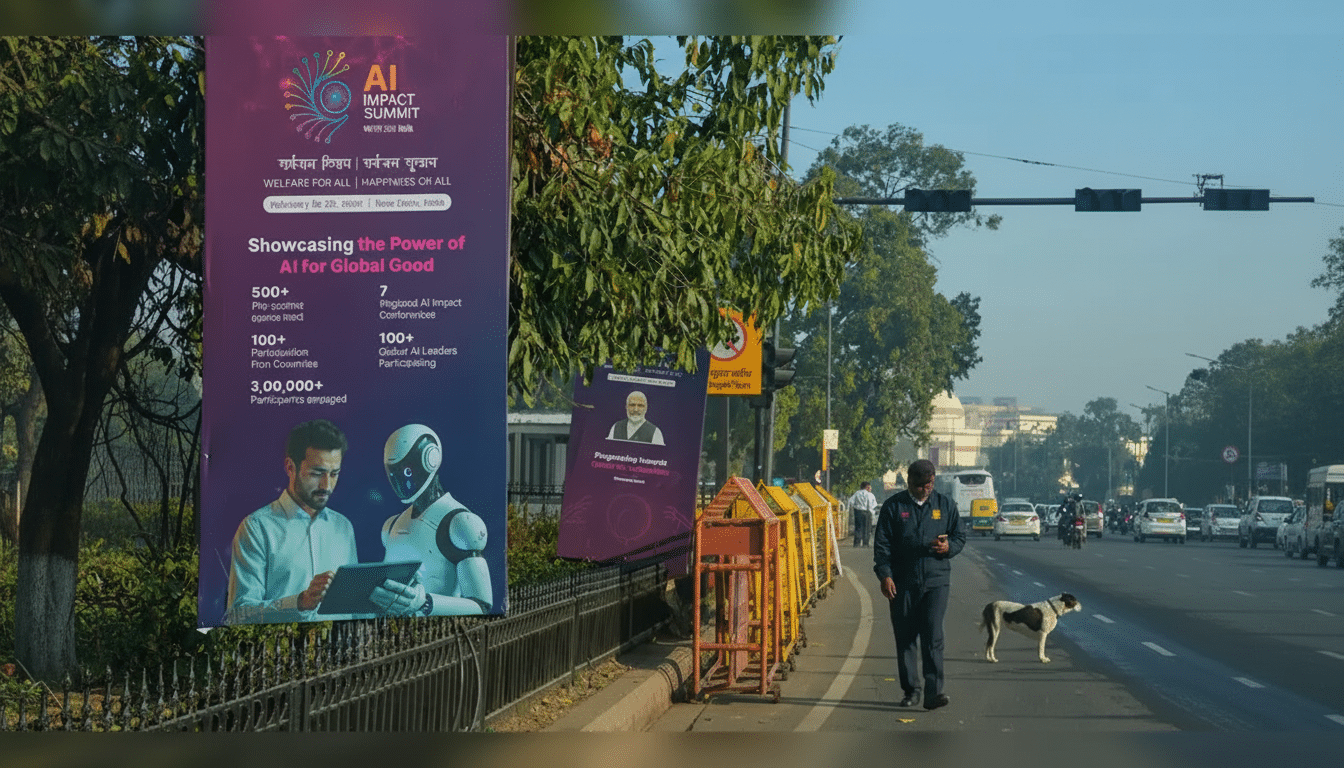
Big Tech and AI Lab Leaders Converge at India AI Summit
Early sessions have zeroed in on scaling generative AI responsibly, building for Indian languages, and moving beyond pilots to production-grade deployments. Participation from leaders such as Sundar Pichai, Sam Altman, Dario Amodei, Demis Hassabis, and Mukesh Ambani signals that the summit’s agenda is not just exploratory—it’s oriented toward near-term execution.
The interest is logical: India is one of the world’s largest internet markets and a fast-growing developer hub. GitHub’s most recent global report highlights India as the fastest-adding developer community worldwide, and industry bodies like NASSCOM note strong enterprise appetite for AI use cases in finance, retail, manufacturing, and healthcare.
Compute And Investment Take Center Stage
A recurring theme is access to affordable, high-performance compute. India’s national AI roadmap—popularly known as the IndiaAI mission—envisions public-private partnerships for large-scale GPU clusters and shared compute for startups and researchers. Discussions at the summit are centering on timelines, access models, and governance to ensure equitable allocation.
Global players are aligning with this push. Nvidia’s previously announced collaborations with Reliance and Tata to build AI infrastructure in India provide a template for industry scale-out. Major cloud providers have also expanded locally in recent years, and analysts at IDC have projected double-digit growth in AI-related IT spending in India, driven by data center capacity and enterprise modernization.
Startups and MSMEs are pressing for predictable credits, transparent queues for training runs, and regional GPU pods to reduce latency and cost. State-led efforts, such as the Telangana AI Mission in partnership with NASSCOM, are being cited as models for nurturing local ecosystems alongside national initiatives.
Safety Governance and Data Access in Focus at Summit
With OpenAI, Anthropic, and Google DeepMind in the room, AI safety has strong representation. Panels are exploring model evaluations, red-teaming, watermarking and provenance, and mechanisms to share research without compromising security. The presence of these labs suggests growing consensus on baseline safeguards and incident reporting, even as competition in model performance intensifies.
On the policy front, India’s Data Protection law, NITI Aayog’s Responsible AI principles, and ongoing consultations by the IT ministry form the backdrop. Delegates referenced multilateral efforts like the Global Partnership on AI and OECD principles, with calls for a risk-based approach aligned to sectoral regulators. A priority emerging from the sessions: enabling privacy-preserving access to high-quality datasets so innovators can train and evaluate models without eroding trust.
Indic Language Models And Public Sector Use
India’s multilingual reality is front and center. Researchers and startups focused on Indic language models—among them teams from AI4Bharat, Sarvam AI, and Krutrim—are in the spotlight for building systems that can understand code-mixed text, dialectal variation, and low-resource scripts. The goal is to move beyond translation toward domain-grounded assistants that perform reliably in banking, agriculture, justice, and healthcare.
The government’s Bhashini platform, part of the National Language Translation Mission, is frequently cited as foundational infrastructure to open datasets, benchmarks, and tools for local languages. Delegates are also pointing to India’s Digital Public Infrastructure—UPI for payments and ONDC for commerce—as natural testbeds where AI copilots can plug into secure, interoperable rails and show measurable impact.
Talent Skilling and Enterprise Adoption Move to Scale
Another headline theme is talent. Universities, edtech providers, and global firms are outlining pathways to upskill millions in AI fundamentals, MLOps, and safety engineering. NASSCOM’s recent analyses indicate strong demand for AI practitioners across sectors, while enterprises report a growing shift from proofs of concept to production, with clear KPIs tied to revenue, cost, and risk outcomes.
For CIOs, the focus is pragmatic: standardize data pipelines, pick fit-for-purpose models, control inference costs, and embed governance from day one. Case studies shared on stage emphasize small, iterative wins—like AI-assisted customer support and forecasting—before leaping to full autonomy in mission-critical workflows.
What to Watch Next at the India AI Impact Summit
All eyes are on the joint leader-level address for signals on bilateral research, compute partnerships, and support for open science. Observers also expect more clarity on the rollout of shared GPU clusters, startup access frameworks, and sandbox programs for high-stakes sectors.
The summit’s success will be judged on execution: how today’s pledges translate into tracked infrastructure, trained professionals, funded experiments, and measurable public-good deployments. If the momentum holds, India’s AI build-out could accelerate from headline promises to hard metrics within the coming quarters.