


A barely known AI company appeared on stage at Snapdragon Summit with a huge idea. The Horizon Pro PC from Humain AI offers an “agentic” AI front end and device subscription model that its founders say could break the traditional enterprise PC refresh cycle. The question is not whether the laptop exists (it does), but whether this design heralds where business PCs are going.
What an agentic AI PC actually does in practice
Humain’s approach begins with Humain One, a task-oriented interface that organizes work across AI agents, not around app hopping. Instead of spinning up five programs to put a report together, an agent parses intent, calls services, and stitches outputs together, relying on local inference for privacy (and speed), offloading to the cloud when expansion to a larger model is required. It’s the AI-native UX a lot of vendors have talked about, but precious few have actually built.
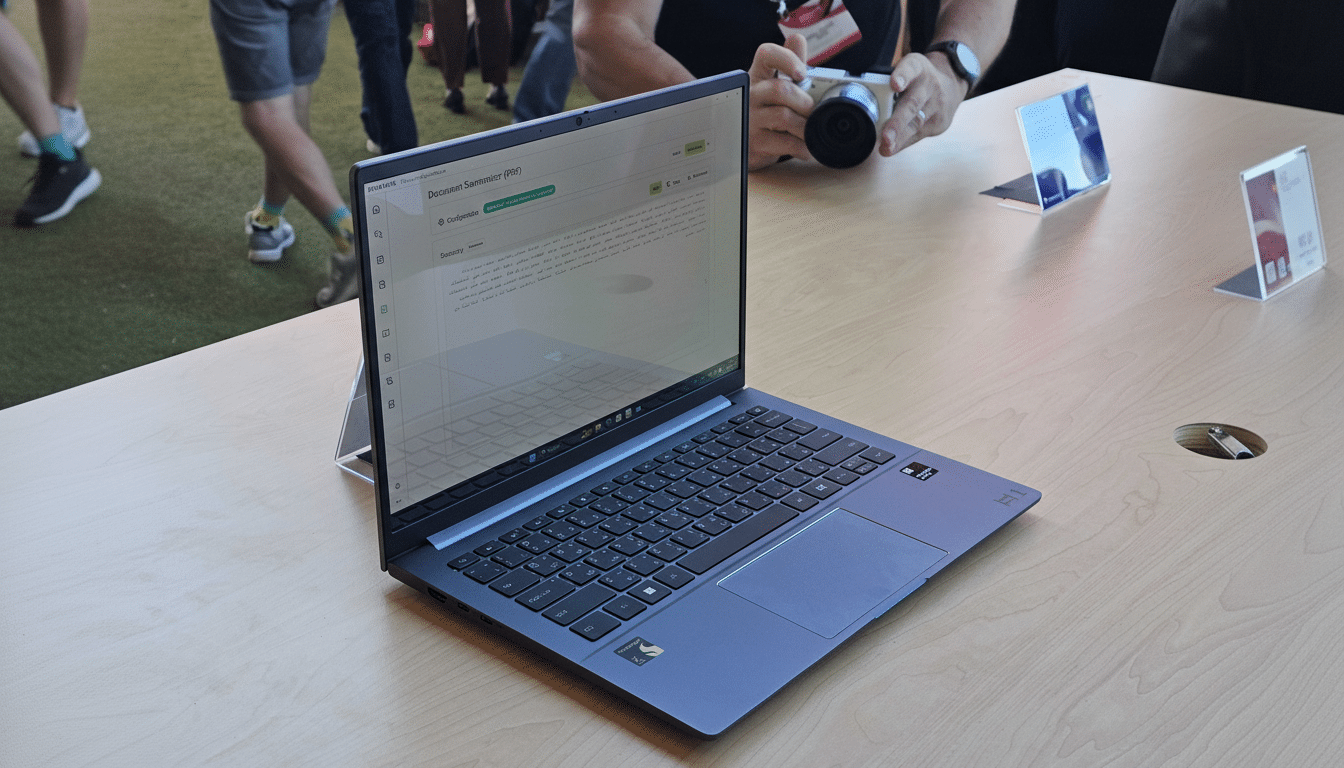
The early demo appeared to be an overlay on top of Windows on Arm, with tiles for Knowledge Retrieval, Doc Summarization, Image Generation, Stock Research Agent, and narrative tools. Under the hood, multiple models work in concert to do so, and one of the primary LLMs is pre-trained specifically on Arabic copy—another sign that region-specific model ecosystems are growing quickly.
Hardware-wise, the one we saw was running a first-gen Snapdragon X Elite configuration with a new NPU, 32GB of memory, and a 1TB SSD, plus Wi‑Fi 7 and an intensely sharp 2,880-by-1,880 OLED panel sourced from Samsung. The company is promising near-instantaneous wake, more than 18 hours of battery life, and aggressive power savings—all tidily in line with the new wave of Arm-based (not Intel or AMD), NPU-forward enterprise laptops that you’re going to start seeing from top OEMs. Microsoft raised the bar with its Copilot+ PC by effectively requiring a 40+ TOPS NPU minimum, and Qualcomm’s platform hits or exceeds that standard.
It’s the Hardware, but the Model Is More Important
The more audacious lunge is Humain’s pricing and lifecycle narrative. Rather than traditional three- to five-year refreshes, Horizon is billed as an all-in-one service featuring subscription-based premium hardware, with rolling hardware updates and validation performed by the provider. Think PC-as-a-service reloaded for AI workloads. Huge vendors already provide DaaS, although it’s more often through image-wrapped Windows devices and software; Humain is betting that a layer-first agent lessens onboarding costs while being able to perpetually improve with model updates.
Why does this matter? AI PCs should become the dominant wave within a couple of years, with well over 100 million AI PCs shipped annually by 2027 as enterprises look for on-device inference to avoid cost, privacy, and latency concerns. If the focus of value shifts away from CPU/GPU specs and toward agent orchestration and enterprise integration, buyers may front-load predictable service tiers ahead of incremental hardware refreshes.
Security and governance remain the central hurdles
Agentic systems don’t get an exemption for enterprise basics. Security executives will ask for model provenance, audit trails for every action an agent takes, and controls for data residency and segregation. Expect questions about how it integrates with Microsoft Entra ID, Intune, and third-party EDR platforms like CrowdStrike or Defender for Endpoint, as well as Windows Secured-core capabilities like support for Qualcomm’s secure processing.
Governance frameworks such as the NIST AI Risk Management Framework and ISO/IEC 42001 have been used more frequently as rails for responsible AI deployment. Practically, Humain will require transparent RAG pipelines for sensitive content, configurable guardrails, human-in-the-loop review for high-risk tasks, and clear SLAs around model updates and incident response—without which no IT team would put an agent layer between employees and regulated data.
A performance reality check for agentic AI PCs
Marketing lines about “100 times faster than human thought” won’t convince procurement. Time-to-answer on real workloads, tokens per second for local models, and battery drain with mixed NPU/CPU/GPU usage will, too. The greater win could be predictability of latency: agentic workflows that remain local for summarization, classification, and retrieval can appear instantaneous compared with cloud-only calls, with heavier-creation tasks that burst to larger models when necessary.
There’s also the Windows on Arm question. Compatibility is better with native apps and emulation, but businesses survive on niche drivers, legacy plug-ins, and security agents. Humain’s overlay needs to play nice with that stack. Apple’s M‑series showed what vertical optimization could bring when hardware, OS, and power management are tightly coupled; any “AI PC” promising transformative UX will have to demonstrate the same kind of whole-system polish.
Can IT Truly Break Up with the Refresh Cycle?
Enterprises have attempted to run away from the refresh treadmill in the past—VDI, thin clients, DaaS—yet user experience and edge computing are still a thing. A subscription AI PC, if built on top of stable silicon and surrounded by model entitlements with continual upgrades, standardized images, and proactive fleet health management, could do that. But other concerns are raised: vendor lock-in at the agent layer, model portability (ONNX and open formats help), and the possibility that a monolithic front end will hide root-cause analysis when the inevitable failure occurs.
Procurement will want to see the hard TCO math: add a three-year lease (including a software layer) for a Copilot+-type notebook and compare that to a Humain subscription with agent services, support, and rolling upgrades. Pilots will quickly follow—especially in jobs where task automation generates sharp productivity increases—if the delta turns out to be anything like the 40% savings the company suggests.
The verdict for enterprise buyers considering agent PCs
Horizon Pro from Humain, on the way for PCs, is also a fascinating signal: you do less launching of apps and more delegating outcomes to agents that at least claim to have some clue, with on-device AI being where most of these things are headed. The demo is promising, but also shows how early the software is. To go from curiosity to deployment, Humain needs to publish MDM and EDR integration matrices, ship auditable agent logs, demonstrate Windows on Arm compatibility at scale, and document battery life, cold start latency, and reliability.
If those things are checked, then that is a direction enterprise PCs could go: subscription devices driven by local AI coordinated by agents enlightened in the ways of business, continually refreshed without forklift upgrades. The hardware is what gets you in the door. It is the agent layer, and the confidence it gains, that will keep you there.