


Temperature monitoring is only as reliable as the weakest link in the measurement chain. The RTD sensor itself gets most of the attention, but the cable connecting it to your control room or field instrument? That part is easy to overlook — and gets things wrong quietly.
Pick the wrong cable and you get resistance errors, noise interference, or insulation that degrades in heat. None of those announce themselves. They just erode your readings over time until a process drifts out of spec.
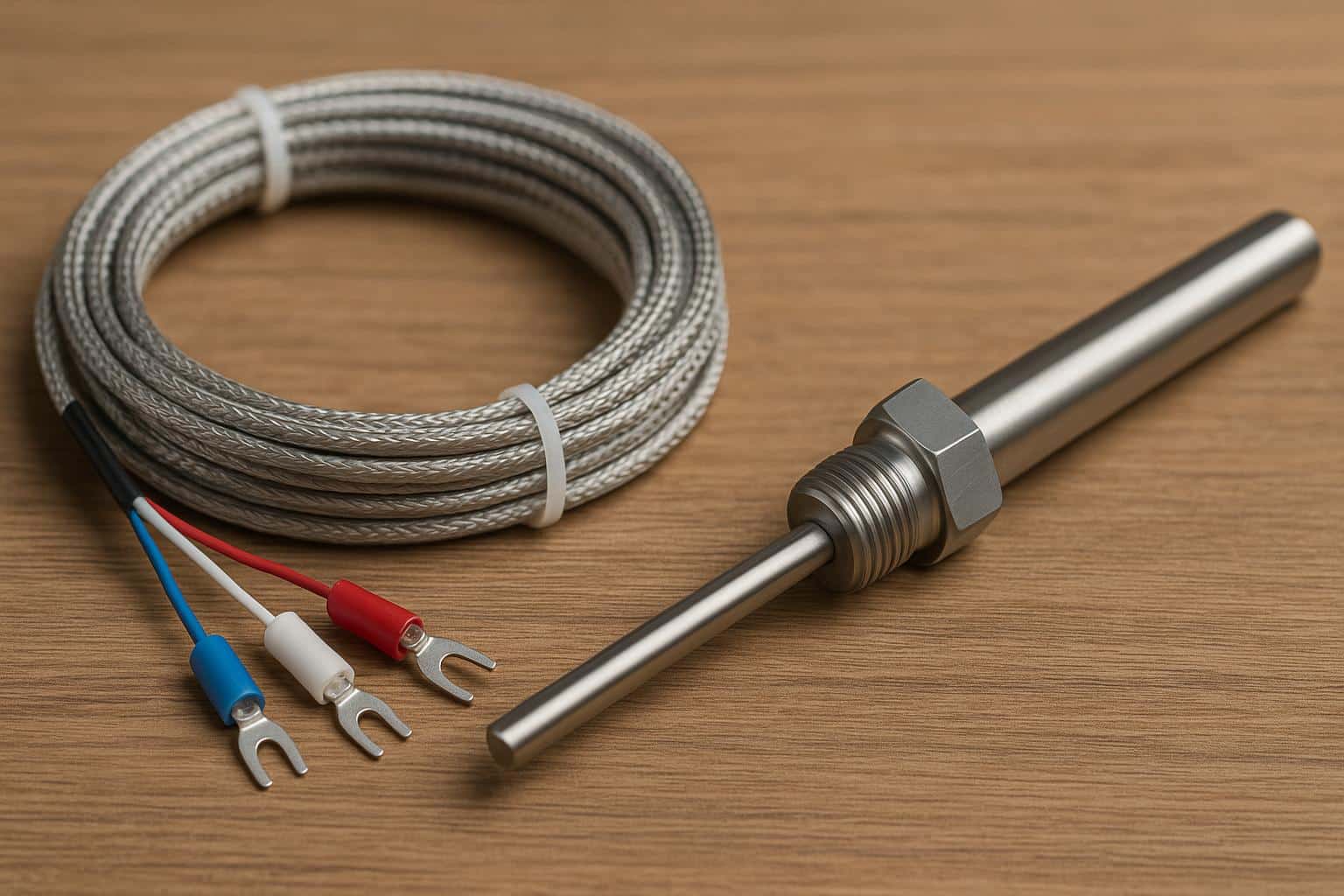
What an RTD cable does
An RTD (Resistance Temperature Detector) cable carries the signal from the sensor element to your measurement instrument or control room. It doesn't generate any signal itself. It just has to carry the existing one faithfully, without adding resistance errors or picking up electrical noise along the way.
That job sounds simple. It gets complicated because RTD sensors measure temperature by detecting tiny changes in electrical resistance. The PT100, for instance, changes resistance by about 0.385 ohms per degree Celsius. If the cable adds resistance or introduces noise, those changes get lost in the noise floor, and your readings become unreliable.
The cable also has to survive whatever environment it's installed in: heat, moisture, vibration, chemical exposure, or mechanical stress, without its insulation degrading or its conductors corroding.
Wire configuration: 2-wire, 3-wire, or 4-wire
- 2-wire configuration is straightforward. Two conductors, sensor at one end, instrument at the other. The problem is that the resistance of the cable itself gets included in the measurement. For long cable runs, or anywhere accuracy matters, this is a real issue.
- 3-wire configuration is the practical standard for most industrial setups. A third conductor lets the instrument cancel out the cable resistance by measuring it separately and subtracting it from the reading. Tempsens RTD cables are available in 3-core configurations — this is the format used in the vast majority of industrial temperature monitoring applications.
- 4-wire configuration goes further. Two conductors carry the measurement current, two carry the voltage sensing. This completely eliminates lead wire resistance error and gives the highest accuracy available. It's used when measurement precision is non-negotiable — semiconductor fabrication, laboratory processes, and some pharmaceutical applications.
Which one do you need? If your cable run is short and precision requirements are moderate, 2-wire works. For most plant floor applications, 3-wire is the right call. If you're measuring temperatures where even small errors have consequences, go 4-wire.
Insulation material
PVC insulation — up to 105°C
PVC is the practical choice for ambient and moderate-temperature applications. It operates reliably from -40°C to +105°C, with heat-resistant PVC compounds extending that to around 120°C for short periods. It's flexible, cost-effective, and widely used where conditions aren't particularly harsh.
For RTD cables feeding signals from HVAC systems, building management setups, or lightly heated process lines, PVC insulation does the job without overengineering the solution.
PTFE insulation — up to 260°C
PTFE (polytetrafluoroethylene) handles significantly higher temperatures and also resists most chemicals. Tempsens makes RTD cables with PTFE core insulation and PTFE sheath, rated for continuous operation up to 260°C. The conductor used is annealed bare copper per IS 8130, available in sizes including AWG 24/7/32 and AWG 26/7/34 depending on the specific cable type.
This is the right choice for furnaces, ovens, and process environments where temperatures push beyond what PVC can take. PTFE also holds up well in chemically aggressive environments, a plus in petrochemical and pharmaceutical settings.
FEP insulation — up to 200°C continuous, 260°C short excursions
FEP (fluorinated ethylene propylene) gives you nearly identical chemical and thermal resistance to PTFE, but it's easier to process during manufacturing. That means more consistent wall thickness and, generally, better mechanical properties at a lower cost. Tempsens produces FEP-insulated RTD cables — for example, 3-core and 4-core variants with FEP core insulation, FEP outer jacket, and optional stainless steel wire braiding, rated to 200°C continuous.
FEP cable runs from -65°C to +200°C continuously, with the ability to handle short excursions up to 260°C. For most industrial RTD applications: refinery process lines, pharmaceutical production, food processing. FEP is the practical call where PTFE's full temperature rating isn't needed.
Fiberglass insulation — severe environments up to 600°C
When temperatures go beyond what fluoropolymers handle, fiberglass insulation is the answer. Tempsens makes fiberglass-insulated RTD cables for severe environments where the cable may be exposed to temperatures up to 600°C. These are used in high-temperature furnace monitoring, steel and metal processing, and glass manufacturing, places where polymer-based insulation would simply fail.
Application by industry
Steel and metal processing plants deal with high-temperature furnaces, annealing lines, and molten metal temperature control. PTFE or fiberglass insulation is needed here. Mechanical robustness matters. Stainless steel braiding adds durability.
Petrochemical refineries need cables that handle both heat and chemical exposure. FEP or PTFE insulation works well in this setting. Shielding helps where electrical interference from pumps and drives is present.
Pharmaceutical manufacturing demands accuracy. Small temperature deviations affect product quality. A 3-wire or 4-wire configuration with FEP insulation suits most pharmaceutical process applications. Materials need to comply with industry cleanliness standards.
Power generation involves turbines, boiler feed systems, and steam lines. High temperatures and vibration are the main concerns. Cables with mechanical protection and appropriate high-temperature insulation are the right fit.
Semiconductor fabrication uses process chambers with tightly controlled temperatures. 4-wire RTD cables give the accuracy these processes need. Chemical resistance of the insulation matters in CVD and etch tool environments.
Quality testing
Every Tempsens RTD cable goes through testing before it ships. The checks include insulation resistance, dielectric strength, and conductor continuity. Insulation resistance testing tells you whether the cable insulation is sound (a degraded insulation will introduce measurement errors); dielectric strength testing confirms the insulation can handle the voltages it will see in service; conductor continuity confirms the signal path is complete.
When specifying cables for critical applications, it's worth asking for test records. For anything safety-critical, a certificate of conformance matched to the specific cable batch gives traceability if something later needs to be investigated.
A practical selection checklist
Before ordering, work through these:
- What is the maximum continuous operating temperature where the cable will be installed?
- Are there temperature excursions above the continuous rating?
- Is the environment chemically aggressive?
- How long is the cable run?
- What measurement accuracy is required? (This drives the 2/3/4-wire decision.)
- Is there significant electrical interference nearby — motors, VFDs, high-voltage cables?
- Is the cable exposed to mechanical hazards?
- How many RTD sensors are being monitored from a single run?
Get those answers, then match them against the insulation type, wire configuration, shielding, and core count discussed above. The right cable for most applications isn't complicated to identify once you have the operating parameters in front of you.
The one mistake worth avoiding: defaulting to the cheapest option without checking the temperature rating. A PVC-insulated cable installed in an environment that regularly hits 150°C will degrade, its resistance will shift, and readings will drift. By the time the error is obvious, tracking it back to the cable takes time you don't want to spend.
Get the cable right, and everything downstream: your sensor, your instrument, your process control, works as intended.