


Dubai is rapidly transforming from being an extravaganza of soaring structures to a living hub of smart and sustainable buildings. As the government and developers respond to the growing need for energy-efficient developments and digital integrations, more spectacles are surfacing with reimagined philosophies.
Newer buildings in Dubai are standing as a portrayal of responsive ecosystems where predictive maintenance sits at the core, energy management is deeply integrated, and resident-facing apps are voluminously expanding. These state-of-the-art features are now becoming standard specifications instead of niche characteristics.
- Unlock Smart Building Technology Moves
- Developer Adoption
- Utility and Smart Grid Integration
- Occupant-Centered Approach
- Regulatory Momentum & Consistent Policy Shifts
- Masterplans and Smart Tech in Dubai
- Smart Building Designs for Dubai’s Climate
- Market and Investment Effects
- Operational Risks and Cyber-Resilience
- Closing In!
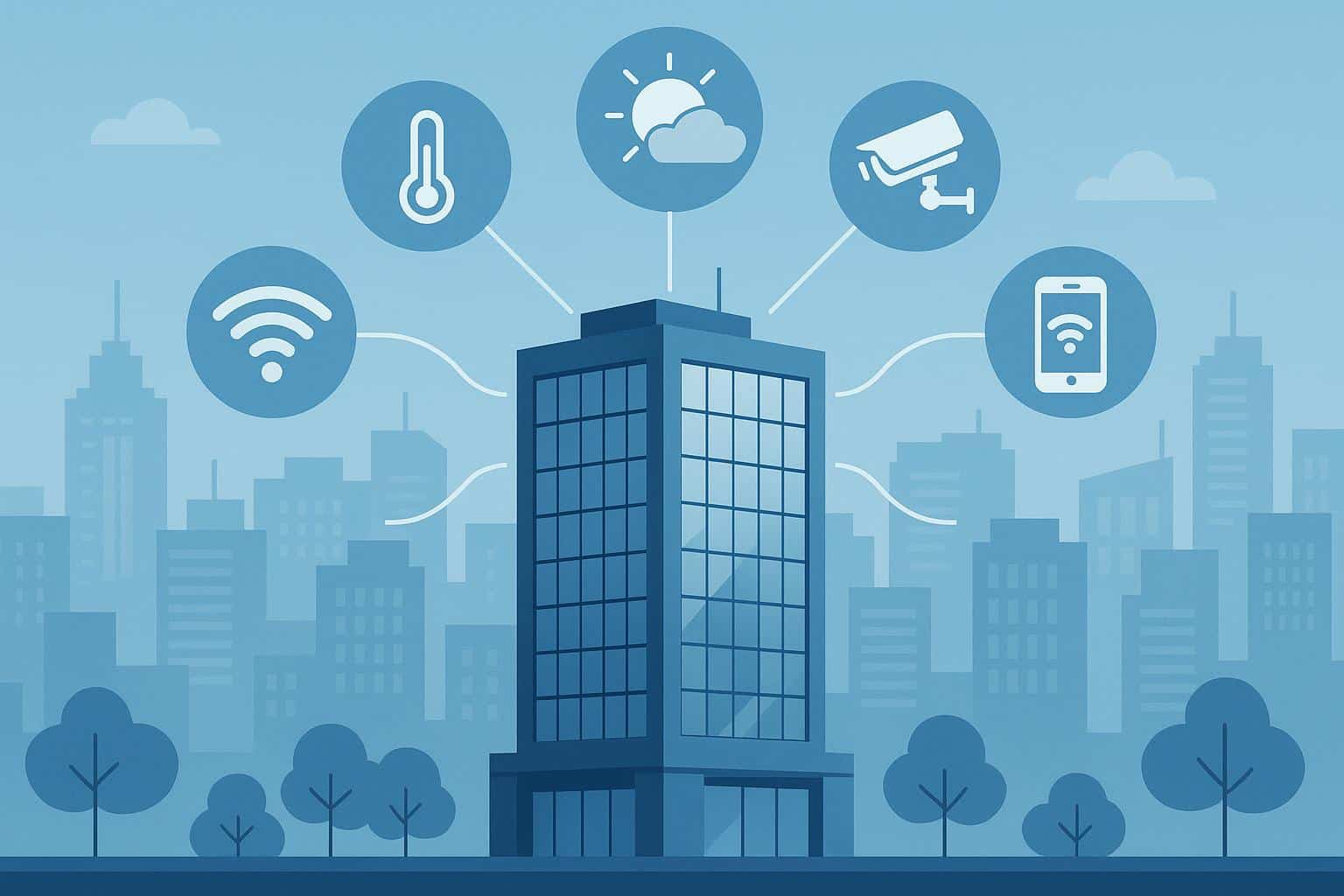
These advanced elements simultaneously benefit all participants in real estate, including investors, tenants, and buyers. With measurable sustainability, lower maintenance expenditures, and an elevated suite of lifestyle services, the real estate sector is now reshaped and fosters a smart living ecosystem.
Unlock Smart Building Technology Moves
Developer Adoption
The leading developers of Dubai are deploying facility management systems by unifying analytics, IoT sensors, and BMS (Building Management Systems). This smart asset management also includes resident apps in a single operational layer.
Such platforms are leveraged to enable portfolio benchmarking, which uncovers underperforming assets and predictive maintenance to minimize equipment downtime. Moreover, automated vendor workflows are enabled, resulting in smart fit-outs, OPEX Volatility, and consistent service delivery.
Utility and Smart Grid Integration
On a wider city scale, utility modernization is expeditiously sprawling in Dubai to make a development truly “smart”. Virtual power plants are installed across newer developments, showcasing the proactive contribution of DEWA in Smart Grid investments.
The distributed energy resource integration and intelligent meters unfold a two-way data flow between the energy-water network and buildings. This helps consumers to proactively monitor and manage the usage, while facilitating time-of-use optimization.
Also, specific initiatives like SHAMS Dubai are encouraging the large-scale integration of rooftop solar panels and battery storage. These smart provisions ultimately benefit both developers and owners through enhanced resilience in complex mixed-use projects, reduced bills, and smoothing peak demand.
Occupant-Centered Approach
Given Dubai’s sweltering conditions and luxury real estate profile, a unique demand for occupant-centric systems has arisen recently. To weave hospitality standards into everyday living, most developments are now embracing smart glazing and AI-driven HVAC dynamically.
This allows environment adjustments based on outdoor temperature, occupancy patterns, and energy-price alerts. Resultantly, it cuts peak cooling loads and preserves comfort. Additionally, contemporary dwellers can now expect air-quality features, personalized lighting systems, and voice apps in premium residential towers across the city.
The inclusion of concierge-grade automation into home living accelerates property pricing to premium levels and promises a demonstrably improved lifestyle.
Regulatory Momentum & Consistent Policy Shifts
Dubai’s decisive policy-making has played a substantial role in expanding smart building technologies. Approaches like Green Building Regulations and Al Sa’fat standards are created to oversee and classify developments based on their materials’ performance, resource utilization, energy efficiency, and water conservation.
What further stimulates these measurable improvements is the 2040 Urban Vision. The smart city plan envisions embedding resource-efficient materials and smart infrastructure into long-term urban planning. This long-term strategic plan pushes developers to enlarge master planned neighborhoods instead of releasing individual buildings.
Masterplans and Smart Tech in Dubai
Most of Dubai’s newer master-planned projects represent the benchmark of smart features, while existing communities are actively undergoing significant transformations. Newest hubs like Dubai Silicon Oasis and Expo City Dubai, along with upcoming projects like Dubai Creek Harbour and Dubai Islands, are experiencing future-forward infrastructure plans and smart technology.
Smart Building Designs for Dubai’s Climate
In Dubai, façade performance and cooling strategy often dominate costs and lifestyle emissions due to its hot climate. This ultimately nudges developers to announce effective projects where high-performance facades pair with shaded walls and optimized HVAC systems.
Furthermore, sensors embedded in ductwork and exteriors feed fault detection and digital twins systems, leading to minimal energy waste and the prevention of equipment oversizing. This co-design approach with controls and materials woven together delivers lower carbon emissions and enhanced value per/sq. ft. to astute buyers.
Market and Investment Effects
Smart building technology is changing the market trend in Dubai by creating a competitive edge for developers and increasing property values. It also corresponds to buyer/ tenant expectations, targeting more connected, intelligent, and future-ready buildings rather than luxury interiors or sought-after locations.
It also serves as a direct level for valuation uplift as improved tenant retention and operational savings magnify net income on a real estate opportunity. Moreover, high-net-worth individuals and tech-savvy expats increasingly prefer building intelligence when selecting luxury properties in Dubai.
Operational Risks and Cyber-Resilience
Though Dubai is adopting smart building features on a mass level, certain challenges still prevail in the environment. A few practical constraints include:
- The cybersecurity hurdles of linking life-safety with access systems.
- Standardization gaps between IoT integrations and the legacy BMS.
- Higher retrofitting costs than embedding features during design.
Best responses in practice include:
- Robust cybersecurity frameworks and open APIs that treat OT systems with the same diligence as IT networks.
- Inclusion of IT teams and facility managers in the early stage of development for reduced integration risk.
Future Prospects: Smart City Agenda and Ambitious Goals
The smart building practices in Dubai are rapidly moving from discrete buildings to district-level intelligence. Future building designs are incorporating coordinated EV charging and energy trading between buildings. This resultantly leverages off-peak renewables, while minimizing emissions and congestion. The real estate sector of Dubai is consistently advancing, thanks to the rapid adoption of PropTech and blockchain transactions.
Closing In!
Dubai sees smart building technologies no longer as an experimental wing of real estate but more as a core design feature, an investment strategy, and a strategic compliance driver. Most developments across the city are boosting operational savings and stronger ESG credentials, promising an enriched resident experience.
From integrating occupant-centered AI to focusing on master-planned assets and utility-grade smart grades, the city is rising as the global hub for intelligent building design and temperature-regulated facades. Whether you are seeking a smart move to Dubai or looking for flourishing investment opportunities, Dubai’s smarter buildings clearly cost less to maintain, perform better, and hold value in the long term.