


Key Takeaways
- Employees with shorter commutes are more likely to visit the office frequently.
- Direct, reliable routes reduce the effort of getting to work.
- Employees need nearby lunch and errand options to make the workday easier.
- Offices must fit the team’s specific hybrid workdays.
- Seeing colleagues is the top reason people choose to come in.
- A good commute isn’t enough if the office space lacks reasons to collaborate.
A three-day office mandate does not make a three-day commute feel reasonable. A 2026 Americas Office Occupier Sentiment Survey indicated that employers expect an average of 3.2 office days per week, while actual attendance hovers at 2.9 days. More crucially for site selections, 62% of respondents saw an inconvenient location as a barrier to attendance.
For a hybrid team, the address affects how practical a regular office day is. Travel time, transport links, local services, and the location’s adaptability for shared office days can change the attendance equation.
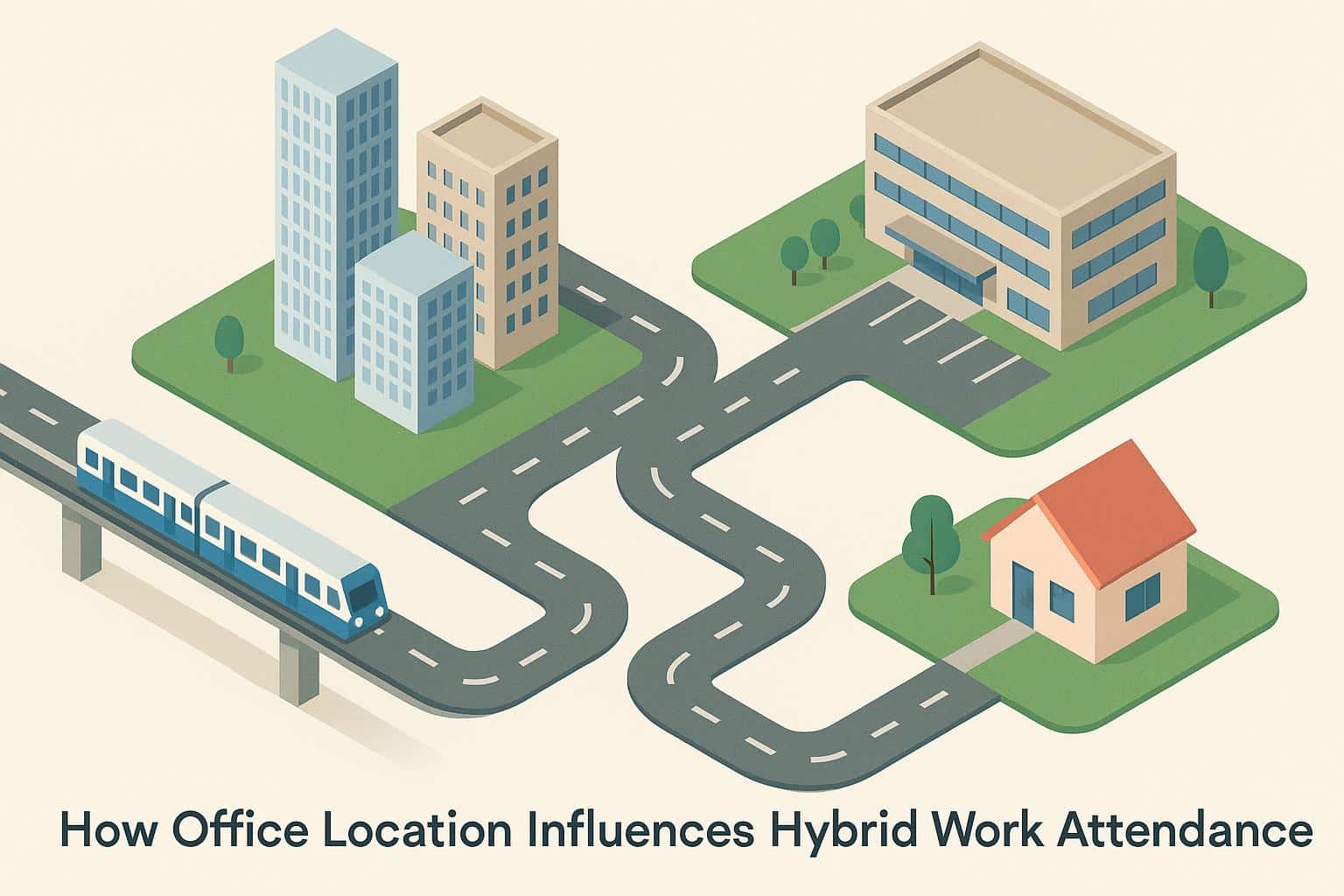
In this blog, we will examine five specific location factors that can influence whether employees choose to attend the office.
Five Office Location Factors That Can Influence Attendance
Office attendance isn’t affected by a single measure, such as distance from a station. Workers get a sense of a place based on how long it takes to get there and how challenging the route is. Other important factors include what they can do in the area, whether it fits into their hybrid work schedule, and whether the workplace motivates them to travel. These five elements clarify how location can either subtly encourage or discourage attendance.
- Commute Time Determines the Cost of Attending
Because the five-day commute is no longer a strict requirement for hybrid employees, the cost-benefit calculation of traveling to work has shifted. Every trip must now fit within the employee’s week, and a lengthy trip may make it harder to justify an extra workday.
- Longer Journeys Create a Higher Attendance Barrier
Leesman’s studies draw a helpful distinction between short and long commutes. Just 11% of workers who traveled more than an hour reported using the office four to five days a week, while 38% reported using it just once. Only 19% of people with commutes of 15 minutes or fewer used the workplace 0–1 days, whereas 37% used it 4–5 days.
The discrepancy shows why travel time should be considered when choosing an office location. However, the research does not prove that commute length alone causes certain attendance patterns.
- Assess the Journey From Where Employees Live
On a property map, a city center address may appear quite accessible, but the people who actually work there may have very different travel times. Businesses should consider where their employees are concentrated and calculate peak-time traffic from those locations when evaluating office space. Consider how much time employees will have to give up to get to work, rather than just the distance to the city center.
When attendance is concentrated into two or three days, this distinction matters most. A commute that is occasionally bearable could turn into a major complaint if the company requires workers to make the same trip every week.
- Transport Connectivity Shapes How Easy Attendance Is
Even when two offices have comparable average travel times, their attendance experiences can differ greatly. One route may offer a direct train and a short walk, while another may require a longer walk and transfers. While the clock records minutes, the employee experiences the physical effort.
- Direct Routes Reduce Attendance Friction
When assessing an office location, transport connectivity should be examined through the actual route employees will use:
- How many adjustments are needed?
- What is the distance between the office space and the main station or stop?
- Can workers use multiple modes of transportation to get there?
- Is it feasible to walk the last stretch during busy hours?
- When one connection is lost, is the route still functional?
This matters because proximity and accessibility are not the same. If you need to make several changes to reach the initial location, it could be harder to get to an office five minutes from a station than one 10 minutes away.
- Reliability Matters Alongside Travel Time
A shorter route that relies on multiple connections may be more difficult to fit into a workweek than a predictable 40-minute trip. This means evaluating transport at the times employees are expected to arrive and depart, rather than relying only on the travel time listed on a property listing, for companies comparing locations.
Commute time measures the duration of attendance. How hard it is to manage that time depends on connectivity.
- Everyday Amenities Can Make an Office Day Easier
The building entryway is not the only way that employees perceive an office space. Whether they can grab lunch, run a quick errand, go outside, or access helpful services without making another trip during the day depends on the surrounding area.
- Convenience Around the Office Affects the Overall Day
In a 2026 survey, 53% of respondents cited a lack of amenities such as dining, errands, and quiet outdoor space as a key barrier to attending the office. By letting employees fit everyday tasks into their routine, nearby amenities reduce the effort needed to manage an in-office workday.
Employees can take care of personal matters during lunch breaks because the office is surrounded by a variety of food options and practical daily services. On the other hand, a place without these amenities turns the workday into a sequence of disparate, fragmented tasks, making it harder to get back to the office space.
- Look for Useful Amenities, Not Prestige Features
The question is not whether the area has the longest possible list of restaurants, gyms and retail brands. It concerns whether the establishment offers the services workers are likely to use on the days they must be present.
JLL’s 2025 survey similarly highlights location, traffic, connectivity, safety, and food options as key drivers of dissatisfaction with the office experience. Its study included 8,700 office workers in 31 different nations.
- Location Must Fit the Company’s Hybrid Attendance Pattern
An easily accessible office may still fail if its location conflicts with team schedules. Hybrid workers commute deliberately, so companies must ensure a location fits their intended attendance days, frequency, and overlap.
- The Same Location Will Not Suit Every Hybrid Work Model
Companies that allow flexible or occasional attendance face different geographic challenges than those that require set office days. JLL’s 2025 Workforce Preference Barometer shows that 66% of global office workers have clear employer expectations regarding on-site days. Although 72% of people have a favourable opinion of these rules, acceptance largely depends on how well employees feel at work. The location must accommodate staff in proportion to how often they need to be in the office.
Instead of assuming workers will adjust to a standard business district, compare locations with actual attendance policies. When evaluating a location, consider three regular weekly journeys if three in-office days are necessary. Maintaining staff happiness and adherence to hybrid work policies is easier when the site fits the practical routine.
- Team Distribution Changes the Location Equation
When team cooperation is needed for attendance, employees’ home locations become more important. A location that is easily accessible for one department may create significant commuting strain for another when team members are geographically distributed across an area. Assess sites from a broader workforce perspective rather than relying only on central features, because this imbalance directly affects overall attendance and employee satisfaction.
This issue is clearest when in-person collaboration is the main reason to gather. Instead of checking if most people can theoretically reach an office, check whether overlapping teams can actually meet on the same days. Choosing a central site for collaborating groups keeps travel time fair and helps teamwork happen naturally.
- The Location Needs to Make Office Attendance Worthwhile
The expense of travelling to a flexible office space is driven by commute time and transportation costs. They don’t explain why a worker would agree to such an expense. That second question matters in hybrid employment, since many employees still have the option to work from home.
- Employees Compare the Office With Working From Home
Employees now weigh the comfort and convenience of working from home against the workplace rather than just comparing different offices. This disparity is shown by Leesman’s research from April 2025, which shows an average home-working experience score of 79.5, compared with 69.5 for the workplace in 2024. This 10-point gap shows that offering a workstation alone is no longer sufficient to encourage employees to commute.
The office location must provide distinctive value that cannot be duplicated at home in order to justify the trip time. When workers drive for 45 minutes to complete solitary chores or join online meetings, the commute adds to their workload without providing significant advantages.
- Colleague Presence Gives the Journey a Purpose
The strongest reason to attend may be the people employees expect to see. According to 77% of respondents to a 2026 survey, coworker involvement was the primary factor influencing office attendance. The same study shows that the main things holding people away are an inconvenient location (62%) and a lack of amenities (53%).
When an employee knows their team will be there for a planning session, client meeting, mentorship chat, or collaborative work, it is easier to justify a challenging journey. The same travel is harder to justify if such exchanges are unlikely to occur that day. Therefore, the office site does not function in a vacuum. It sets the level of effort needed to attend, and whether that effort is valuable depends on the people and activities in the office.
What These Five Factors Mean When Comparing Office Locations
Instead of rating the five elements as separate characteristics of the property, take them into consideration collectively.
| Factor | The attendance question |
| Commute time | How much time does attending cost employees? |
| Transport connectivity | How straightforward and predictable is the journey? |
| Everyday amenities | Does the surrounding area make the office day easier? |
| Hybrid attendance pattern | Does the location work with when and how teams are expected to attend? |
| Value of being there | Is there enough happening at the office to justify making the journey? |
Office Location Sets the Cost of Showing Up
Attendance decisions are influenced by a variety of factors, including commute time, transport connections, local services, hybrid work schedules, and the reason for being in the office. Businesses must evaluate the entire process against how their staff actually use the workplace, because a site may score highly on one metric but create friction elsewhere.
This is where a location-led shortlist is more helpful for companies comparing office space than a general property search. Office Hub’s experts let teams compare flexible office spaces across different areas, with transport proximity, workspace type, size, and pricing visible at the property level rather than after a long leasing process.