


A surprising number of organizations still operate with a spreadsheet mentality, relying on manually generated reports and disparate analytics tools to understand the state of the business. Every department has its own information, in its own format, updated at its own pace. The executive leadership has to try to assemble a picture of the entire organization from these disparate sources, often days after the events that have defined the state of the business have occurred.
The rise in the need for unified business dashboards is, in part, an acknowledgement that this approach is no longer sufficient for organizations that must compete based on speed and accuracy. A good dashboard is not simply a way to display information; it is the conversion of raw information into useful, timely, and accurate knowledge that the executive leadership can act upon with certainty.
- Why Traditional Reporting Methods Limit Business Growth
- Fragmented Data Sources Across Departments
- Delayed Reporting Cycles
- Limited Data Visibility for Leadership Teams
- What Modern Business Dashboards Actually Do
- Centralizing Operational and Financial Data
- Visualizing KPIs in Real Time
- Supporting Faster Strategic Decisions
- Why Python Is Ideal for Building Business Analytics Platforms
- When Companies Need Custom Business Dashboards
- Best Practices for Designing Effective Dashboards
- Conclusion
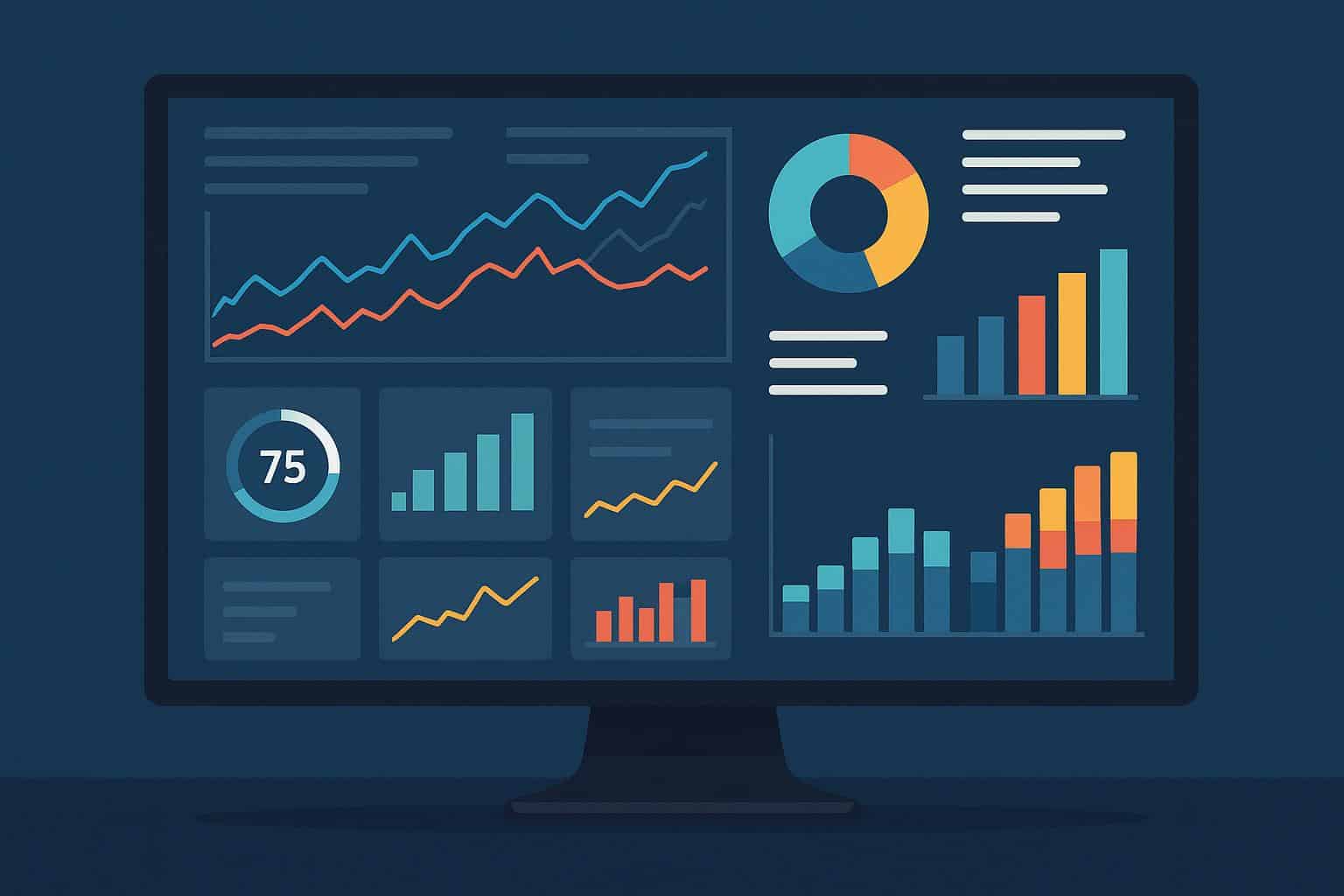
In this post, we’ll walk through why traditional reporting holds businesses back, what modern dashboards actually do, and how to build the right infrastructure to support faster, more confident decisions.
Why Traditional Reporting Methods Limit Business Growth
The limitations of traditional reporting are fundamental, not trivial – hardwired into the tools organizations inherited, and worsening as their business becomes increasingly complicated.
Fragmented Data Sources Across Departments
Marketing, sales, operations, and finance tend to use different data systems – a CRM tool here, an ERP tool there, a spreadsheet somewhere in between. Creating a unified view of performance requires manually extracting data from each source, resolving any discrepancies, and then reassembling it all from scratch every time a report is needed. Not only is this inefficient, but it is also impossible in today’s fast-paced business world.
Delayed Reporting Cycles
One of the biggest issues with manual reporting is the delay that can occur over the course of days and even weeks. The report is not received by the decision-maker when they need it, and the information contained within the report is no longer relevant because it is from the past. In today’s fast-paced world, the prices and customers can change overnight, and decisions based on information from the previous month are not just delayed; they are inaccurate.
Limited Data Visibility for Leadership Teams
If the leadership is not able to see the state of the business at any given time, they must rely on gut feelings and reporting that may not be accurate as of today. The key information that any decision relies on is the real-time information related to revenue, customer acquisition costs, and operational throughput, and no reporting tool is able to provide that information when it is needed the most.
What Modern Business Dashboards Actually Do
A modern dashboard is a seamless, live connection between the business and its data, surfacing what matters in the right format at the right time.
Centralizing Operational and Financial Data
A well-designed dashboard can access all this information at once through its simultaneous connection to APIs, databases, and analytics systems. As a result, there is no need for consolidating data manually. Marketing results, sales pipeline, financial status, or operational status can all be displayed in a single environment without human intervention.
Visualizing KPIs in Real Time
Data can only be used strategically when it is displayed in a certain context. Displaying revenue growth in relation to expected growth over time, displaying acquisition costs in relation to campaign spend, or displaying inventory in relation to expected demand can all help business leadership identify trends in their operations that would be impossible to discern from a table or spreadsheet alone. The importance of dashboards in business intelligence is precisely this ability to make complex operational data legible in real-time.
Supporting Faster Strategic Decisions
With accurate data at hand in real-time, the window between noticing a problem and addressing it is greatly reduced. A dashboard showing a change in conversion rate, a spike in support requests, or a narrowing profit margin in a particular category provides executives with the information they need to take action before the problem worsens. This is the real-world benefit of business dashboards: not just visibility, but velocity in making decisions.
Why Python Is Ideal for Building Business Analytics Platforms
For businesses looking to develop their own infrastructure, Python has become the de facto choice, leveraging the ability to process large amounts of data while also being able to connect to any data source and present results in any interface.
Data Processing and Backend Frameworks
Introducing the data libraries pandas, NumPy, and SQLAlchemy, and integrations with data warehouses such as BigQuery and Redshift, Python provides an easy way to process, manipulate, and aggregate large sets of data generated by a business’s operations. Backend frameworks such as Django, FastAPI, and Flask efficiently serve the processed data to the front-end visualization tools, managing requests in a structured fashion.
Integration Capabilities
Most businesses use different third-party platforms for different things, like CRMs, payment gateways, marketing tools, logistics tools, etc. But due to the integration capabilities of Python, it is possible to integrate all these data sources in one go, so that the custom dashboard built using it can show all aspects of business performance rather than just providing limited data available in any third-party tool.
Agencies specialising in Python-based data infrastructure are well-positioned to build such solutions. PLANEKS is one such firm, with experience delivering custom business dashboards and analytics platforms for SaaS companies, e-commerce operators, and data-driven organizations. Their services deliver strong backend engineering and a clear understanding of what operational visibility means in practice, producing dashboard products that are technically sound, genuinely useful, and smoothly grow hand in hand with the business.
When Companies Need Custom Business Dashboards
While off-the-shelf tools are useful, there are limits to their effectiveness, which become obvious as the business increases in scale and complexity. There are three kinds of businesses that tend to outgrow these tools in their quest for scale.
Scaling Startups, E-Commerce, and SaaS Platforms
The importance of dashboards in business intelligence becomes especially clear for scaling startups, where monitoring growth rate, unit economics, and cohort performance across multiple systems in real time is essential. E-commerce businesses that operate across multiple channels need to unify their inventory, sales, and logistics data in a single place. SaaS businesses need to monitor their product usage and revenue metrics, which demand dashboard infrastructure that understands their business model, not just something generic that works for another business or industry.
Best Practices for Designing Effective Dashboards
A dashboard that contains too much information is nearly as unhelpful as one that contains too little. Effective design requires deliberate choices about what to include and how to present it.
Focus on Decision-Making Metrics
Every metric on a dashboard should answer a question someone in the business needs to act on. Starting from the decision and working backwards to the data produces dashboards that are genuinely used, rather than built once and gradually ignored. Dashboard business examples that succeed share this trait: they reflect the decisions their users actually make, not an exhaustive inventory of available data.
Avoiding Dashboard Overload and Ensuring Data Accuracy
Displaying too many metrics simultaneously creates cognitive overload that defeats the purpose of a dashboard. Effective implementations centre on a small number of high-signal indicators, with the ability to drill down when needed. Equally important is data accuracy: a dashboard built on unreliable pipelines erodes trust quickly. Real-time accuracy requires robust ingestion, regular validation, and clear alerting when data sources fail or behave unexpectedly.
Conclusion
The shift from fragmented spreadsheets to unified, real-time analytics infrastructure is one of the clearest operational improvements a growing company can make. Modern dashboards replace the guesswork and delays of manual reporting with current, structured, decision-ready information – and scale with the business as it grows. For companies whose data complexity has outgrown the tools they started with, investing in purpose-built dashboard infrastructure is a direct investment in the quality and speed of every strategic decision that follows.