


The Department of Health and Human Services and its Advanced Research Projects Agency for Health have launched four connected efforts intended to change how U.S. clinical trials are designed, staffed, consented and managed. The centerpiece, called SURPASS, is meant to develop tools for adapting trials as data accrue; companion programs address research-site activation, participant consent and patient-facing data and navigation.
The announcement matters because clinical studies can be delayed at several points well before a medicine reaches a patient: sponsors must settle on a protocol, activate participating sites, recruit volunteers, collect and govern data, and respond to information emerging during a study. But the rollout is a federal research-and-infrastructure initiative, not evidence that the proposed systems have yet shortened a trial, lowered its cost, reduced enrollment or improved a regulatory decision.

Four programs target different trial bottlenecks
SURPASS, short for Simulation-augmented, Real-time Platform Adaptive Seamless Trials, is the program focused most directly on trial design and analysis. As described by Applied Clinical Trials and independently outlined by BioSpace, it brings together predictive or computational modeling, analysis of data accumulating during a study, and automation intended to support trial operations.
The agency’s framework has three parts: a “phaseless” design engine, a continuous inference engine and an agentic operations layer. In practical terms, the first is intended to help plan studies across what have traditionally been more distinct development stages; the second would update analyses as new trial information arrives; and the third is aimed at automating portions of operational work. The reports describe these as development goals, rather than deployed systems with established performance.
Its three companion initiatives are directed at other constraints. STACK would use artificial intelligence to accelerate clinical-site activation and help sites with little or no previous trial experience become capable of conducting studies. COMMONS is intended to create a consent and data-access architecture for the clinical-trial ecosystem. CINCH would help patients contribute real-world data and connect them with care navigation or trials that may be appropriate for them.
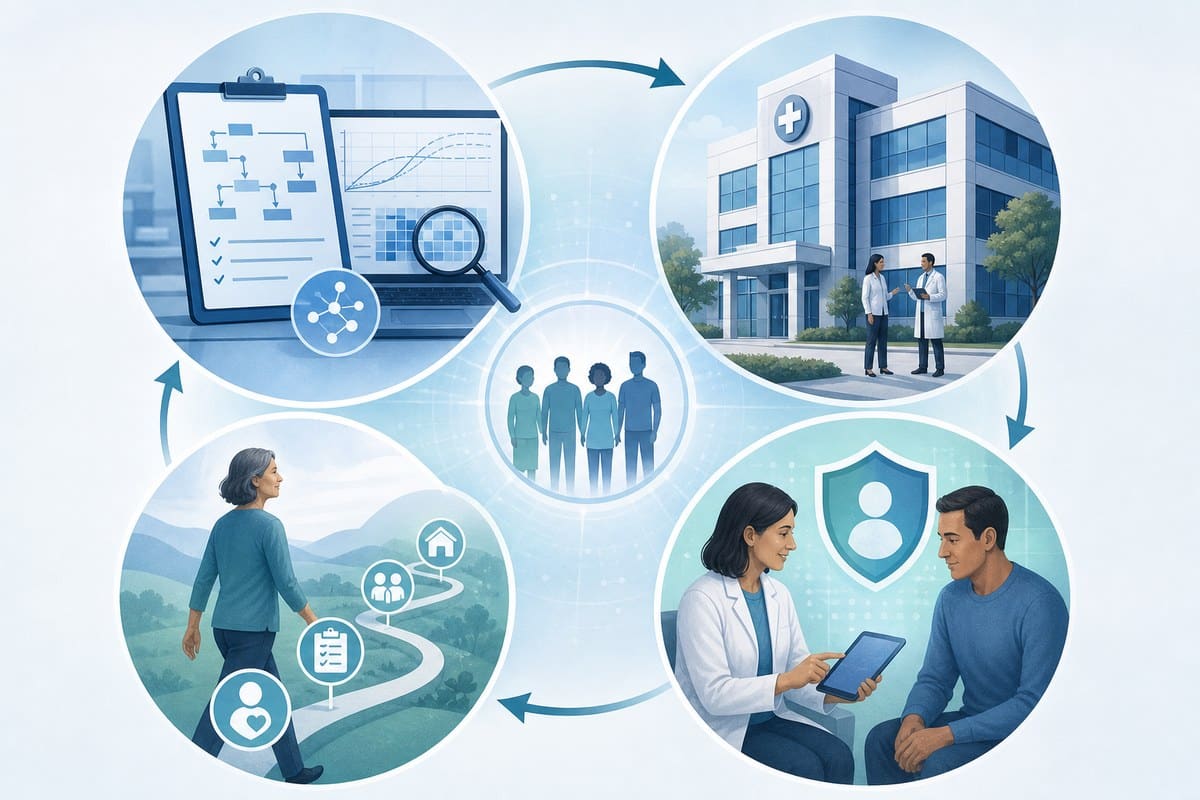
Taken together, the portfolio is broader than a proposal for AI-assisted trial analysis. It treats trial delays as a chain of operational and information problems: a study cannot benefit from a sophisticated design if sites cannot open, patients cannot understand or manage data-sharing choices, or relevant data remain difficult to use across settings.
Adaptive trials can be useful, but require safeguards
Adaptive trials are not new. They are studies designed to allow preplanned changes, such as modifying enrollment, dropping an ineffective treatment group or changing allocation between study arms, after interim data are assessed. Such approaches can make research more efficient in some settings, but they require careful statistical planning so that repeated looks at data do not produce misleading findings.
SURPASS proposes more continuous learning during a trial, supported by modeling and operational automation. That could potentially help investigators identify unpromising paths earlier or test several interventions within a shared structure. Yet a model that forecasts how a trial may unfold is not itself clinical evidence. Its reliability depends on the data used to build it, the assumptions embedded in its design, the population being studied and whether its recommendations hold up when tested prospectively.
Regulators also need to be able to assess how a study changed, why it changed and whether the changes preserved the trial’s scientific validity. The announcement did not set out a validation protocol, a timetable for implementation, named award recipients, a budget, or evidence that the Food and Drug Administration has accepted any particular SURPASS-generated approach for regulatory use.
ARPA-H has said the program aims to permit faster and less expensive evaluation of drugs and biologics, potentially with fewer participants while retaining rigorous evidence generation. Those are prospective objectives. Fewer participants are not automatically preferable: an adequately sized and representative study population remains important for detecting benefits, harms and differences among groups who may use a treatment.
Infrastructure may determine whether the approach reaches patients
The supporting programs address obstacles that are less visible than protocol statistics but can dictate whether a trial succeeds. Site startup often involves training, contracting, ethics review processes, data-system preparation and staff availability. Expanding participation beyond established research centers could increase capacity, but research-naive sites would still need the personnel, oversight and technical support necessary to protect participants and produce dependable data.
COMMONS places consent and data access in the same modernization agenda. Consent is more than a form: participants need to know what information will be collected, who may use it, whether it can be shared and what choices remain available as data are reused. A national-scale architecture could ease fragmentation, but its public-health value will depend on privacy protections, governance, interoperability and whether patients and institutions trust the arrangement.
CINCH, meanwhile, links real-world data contribution with care navigation. Real-world data can include information recorded during routine care or supplied by patients outside a conventional study visit. These data may help identify potentially relevant trials or describe outcomes in everyday settings, but they can be incomplete and unevenly collected. They do not automatically carry the same evidentiary weight as randomized trial data.
A new phase of Operation TrialBlazer
The programs follow HHS’s broader Operation TrialBlazer initiative, announced in June, which focuses on U.S. clinical-research capacity and development processes. The newer effort appears to divide that broad goal into more specific technical and operational projects, from protocol design through patient access.
Specialist coverage placed the SURPASS announcement on Sept. 30; BioSpace published its account the following day, and Applied Clinical Trials published its report Oct. 2. Neither report described patient outcomes or a completed evaluation of the four initiatives. For now, the most concrete development is the creation of a coordinated federal program structure. Whether it produces trials that are faster, less burdensome and no less rigorous will require results from actual implementations and scrutiny by researchers, participants and regulators.