


Remember the last time you were at a lively family dinner? The clinking of glasses, the overlapping conversations, the laughter from the other room—for many, it’s a symphony of joy. But for someone with hearing loss, it can become a confusing, muffled cacophony where words are lost and connection fades.
Here, modern technology bridges the gap back to clarity. A prime example is the Behind-the-Ear (BTE) hearing aid—a compact, curved device worn discreetly. Within its tiny shell lies a digital engineering marvel, working tirelessly to make your world sound clear, safe, and vibrant. Let’s explore how.
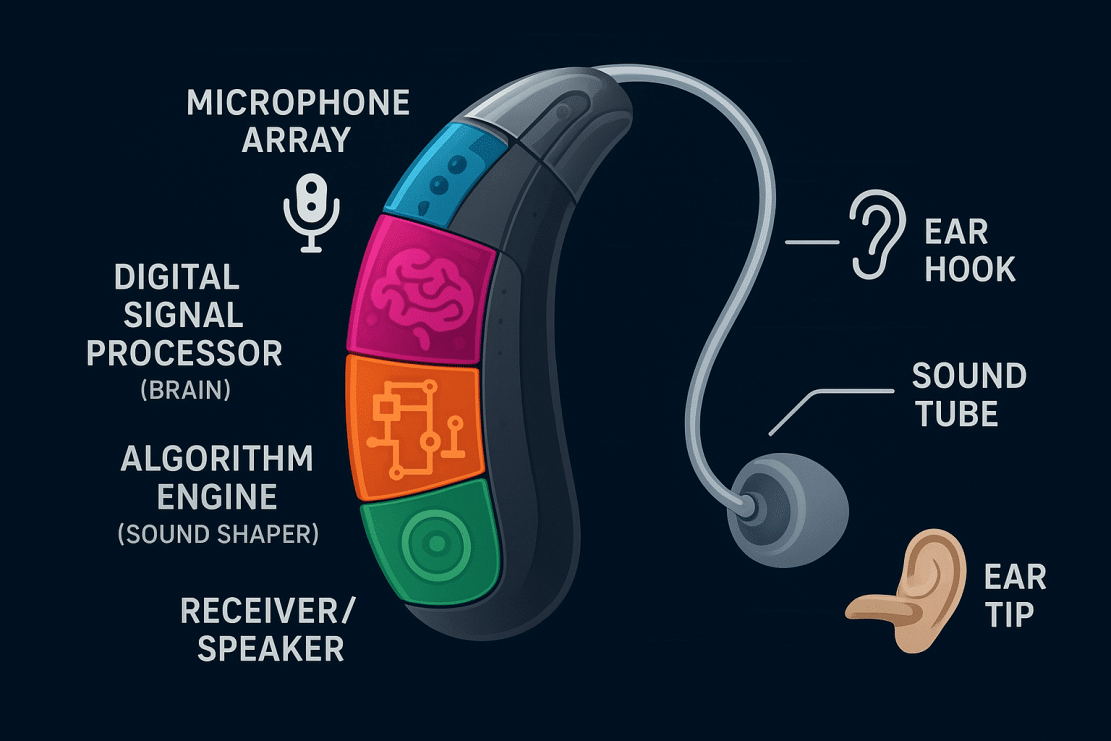
The Precision Architecture — Your Personal Audio Workstation Behind the Ear
Modern hearing aids are far from simple amplifiers—they are highly integrated micro-intelligent audio processing centers. To understand how they work, let’s first meet their core “team members”:
- Microphone (Sound Pickup): The environmental “scout.” Usually consisting of two or more in an array, it captures all surrounding sounds—whether conversations, music, or noise—in 360 degrees and converts them into raw electrical signals.
- Digital Signal Processor: The system’s “brain” and “conductor.” This is an ultra-micro chip that serves as the core of the device. It receives signals from the microphone and utilizes powerful computing capabilities to analyze, calculate, and make decisions about sound in real-time at the millisecond level. Its performance directly determines the intelligence of the hearing aid.
- Algorithm Processing Engine: The “sound sculptor” embedded in the chip. This is where the hearing aid’s intelligence resides, composed of a series of complex software algorithms, mainly including:
- Multi-channel Compression and Frequency Band Compensation: Hearing loss often affects different sound frequencies differently. The engine divides sound into multiple independent frequency bands (e.g., 16 or more) and applies personalized gain to each band—gently compensating for high-frequency sounds you may struggle to hear (like birds chirping or consonants) while controlling excessively loud low-frequency sounds to avoid distortion or discomfort.
- Intelligent Environmental Analysis: By analyzing the spectral characteristics of sound, the engine can automatically recognize the environment you’re in—whether it’s a quiet living room, a noisy street, or a reverberant restaurant—and select the most suitable listening program accordingly.
- Receiver (Speaker): The high-fidelity “announcer.” It receives the refined, high-quality electrical signal from the processor and converts it back into the enhanced sound waves we can hear. Its precision determines the clarity and fidelity of the final audio output.
- Ear Hook, Sound Tube, and Earpiece: The customized “acoustic transmission channel.” They efficiently and losslessly deliver the sound produced by the receiver deep into your ear canal. A well-fitted earmold or earpiece also enhances wearing comfort and prevents sound leakage (thereby avoiding feedback whistling).
These components work closely together, forming a complete chain from sound capture → intelligent analysis → digital processing → high-definition restoration.
The “Magical Transformation” Journey of Sound
Let’s follow a conversation in a noisy restaurant to see how it undergoes “high-definition reconstruction” inside a hearing aid:
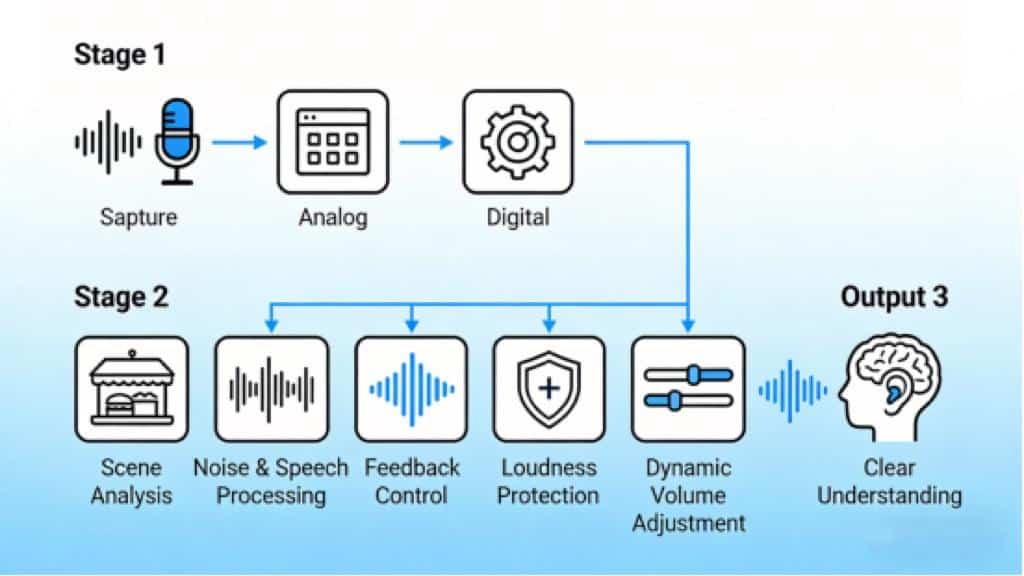
Stage 1: High-Fidelity Capture and Digitization
When you’re talking with a friend, the microphone simultaneously captures their voice, surrounding chatter, and background music. All these sounds merge into complex sound waves, which are instantly converted into a stream of high-precision digital code, ready for the subsequent “intelligent surgery.”
Stage 2: Millisecond-Level Intelligent Acoustic Processing (The Core Stage)
In this critical stage, the digital signal is processed in real time through a series of smart algorithms:
·Scene Analysis: Instantly recognizes your acoustic environment (e.g., “noisy restaurant”) by analyzing sound characteristics.
·Noise & Speech Processing: Separates background noise from speech, suppressing the former while enhancing vocal clarity.
·Feedback Control: Prevents whistling and interference without affecting desired sound amplification.
·Loud Sound Protection: Detects sudden noises (e.g., a plate dropping) within milliseconds and limits their volume to a safe level.
·Dynamic Volume Adjustment: Gently amplifies soft sounds while keeping loud sounds comfortable, creating a natural listening experience.
Stage 3: Personalized Reconstruction and Comfortable Output
After this complex yet rapid “digital reshaping,” the optimized signal is sent to the receiver and converted back into clear, rich, and layered sound waves. These waves travel through the custom-fitted earpiece and comfortably enter your ear canal.

Retekess TE202: Next-Generation Clarity for Every Scene
Our new Retekess TE202 BTE Hearing Aid is engineered for exceptional performance:
·Equipped with the advanced Onsemi 5900 series digital chip for real-time sound analysis.
·Features four self-developed algorithm engines: Intelligent Noise Reduction, Dynamic Feedback Cancellation, Transient Loud Sound Interruption, and Wind Noise Suppression.
·Offers 32-channel environmental recognition and 16-channel dynamic sound processing.
·Provides an impressive 80-hour battery life, IP65 dust/water resistance, and a built-in tinnitus sound therapy system.
·Designed for all-day comfort, making it an ideal invisible hearing aid solution for active lifestyles.
Hearing aids for seniors have never been this intuitive—TE202 delivers clarity, protection, and seamless adaptation to any environment.

Conclusion: Your Gateway Back to Connection
A modern BTE hearing aid is more than an amplifier—it’s an intelligent sound processor and a bridge back to the conversations that matter. Whether you’re seeking hearing aids for seniors or a discreet invisible hearing aid, technology today offers freedom, confidence, and reconnection to the world in high definition.