


Google is making its most widely used product decidedly more personal. The company is extending its Personal Intelligence features from Gemini to AI Mode in Search, allowing results to blend the public web with context pulled from your Gmail and Google Photos. It’s opt-in, gated behind premium AI plans, and rolling out as a Labs experiment in the US—but it signals a fundamental shift in how Search will work.
What Personal Intelligence Changes in Search
Traditional personalization in Search relied on signals like location, recent queries, and browsing history. Personal Intelligence goes further. When you ask something that benefits from your own data—think travel, shopping, or logistics—AI Mode can reference relevant emails or photos to tailor the answer to you, not a generic user.
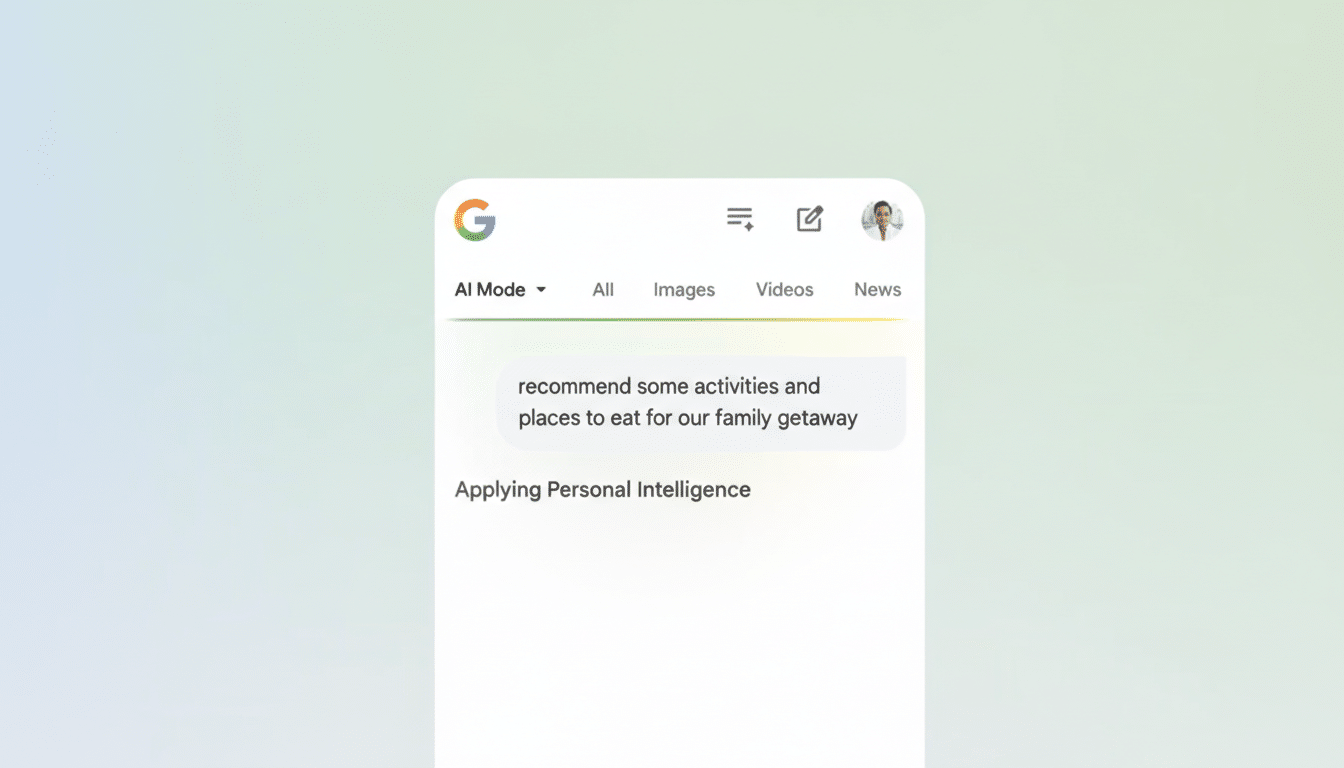
Ask for a weekend itinerary, and instead of a list of popular attractions, it can factor in your hotel booking in Gmail and your past travel photos to suggest options near where you’re staying and aligned with places you’ve enjoyed before. Looking for a new coat? It can note your upcoming flight in Gmail, infer the destination’s weather window, and suggest styles that match the brands you tend to buy.
This is still Search—you’ll see results informed by the open web—but the answer can lean on your personal context to be more immediately useful. The promise is less sifting and more solving.
How It Works Under the Hood in Google Search
Google says the feature runs on Gemini 3 and uses a method the company calls context packing. Instead of sending your entire inbox or photo library to the model, a retrieval layer extracts only the most relevant snippets—say, your hotel confirmation number or a picture of last year’s ski trip—when the question calls for it. That targeted context is then combined with live web knowledge to produce an answer.
In practice, this looks like retrieval-augmented generation tuned for your life. The guardrails matter: when there’s no clear personal signal, AI Mode falls back on general results. When there is, it selectively brings in just enough detail to adapt the response to you.
Privacy Controls and Limits for Personal Search
Personal Intelligence is strictly opt-in. You choose whether to connect Gmail and Photos, and you can disconnect either at any time from Search personalization settings under Connected Content Apps. Google says the model doesn’t train on your private Gmail or Photos data; training is limited to your prompts and the AI’s responses, a boundary the company has emphasized in recent AI documentation and product briefings.
As with any early AI feature, expect rough edges. Google notes that AI Mode may misinterpret relationships or conflate topics, and it encourages feedback via a thumbs-down or a clarifying follow-up. Because access is scoped to your personal Google account, Workspace education and business users are excluded for now, which should alleviate concerns in regulated environments.
Who Can Try It Now and Where It Is Available
The feature is rolling out over the next few days as a Labs experiment to English-speaking users in the US.
You’ll need a Google AI Pro or AI Ultra subscription to enable AI Mode with Personal Intelligence.
If you’re eligible, follow these steps:
- Open Search.
- Tap your profile.
- Visit Search personalization.
- Link Gmail and Photos under Connected Content Apps.
Why This Matters for the Future of Search
Search is evolving from indexing the world’s information to understanding yours—with your permission. That raises the ceiling on utility: finding a return policy is faster when Search can pull your order confirmation; planning a night out is easier when it knows where you’re staying; tracking warranties, receipts, or delivery windows can happen in one query instead of ten tabs.
This direction mirrors a broader industry trend toward personal-context AI, visible in recent product moves across big tech. It also heightens the privacy bar. Consumer surveys from organizations like the Pew Research Center consistently show strong concern about corporate data use, which means clear consent, transparent controls, and strict data boundaries will be critical for trust and adoption.
If Google gets the balance right, AI Mode with Personal Intelligence could make Search feel less like a directory and more like an assistant that knows you well enough to be genuinely helpful—without oversharing or overreaching. That’s a high-wire act, but the payoff could redefine what “just Google it” means.