


Google has finally drawn a roadmap to everyday XR glasses that’s manageable and makes sense, beginning with the most basic of wearables and advancing to real mixed reality over several years. Revealed in The Android Show XR Edition, that roadmap signals a big pivot away from bulky headsets to lightweight eyewear made for all-day wear, and could change how Android uses spatial computing.
What Google Announced for Its New Android XR Glasses
Instead of betting on just one device, Google has split Android XR into three discrete glasses categories. The initial two, due out in 2026, are all about hands-free help and glanceable visuals. The more advanced binocular model, tentatively scheduled for 2027, will go after depth-aware mixed reality without leaving the ski-goggle footprint.
- What Google Announced for Its New Android XR Glasses
- Google’s Three Tiers of Android XR Glasses Explained
- Why Google’s Android XR Glasses Roadmap Matters Now
- What the Android XR Glasses Roadmap Means for Developers
- The Hurdles Ahead for Bringing Android XR Glasses Mainstream
- Bottom Line on Google’s Android XR Glasses Strategy
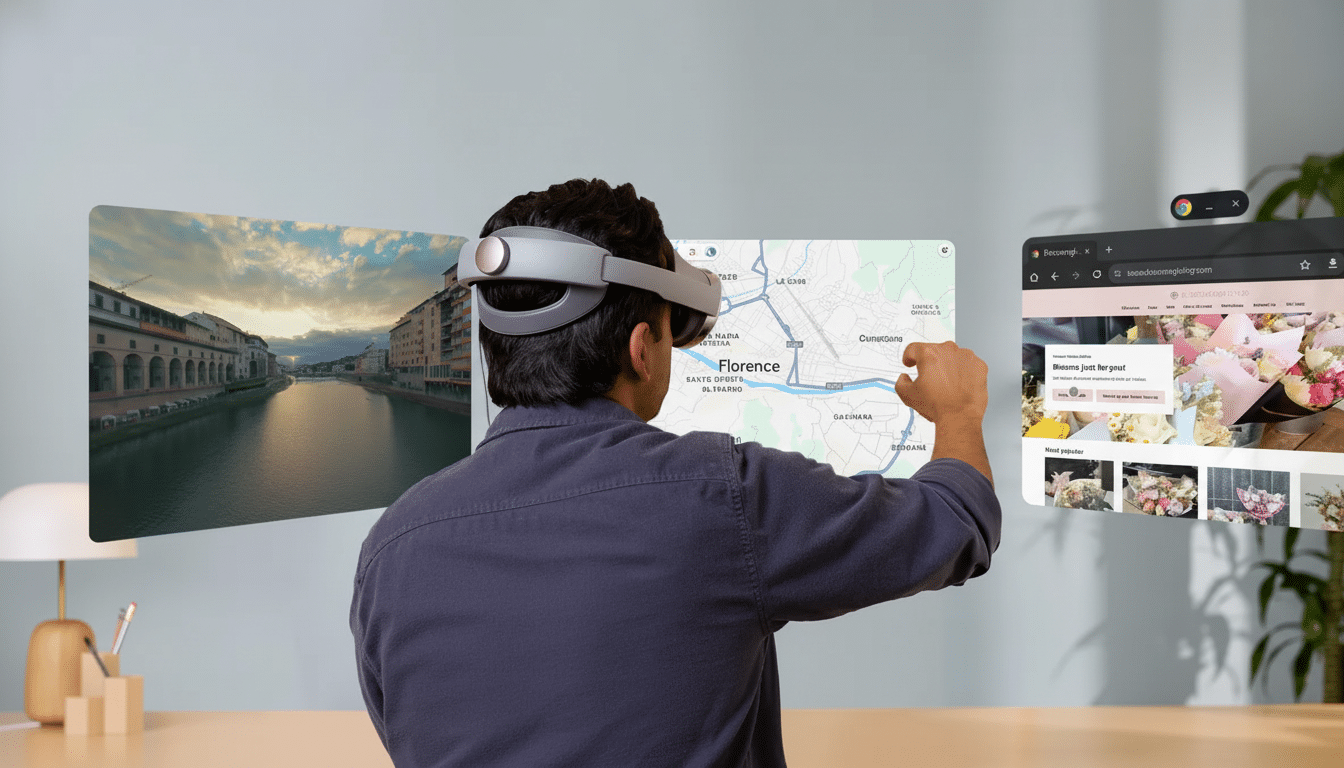
This staggered rollout complements Android XR’s platform-wide push, which sees the introduction of new capabilities such as PC Connect for desktop integration, Travel Mode on the Quest device for seamless use on the go, and a Likeness system that delivers an ever-same avatar across apps. It makes Android OS a sort of ‘general-purpose layer’ for production AI/AR glasses, display glasses, wired viewers, and traditional headsets.
Google’s Three Tiers of Android XR Glasses Explained
Audio-forward glasses are the first step. The frames, which are due to begin shipping in 2026 if all goes according to plan, resemble normal glasses but with speakers, microphones, and forward-facing cameras. Paired with your phone, they will provide voice-first Gemini assistance and capture from the device for big moments when using a phone would be inopportune. There is no display; instead, the emphasis is on ambient help, quick queries, and quiet documentation.
Monocular display glasses, also aiming for 2026, place a microdisplay over the lens to deliver turn-by-turn directions, media controls, notifications, and context-rich prompts from Gemini. Consider them a heads-up layer for the real world, perfect for quick-glance tasks like checking on an Uber pickup progression or receiving a calendar nudge.
Binocular XR glasses, scheduled for 2027, feature two microdisplays—one for each eye—for stereoscopic depth. That unlocks spatial UI and mixed-reality overlays that are more like what you would expect from a headset, only this time in general-purpose eyewear form. Look for heavier compute requirements, tighter thermal envelopes, and tougher design trade-offs to make weight manageable.
Google says it’s partnering with fashion leaders like Gentle Monster and Warby Parker, an acknowledgment that fashion and fit are as important as silicon. Other XR work between the company and Samsung is continuing in the background after the debut of a Galaxy-branded headset skewed expectations for premium Android-operated MR.
Why Google’s Android XR Glasses Roadmap Matters Now
But for most XR adoption, it will come down to comfort and context. Headsets can be heavy (400–650 grams) and out of touch with a public-space setting. Glasses, by contrast, can range in weight from 45 to 80 grams—much more like everyday eyewear. By leading with audio and a one-eye display, Google focuses on what people already want in public: hands-free search, navigation, messaging, and quick capture.
The approach also meets the market where it is. Products such as Ray‑Ban’s Meta smart glasses have demonstrated real-world appetite for camera-enabled, voice-first wearables. At the high end, mixed-reality devices have demonstrated potential, but so far are niche products due to cost, bulk, and battery limitations. A laddered lineup lets consumers enjoy a clear ladder to climb for upgrading, and offers developers a stable target of the sort we see today, even if the three tiers are relatively outdated.
Analysts say momentum is returning to spatial computing as the ecosystem diversifies. IDC is picking up on an AR/VR shipment rebound due to new hardware cycles and wider price bands, while PwC this spring projected that XR could contribute some $1.5 trillion to the world’s GDP by 2030. Google’s roadmap follows that trend with real-world value for day-to-day living, rather than tech demos.
What the Android XR Glasses Roadmap Means for Developers
Android XR’s SDK is intended to be one set of development tools for AI-first spectacles, display glasses, tethered viewers, and headsets. This matters: one codebase that can scale all the way from audio-only interactions up to stereoscopic MR saves teams from fragmented investments. PC Connect suggests smooth workflows between devices, and Travel Mode solves performance inconsistency when off Wi‑Fi, both essential for real-world reliability.
Look for even more Gemini hooks around voice, vision, and context sharing, with on-device models such as Gemini Nano that do privacy-sensitive tasks locally where feasible. For binocular MR, the usual Android primitives—input, windowing, sensors—should reduce, but not eliminate, the resistance to spatial UI without forcing developers into some strange new engine unless that’s what they really want.
The Hurdles Ahead for Bringing Android XR Glasses Mainstream
Always-on cameras in everyday glasses raise privacy concerns. Recording light indicators visible from across a room, restrictive permissions, and default on-device processing will be table stakes. Battery life and heat are just as sticky: audio-only wearables can last all day, but microdisplays—or dual displays—put power budgets under extreme stress, particularly if phones aren’t doing all the compute.
Optics will matter, too. FOV, brightness under the sun, and prescription compatibility are deal-makers or breakers for usability. That makes the fashion partnerships more than skin-deep; comfort and lens options are key to adoption. Clearly communicating where data is processed—and how well it’s secured—will be key to winning trust beyond early adopters.
Bottom Line on Google’s Android XR Glasses Strategy
Google is taking a practical XR roadmap: Begin with useful, wearable glasses and then escalate to mixed reality when the technology fits your face comfortably. If it can stick that landing in 2026 and 2027—and keep developers and designers on board, along with privacy advocates—the default platform for spatial computing’s next wave could be Android.