


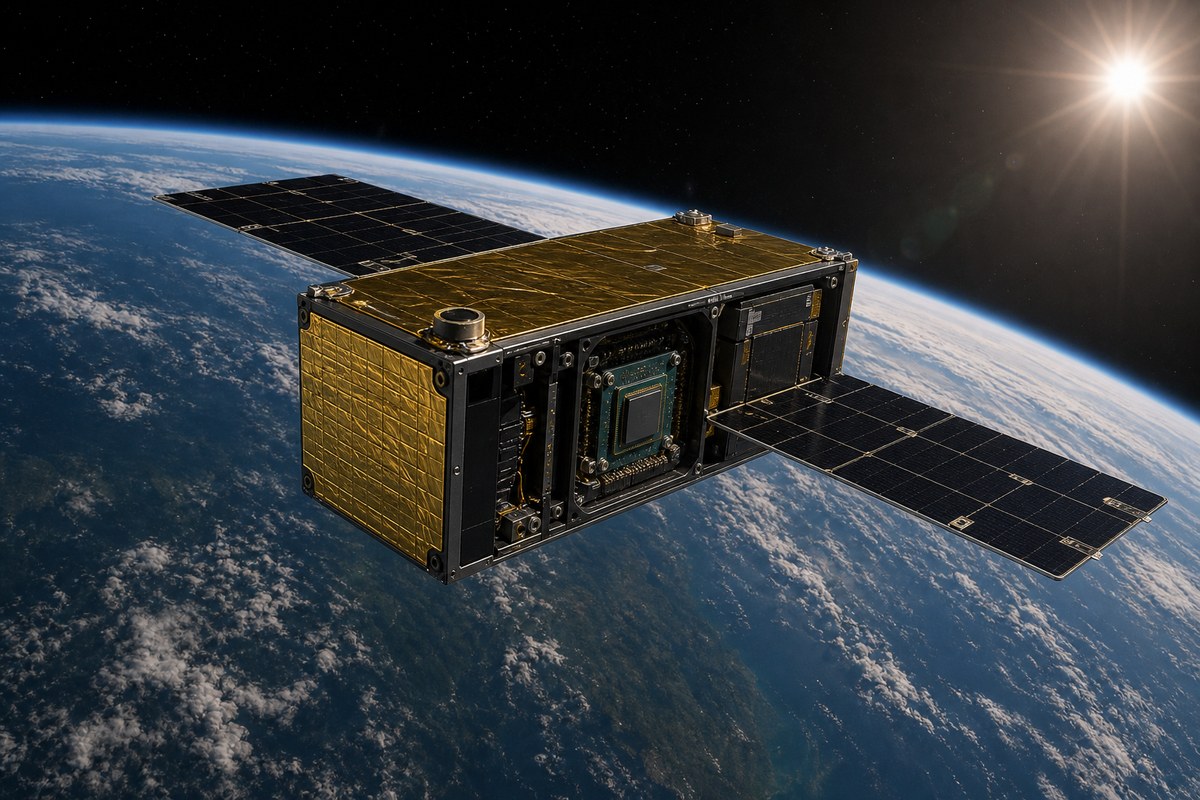
Google says it is preparing to send a prototype satellite carrying Tensor Processing Unit hardware into low Earth orbit, the first flight test in its long-range Project Suncatcher effort to explore AI computing in space. The satellite is scheduled to fly on SpaceX’s Transporter-18 rideshare mission in partnership with Planet, according to a September 24 Google update.
The immediate mission is considerably narrower than the orbital-data-center vision that has drawn attention to the project. Google is not launching a functioning cloud-computing facility or a network of AI satellites. It is sending one prototype to gather data on how its hardware handles launch, radiation and the severe thermal conditions of orbit—basic evidence the company would need before arguing that distributed computing satellites are practical.
The hardware test comes before the network
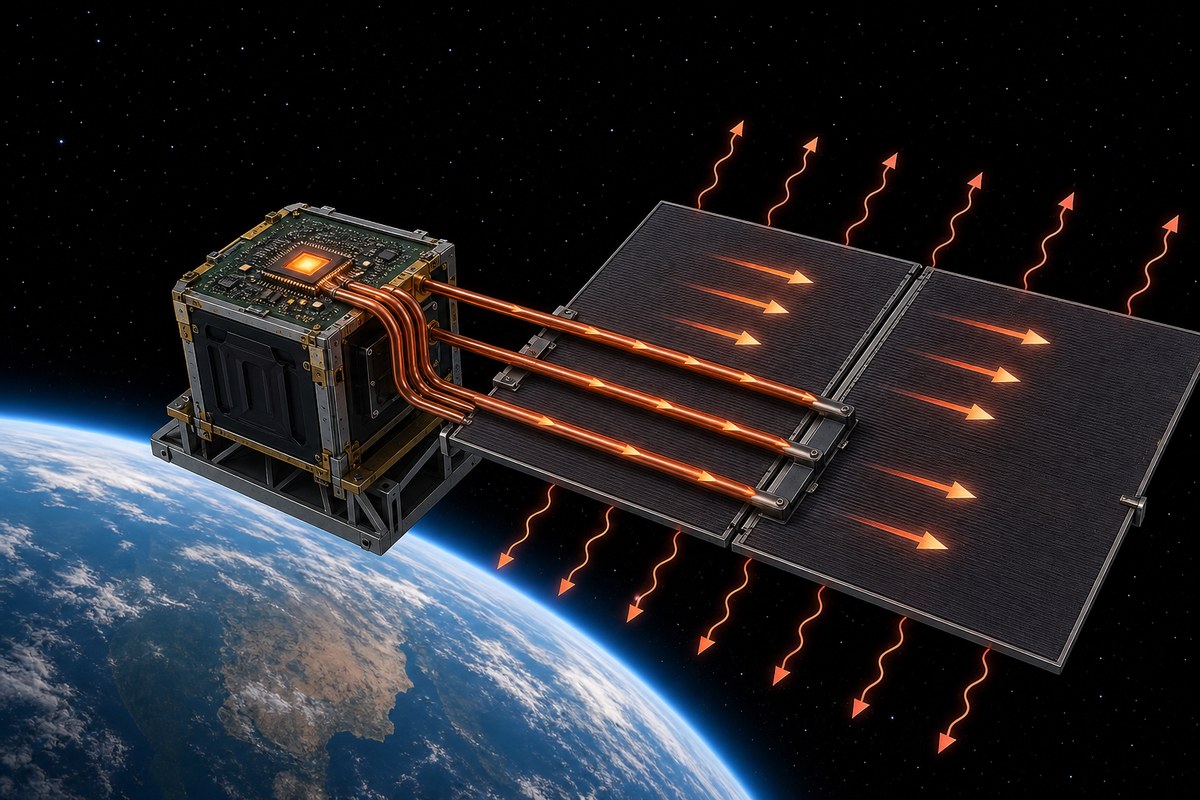
Modern accelerators are built for terrestrial data centers, where power delivery, cooling and physical access are comparatively manageable. In vacuum, a satellite cannot shed heat through ordinary airflow. Google says it is evaluating a thermal design using heat pipes and radiators, moving heat away from the electronics and then radiating it into space. That is an engineering requirement rather than a minor packaging detail: processors that cannot sustain their operating temperature cannot provide useful computing capacity.
Radiation is the other immediate constraint. Google says testing at UC Davis’s Crocker Nuclear Laboratory indicated that its Trillium TPUs could tolerate a total ionizing dose above what it expects during a five-year mission. That is a company-reported ground-test result, not proof that a TPU will remain reliable through years of orbital operations. Launch vibration, temperature cycling, radiation effects beyond cumulative dose and failures in surrounding satellite electronics still have to be addressed in flight.
The test follows the first public outline of the program, published by Google Research in 2025. That design proposed a constellation of solar-powered satellites carrying TPUs and passing data between spacecraft with free-space optical links. The newly announced flight is a progression from system design and laboratory work to a single-hardware validation, not a demonstration of that full architecture.
Solar power does not solve the data-center problem
The attraction is straightforward. Google argues that low Earth orbit offers near-continuous sunlight and potentially far more usable solar generation than an installation on the ground. For an industry confronting rapidly growing electricity demand for AI training and inference, an energy source above the atmosphere is an alluring proposition.
But generating power is only one part of operating a data center. A useful orbital computing system would have to move enormous quantities of data among processors and to users or terrestrial facilities. Google has identified high-bandwidth ground communications, thermal control and reliable operation in orbit as major unresolved issues. Satellites would also need to coordinate tightly enough for distributed workloads, while their changing positions, limited contact windows and orbital mechanics complicate networking.
Google’s initial research described a bench-scale experiment with one optical-transceiver pair that reached 800 gigabits per second in each direction, or 1.6 terabits per second combined. It is a meaningful laboratory throughput figure, but it is not yet a demonstration of a many-satellite computing fabric. Laser links in orbit must acquire and hold pointing between rapidly moving spacecraft, preserve capacity under operational conditions and connect a larger network without turning communications into the bottleneck.
That is why the next stated milestone is different from the first. Google says it plans to put two satellites into orbit in 2027 to test high-bandwidth laser communications. The plan, also reported by the Hungarian Conservative, would test a capability central to the constellation concept but absent from the upcoming one-satellite hardware mission. It remains a planned flight rather than a fixed operational service.
Economics remain modeled, not established
Even if the hardware and networking work, the commercial case depends heavily on launch. Google’s 2025 analysis projected that launch prices could drop below $200 per kilogram by the mid-2030s, a threshold it modeled as potentially bringing launch and operating costs near reported terrestrial-data-center energy costs on a per-kilowatt-year basis. That is an assumption-driven forecast, not a current price comparison or a commitment from launch providers.
The calculation also leaves a wide practical gap between putting equipment in orbit and maintaining computing infrastructure there. Satellite manufacturing capacity, replacement launches, ground-station capacity, radiation tolerance, heat rejection and hardware upgrades all affect the cost of a service expected to evolve as quickly as AI chips do. Ground data centers can swap servers and repair systems; an orbital machine generally must work as launched or be replaced.
Project Suncatcher therefore sits closer to a feasibility program than a product roadmap. Google has now set a short-term test of whether a TPU-equipped satellite can operate in space, followed by a proposed 2027 communications experiment. The crucial evidence will be whether those flights validate the unglamorous infrastructure—cooling, reliability and optical networking—that an AI constellation would require long before it could be called a data center.