


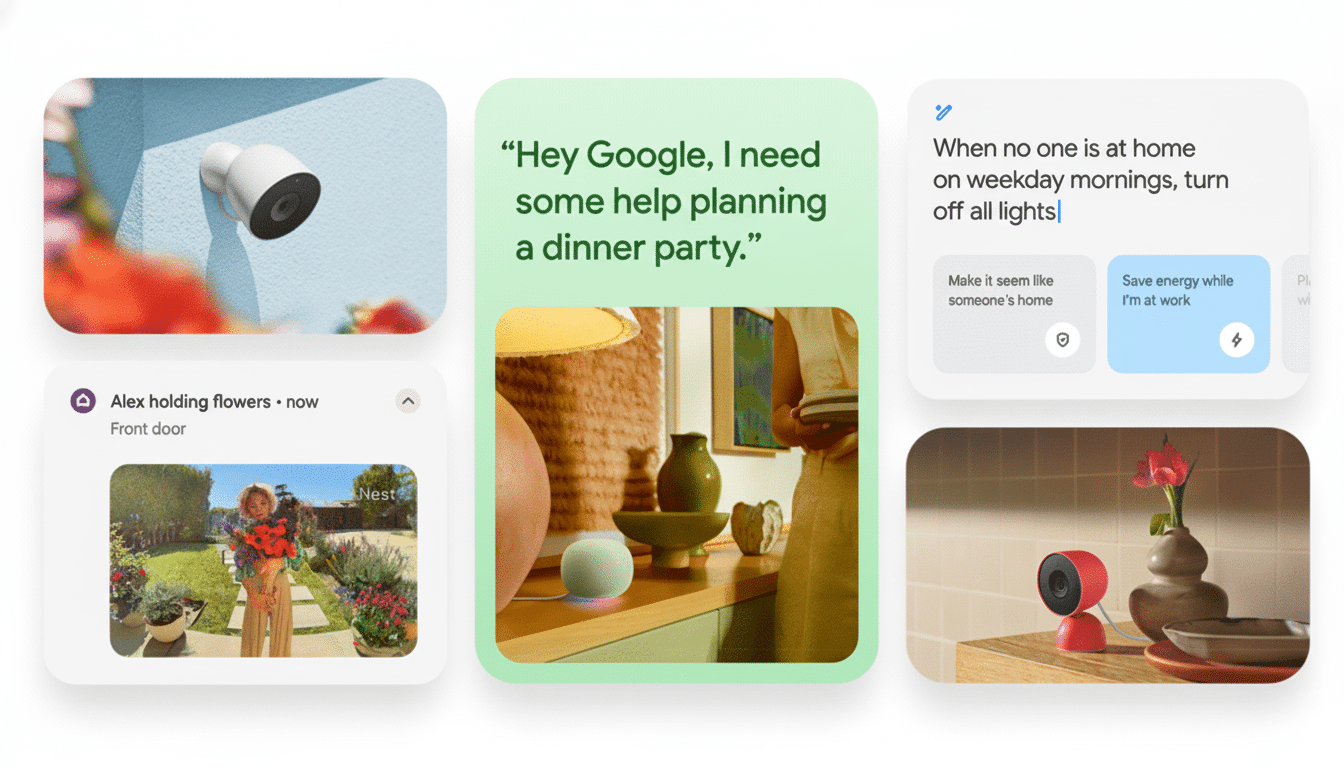
Google is announcing its latest round of Nest gadgets tying into the search giant’s Gemini AI and a clear pivot toward conversational control and contextually aware automation in the home. The lineup consists of the new Nest Cams for indoors and outdoors, a redesigned Nest Doorbell and a $99 Google Home Speaker on deck later, all wrapped up in Gemini for Home, which supplants Google Assistant across the company’s smart things universe.
Gemini for Home Is the Brain Behind New Automations
At the middle of it all is Gemini for Home, technology that can comprehend natural language, remember previous conversations on other devices, and initiate more complex routines. The new Google Home app introduces simplified “Home,” “Activity” and “Automations” tabs, along with a new Ask Home experience that’s akin to a control center. You won’t have to remember fixed wording, but can instead ask, “Is the back door locked and what has the porch camera seen in the last hour?” and continue with “Turn on the entry lights and tell me if that package arrives.”

Gemini Live takes that conversational smarts to speakers and displays, so you can have a real-time back-and-forth and hands-free help. The long-term play here is to consolidate cameras, microphones and speakers under a single AI layer which understands rooms, occupants, schedules and preferences — something that the legacy voice assistants found difficult to deliver without esoteric scripting.
Nest Cameras and Doorbell Receive 2K HDR Upgrades
The new cameras focus on greater clarity and coverage. Using the same-style plastic base that Google uses for its Nest Cam Indoor (at a $100 price point) and Outdoor ($150) versions, both add higher resolution to the mix, with 2K resolution and HDR support in order to deliver cleaner detail for faces or license plates as well as more balanced exposure in difficult lighting. The Nest Cam’s 152-degree field of vision is meant to minimize blind spots in living areas and hallways, while the redesigned Nest Doorbell pushes to a 166-degree diagonal view for more head-to-toe framing of visitors and packages.
When used in conjunction with AI-powered detection, the cameras aim to put a stop to nuisance alerts by detecting important activity and bringing it to the user’s attention through the Activity tab. In theory, that could mean fewer pings for shadows or swaying branches, and more timely highlights of friends, family members, pets or deliveries. Low-light performance and HDR should also serve to reduce false positives during sunrise and sunset — two of the biggest struggle points for camera analytics.
Subscriptions and Availability for Gemini Home Features
Most of that advanced Gemini for Home functionality sits behind a subscription. For $20 per month or $200 per year, Google Home Advanced includes the full AI set. A less expensive, $10 per month tier provides 30-day event history, intelligent alerts and Gemini Live on speakers and displays but doesn’t come with the expanded Gemini for Home tools. The camera lineup is out now, with the $99 Google Home Speaker set to ship in due course — making it a mass-market entry point for Gemini-pushed voice interactions.
This tiered structure is part of a more widespread transition sweeping the smart home market, as companies shift AI-heavy features to paid plans in order to help recoup ongoing cloud expenditures. The trade-off is obvious: more powerful automation and conversational control, but a monthly fee for the best experience.
How It Compares and Why This Smart Home Shift Matters
Google’s pivot arrives at a time when the entire industry is undergoing a reset. Amazon has been previewing a next-gen Alexa using generative AI, while Apple has been adding deeper on-device intelligence into Home and Siri. The Connectivity Standards Alliance is still building out Matter, the cross-platform standard that makes devices play nice with each other; recent updates are adding support for appliance and energy features — which means ecosystems like Google Home can talk to more brands with less hassle.
Adoption patterns suggest the timing is right for that. More than half of U.S. internet households have at least one smart home device, and security cameras are among the leading categories, Parks Associates found. Cameras and doorbells have continuously been among the top-shipping segments by volume, IDC said. That base plants seeds for AI to stitch together devices, eliminate such an overwhelming flood of notifications and push considerably more tech automation rather than just voice ordering.
Key Questions and Concerns as Gemini for Home Rolls Out
Three specific things to watch out for as Gemini goes live at Home:
- Latency
- Reliability
- Consistent portability
Users will be eager to see how quickly Gemini executes complex commands, how gracefully it handles outages or edge cases, and whether existing routines they use in Assistant can automatically shift over to the new Automations system. Privacy-oriented households will also be looking for transparency around on-device processing versus processing in the cloud, particularly in video analytics and voice queries.
Still, the strategy is unmistakable. By designing the home around Gemini and marrying it to powerful new hardware with an AI-first software stack, Google is betting that the next generation of smart home isn’t about more gadgets; it’s about more intelligence: understanding better what you mean — and reacting on your behalf — without insisting you give step-by-step instructions.