


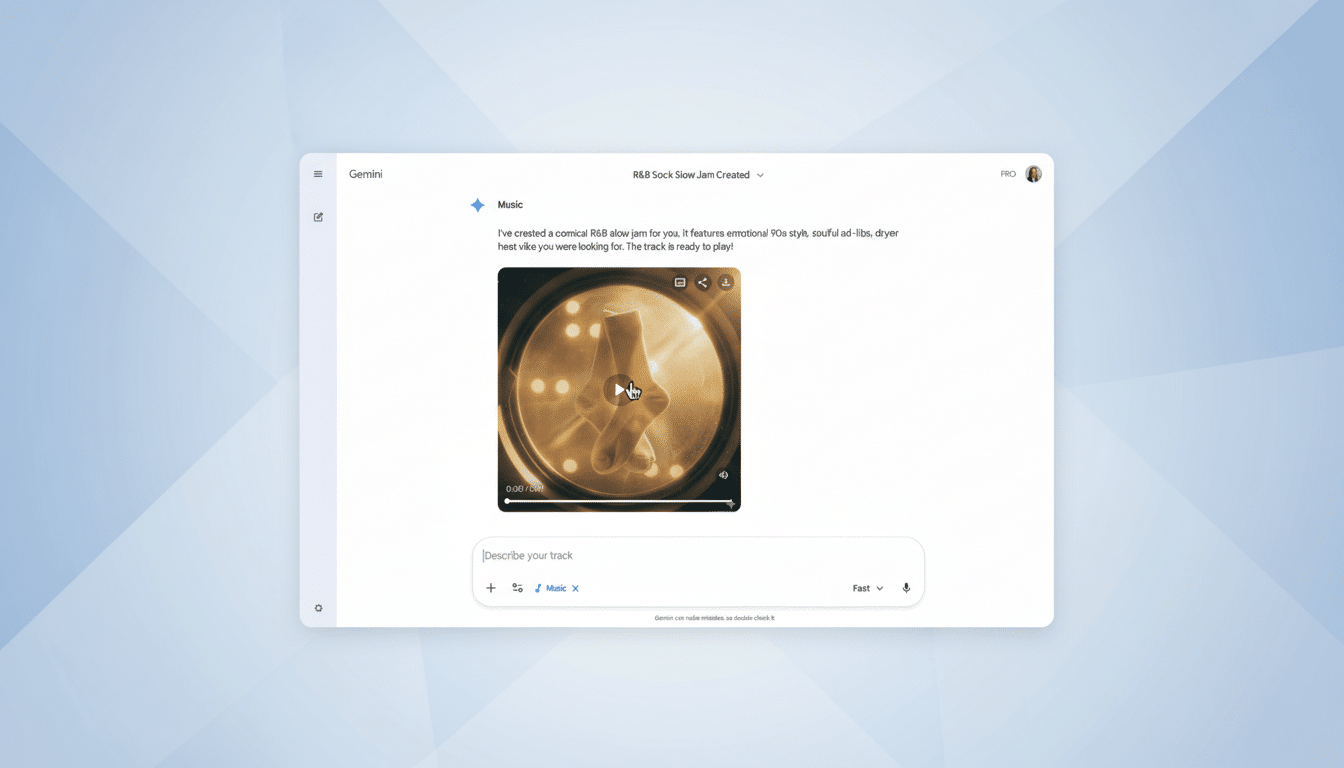
Google is turning its chatbot into a pocket-sized studio. With the debut of Lyria 3 inside Gemini, anyone can generate a 30-second song from a short text prompt—or even from an image that sets the mood—complete with vocals, instrumentation, and auto-written lyrics. The feature is rolling out to adults on desktop first, with mobile to follow.
A New Music Model Inside Gemini Focused on Short Clips
Lyria 3 is Google’s latest generative music model and the most consumer-facing yet. Rather than aiming for fully produced tracks, it specializes in short, catchy clips designed for social snippets, samples, and sketching out ideas. Ask for a 90s rap vibe, a Latin pop hook, or “slow, dreamy R&B with soft female vocals,” and Gemini returns a tight 30-second cut, often with auto-generated cover art so it’s ready to share.
- A New Music Model Inside Gemini Focused on Short Clips
- How Prompting and Lyrics Work for 30-Second Songs
- Safety Guardrails and Watermarking for AI Music Clips
- Industry Context and the Changing Legal Landscape
- Language Availability and Limits for Music Generation
- What This Means for Creators Using Gemini’s Lyria 3
Prompts can be as simple as a mood and tempo or as detailed as a scene. Uploading an image—say, a dog on a forest hike—nudges the model to generate lyrics and tone that match the visual. It’s closer to storyboarding a song than writing one from scratch, which lowers the barrier for non-musicians while still producing coherent structure and vocal lines.
How Prompting and Lyrics Work for 30-Second Songs
Gemini lets you pick from genre templates or describe style, vocals, instruments, and pacing. Lyria 3 then builds a vocal melody, harmony, and arrangement around your brief. The model can write lyrics based on your description or image context, aiming for topical coherence (e.g., “a breezy chorus about city lights and late-night rides”). In practical tests, short hooks and refrains are where these systems shine; dense verses still vary in quality, but the melodies typically hold together.
The 30-second cap is intentional. Short form rules music discovery on platforms like Shorts, Reels, and TikTok, and creators often need an identifiable hook more than a full composition. A tight limit encourages punchy intros and memorable choruses that sync well to video.
Safety Guardrails and Watermarking for AI Music Clips
Google emphasizes that Lyria 3 is built for original expression, not impersonation. Requesting music “in the style of” a living artist or close matches to known recordings is meant to be filtered out. This aligns with growing industry scrutiny as labels and artists push back on imitators while cautiously exploring licensed AI experiments.
Every audio clip carries Google’s SynthID watermark, a machine-detectable signal designed by DeepMind to persist through common edits and compression. If you’re unsure whether a track came from Gemini, you can upload it back into Gemini to check. This provenance approach mirrors broader content-authentication efforts advocated by organizations such as the C2PA, which media and tech firms use to label AI-generated content.
Industry Context and the Changing Legal Landscape
Generative music isn’t new—Suno and Udio have popularized text-to-song over the past two years—but rapid growth put them in the crosshairs of major labels including Universal Music Group, Sony Music Entertainment, and Warner Music Group. Recent settlements and licensing deals show that negotiated use is the path forward, especially for training data and voice likenesses.
YouTube, the largest music discovery engine globally, has been piloting AI music features and creator experiments. Google’s decision to integrate Lyria 3 into Gemini and bring the model to tools like Dream Track for Shorts signals a push toward sanctioned, watermark-backed creation that slots neatly into social video workflows where clips drive engagement.
Language Availability and Limits for Music Generation
At launch, Gemini’s music generation supports eight languages: English, German, Spanish, French, Hindi, Japanese, Korean, and Portuguese, with more on the roadmap. The feature is arriving first on desktop for users aged 18+ and will land in the mobile app soon after.
Google hasn’t disclosed firm generation caps for the free tier. However, subscribers to AI Plus, Pro, and Ultra plans will receive higher limits—typical of Google’s broader AI rollouts, where advanced tiers unlock more generations and faster queues. Exports are downloadable, and share links make it straightforward to post across platforms.
What This Means for Creators Using Gemini’s Lyria 3
Lyria 3 turns musical ideation into a chat prompt. For creators, that means faster scoring for Shorts, podcast bumpers, prototype jingles, and mood pieces for reels or slideshows. For hobbyists, it’s a playful way to turn a photo or a vibe into a singable refrain without touching a DAW.
The trade-off is scope: 30 seconds won’t replace a full studio workflow, and stylistic nuance is still evolving. But as an on-ramp to music creation—with built-in watermarking and rules that discourage mimicry—Gemini’s Lyria 3 feels calibrated to where most audiences actually consume music today: in short, sticky bursts that travel fast.