


Google is bringing Gemini 3 Deep Think to its elite AI Ultra subscribers, adding a higher-octane mode of reasoning to the Gemini app for those customers who pay $250 per month. The new environment is meant for more complex prompts with multiple steps and high complexity, and should result in more deliberate responses that analyze competing options before providing an answer.
What Deep Think brings to advanced AI reasoning tasks
Deep Think is Google’s newest effort into intensive reasoning that employs parallel search to consider many hypotheses at once. In more concrete terms, it tries to explore alternative solution paths, measure their differences, and converge on a better grounded answer — which can be quite limitless and useful in real-world scenarios like refactoring non-trivial codebases or brainstorming research plans or even analyzing ambiguous business cases where constraints and trade-offs are a concern.
Anticipate different ergonomics than regular chatting. Deep Think usually gives me the answer I am looking for, in more time and with more compute than Deep Light. In return, it hopes to decrease “first-thought bias,” or when models fixate on the most obvious answer. Google describes the mode as suitable for “hard” prompts that gain from decomposition, verification, and explicit cross-checking.
Possible use cases that would benefit may include:
- Multi-step data analysis
- Comparing legal or policy frameworks across jurisdictions
- Debugging logic that cuts across multiple files
- Technical writing that needs to reconcile conflicting source material
For rapid summaries or daily Q&A, regular mode ought to remain faster and more cost-effective.
Early benchmarks and limits of Gemini 3 Deep Think
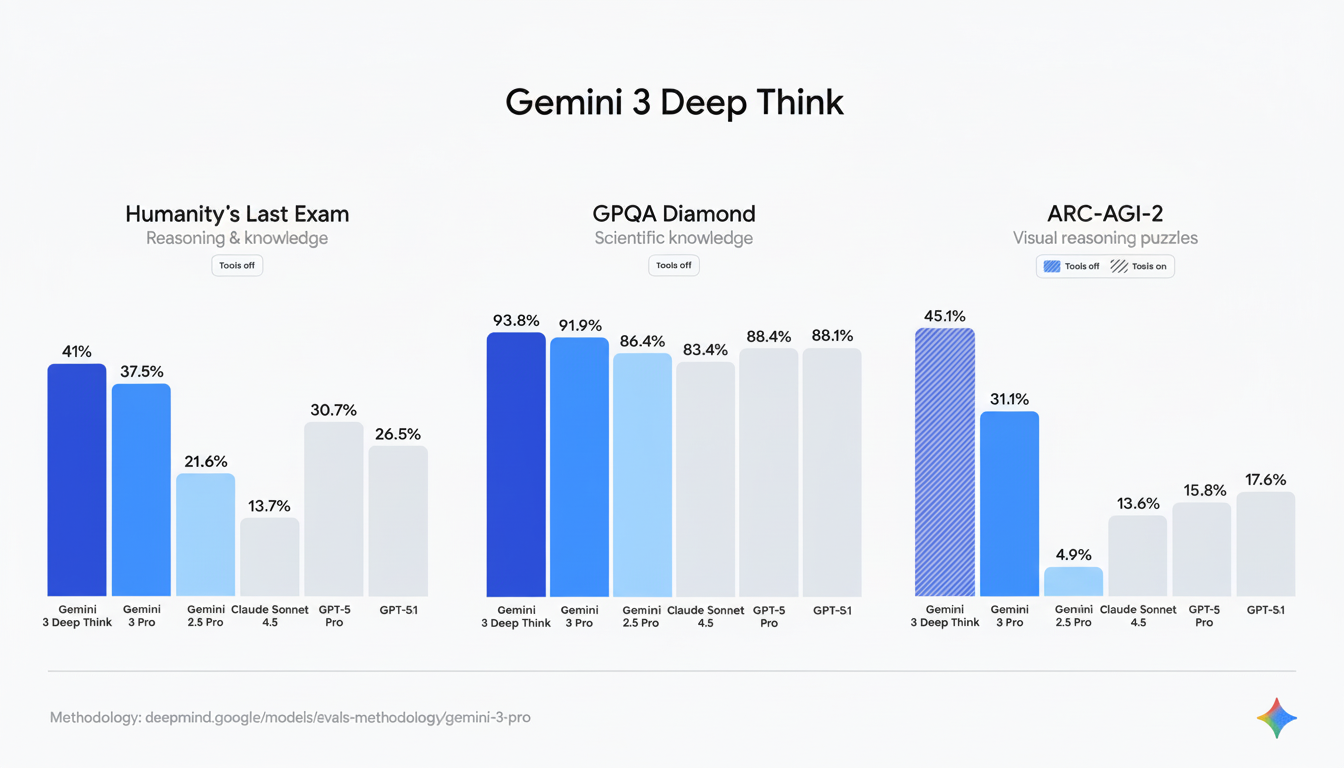
According to Google, Gemini 3 Deep Think got 41 out of 100 on Humanity’s Last Exam, an extremely taxing assessment that was designed by Google as a sort of thought experiment to put long-horizon reasoning through the wringer. It’s not like any one benchmark represents real-world performance, but that suggests progress on tasks where models have to plan, simulate, and revise, instead of just recall.
Benchmarks, however, are not destiny. Models that perform well on synthetic tests can still hallucinate if given messy, real-world inputs. In production, one is still probably safest with the old “trust but verify” model:
- Ask the model for citations
- Show it alternatives and ask why those are not plausible assumptions instead of its preferred ones
- Test critical predictions against ground truth
Demand for Google’s AI software has been rising. The Gemini app now has 650 million monthly users, the company says. That scale provides Google with a feedback loop rich in data, but it also inflates expectations for reliability and safety — particularly now that more advanced reasoning modes are becoming more widely available.
How paid AI Ultra subscribers can access Deep Think
AI Ultra subscribers can turn on Deep Think from within the Gemini app: bring up the prompt bar and select Deep Think in the dropdown. The mode can routinely be turned on for some prompts where you are looking to add rigor and off if speed is the emphasis.
The release comes after a spate of product changes throughout Google’s artificial intelligence portfolio. It just pulled back the reins on access to its next-gen image generator, Nano Banana, scaling free image prompts down from three to two thanks to overwhelming use. Paid users of Google AI Pro and AI Ultra remained unaffected, which is part of a general pattern of saving the most intensive work for higher tiers.
Competitive context for premium reasoning-first AI plans
Deep Think comes amid increasing competition on “reasoning-first” systems, an area OpenAI and Anthropic have emphasized as well, which include step-by-step problem solving, tool use, and checks for information. Feature checklists differ, but the strategic throughline is this: advanced reasoning is coming to be the differentiator for premium plans, not just raw text output.
The rollout is also happening as mega AI labs are facing increasing scrutiny over the safety and transparency of this research. Google and its rivals (OpenAI and some other research labs) have received mixed marks in recent third-party assessments, highlighting the tension between rapidly advancing capabilities on one hand, and their responsible use on the other. For buyers, that requires looking beneath just model power — to controls, auditability, and support.
What to watch next as Deep Think expands to subscribers
Key questions at this point shift to practical terms: How much lift in accuracy does Deep Think yield for real workflows, what is the latency trade-off, and where do hallucination and edge-case failures continue to exist? Teams that implement the mode should test it against representative prompts, measure the results relative to baselines, and see when the extra time for thinking will pay off.
If Google can turn these sorts of benchmark gains into reliable, traceable results in more complex tasks, Deep Think could become a one-click destination for professionals who want something beyond fast entries and exits but who don’t have the time to sift through mounds of research findings. If the lift is marginal in everyday use, then it will be — and should be — a niche tool for the hardest questions. Either way, the signal is clear: premium AI is moving beyond small talk into thoughtful analysis, and Gemini 3 Deep Think is Google’s newest bet on that future.