


FX’s new limited series Love Story: John F. Kennedy Jr. and Carolyn Bessette lands with the sheen of a grand romance and the unease of a psychological thriller. Created by Connor Hines and executive produced by Ryan Murphy, the nine-episode drama tracks an ascendant couple crushed under a camera-lens vise, turning flashbulbs and door buzzers into instruments of dread. It is both an intimate courtship and a critique of the culture that devoured it—while acknowledging, uncomfortably, that dramatization sits close to the same flame.
A romance framed by relentless scrutiny
Love Story opens with the memory of an ill-fated flight before rewinding to the magnetism that first drew John and Carolyn together. The show resists the easy mythologizing that tends to calcify around famous names, focusing instead on chemistry that feels tentative, playful, and charged. It’s a canny setup: the fairy tale is never allowed to float free of the wolves circling the perimeter.
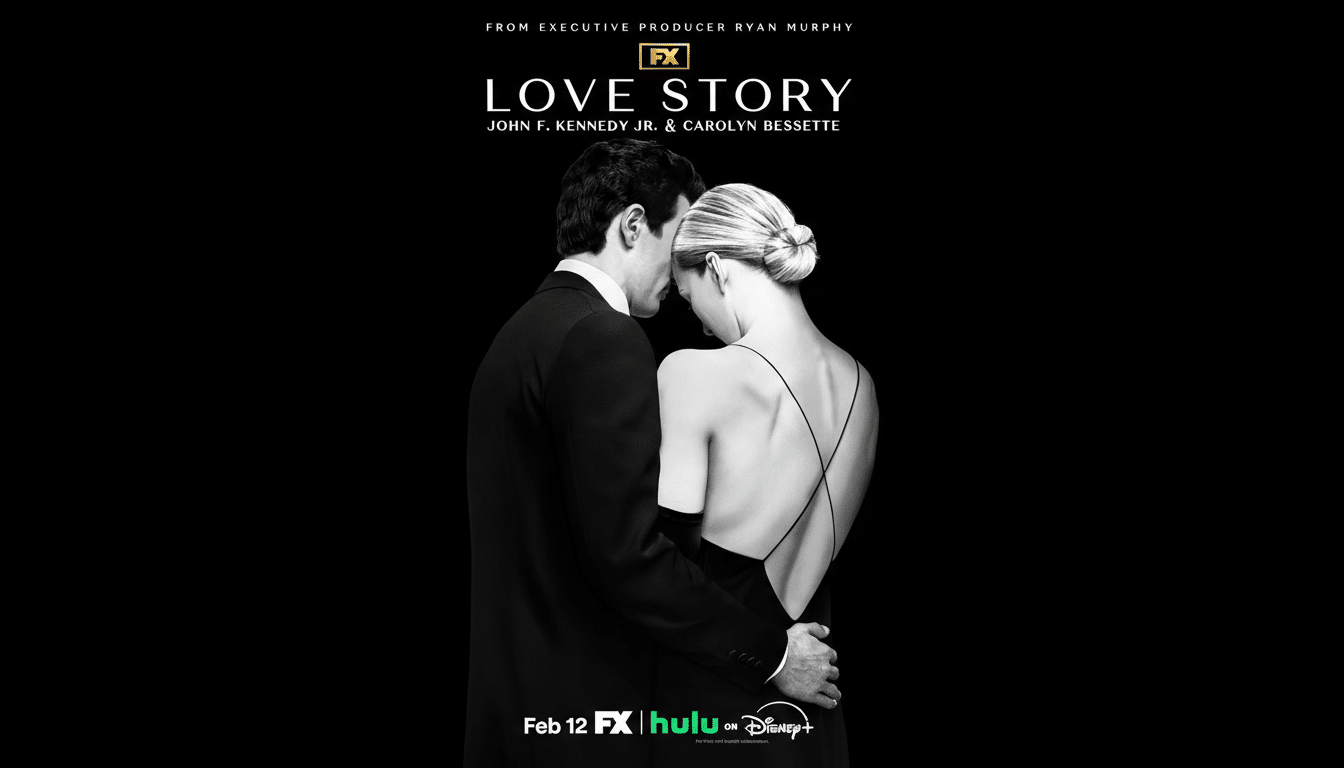
Sarah Pidgeon’s Carolyn is the series’ compass—controlled in public, candid in private, constantly running the mental math of what her presence will cost everyone around her. Paul Anthony Kelly dodges caricature as John, layering in a fretful charm and a quietly destabilizing self-awareness. Together they sell a relationship that is at once glamorous and fragile, made delicate by the knowledge that their dates are never truly for two.
The show’s sharpest choice is to stage media attention as horror. Paparazzi here are less individual antagonists than an accumulating force: camera strobes pulse like a heartbeat; an intercom rings with the violence of a jump scare; doorways become siege points. It’s not subtle, but it is persuasive, and it captures something specific about life lived at sidewalk level when public appetite is insatiable.
Performances that humanize icons with nuanced detail
Pidgeon plays the hard parts softly—the flicker of dread when a stranger recognizes her, the microsecond she takes to decide whether to stay at a party, the resignation that follows. Kelly, for his part, finds the person beneath the surname: a man negotiating the gravitational pull of an American dynasty while trying to make ordinary choices. Sydney Lemmon, as Carolyn’s sister Lauren, adds ballast and bite, reminding the series that this love story had a real family orbit.
Importantly, the show allows both leads an interior life. We see a publicist determined not to be reduced to “wife,” and a famous son working not to be reduced to “heir.” Those conflicts—careers, privacy, autonomy—are recognizable even if the stakes around them are extraordinary. That grounding makes the spectacle legible as lived experience rather than legend.
Fact, fiction, and the ethics of reenactment
Love Story recreates widely photographed encounters and, at times, juxtaposes dramatization with archival imagery. That approach gives the series docudrama immediacy but also raises ethical questions. Reconstructing a viral sidewalk argument or restaging a tabloid cover compels viewer empathy; it also risks reanimating the very voyeurism the script condemns.
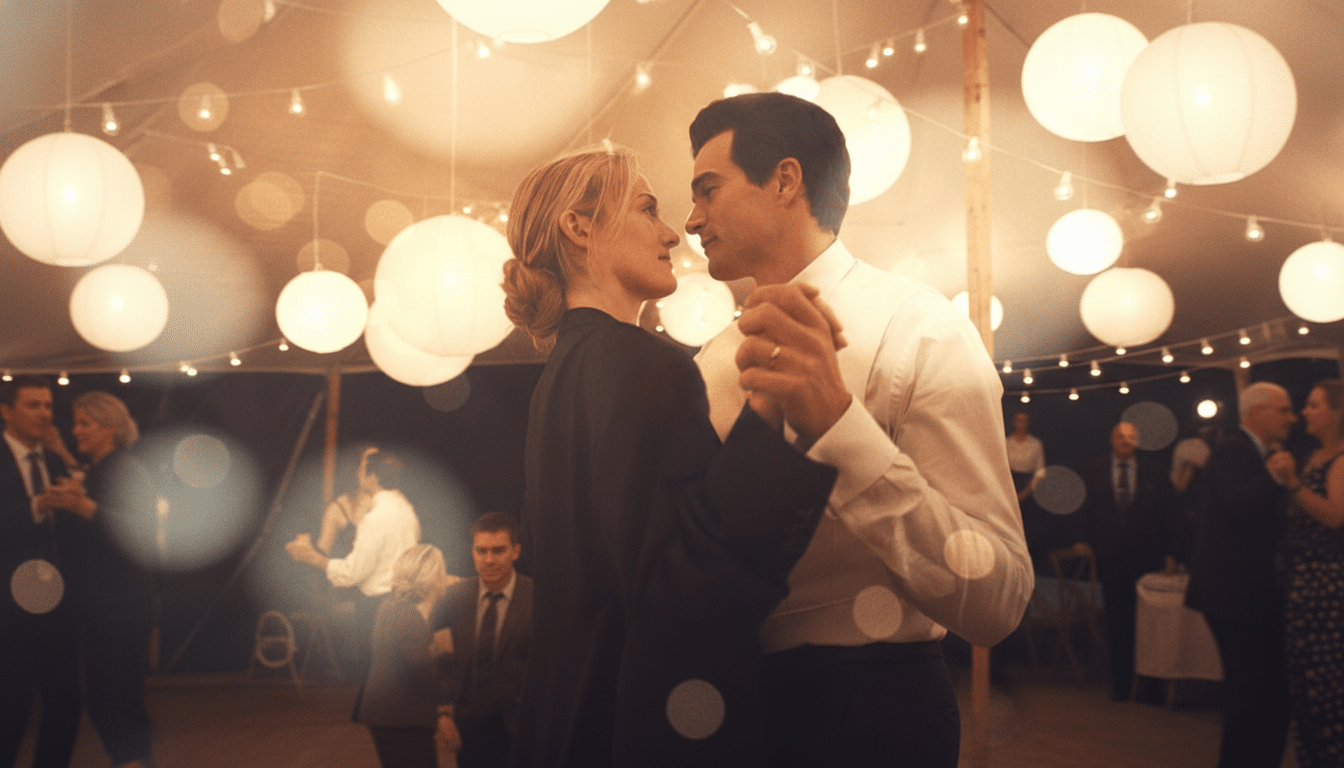
The tension is not abstract. The Kennedy family was not consulted, and in today’s media ecosystem, any buzzy scene is likely to be clipped, fact-checked, and debated on social video within hours. Pew Research Center has documented the platform-driven loop wherein entertainment moments swiftly become news objects, and then fandom fodder. In other words, the feedback cycle that swamped this couple never really ended—it mutated.
The production’s brush with history also carries the weight of the tragedy that ended the couple’s lives. The National Transportation Safety Board’s final report on the crash that killed John, Carolyn, and Lauren cited spatial disorientation at night as the probable cause and noted that John was not instrument-rated at the time, details the series treats with restraint. The choice to allude rather than reenact is one of its most responsible calls.
Context matters beyond the show’s frame. In the wake of high-profile chases and intrusions, California enacted and later strengthened an anti-paparazzi statute (Civil Code §1708.8) aimed at curbing assaultive newsgathering and invasive surveillance. The law reflects a public policy arc that Love Story mines dramatically: outrage at tactics that turn private moments into monetizable content, even as the market rewards the results.
Verdict: a cautionary tale about love under siege
Love Story succeeds most when it slows down, letting us feel how logistics—getting into a car, crossing a sidewalk, exiting a restaurant—become moral choices when everyone is watching. It is less persuasive when it leans too literally on the iconography that once flattened its subjects. Still, the empathy on display, the measured performances, and the pointed use of genre make this as much a cautionary tale as a valentine.
Call it a two-hander about love under siege. Or call it a horror story about how an audience can get too close. Either way, FX’s entry makes a strong case that the real plot twist in American celebrity isn’t fame—it’s what the rest of us choose to do with it.