


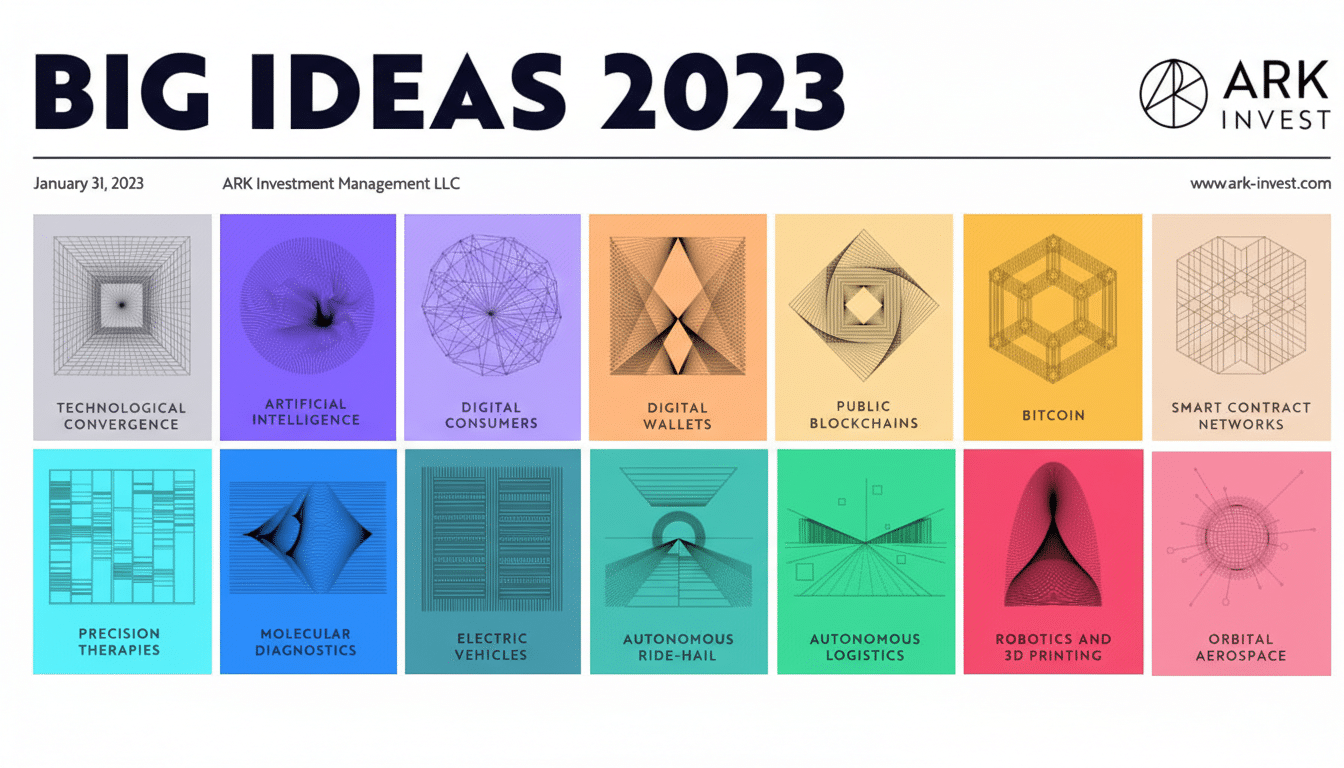
Investors and executives are aligning around four technology bets with outsize power to move output, prices, and productivity: AI infrastructure, the AI consumer operating system, AI-driven productivity, and robotics. Fresh research from ARK Invest’s Big Ideas program frames these as mutually reinforcing platforms, with AI acting as the catalyst that unlocks step-change gains across the others.
ARK’s analysis argues that disruptive platforms could add roughly 1.9% to annualized real GDP growth this decade through capital deepening alone. The thesis is simple but consequential: when compute gets vastly cheaper and more abundant, and when machines can reason, sense, and act with autonomy, the entire economy reorganizes around that capability.
AI Infrastructure Powers The Next Cloud Buildout
Inference costs have collapsed by more than 99% since the first wave of generative tools hit the market, according to ARK. That has flipped the demand curve: data center systems growth jumped from the low single digits to near 30% annually, and hyperscalers are preparing capex outlays that ARK estimates will exceed $500 billion in the near term, nearly quadruple early-decade levels.
Cumulatively, AI infrastructure investment could top $1.4 trillion over the decade, spanning advanced GPUs, custom accelerators, high-bandwidth memory, optical networking, and power-hungry cooling. Bottlenecks are shifting from chips to everything around the chip: grid interconnects, transformers, and advanced packaging. Industry watchers from the International Energy Agency to Uptime Institute have flagged power availability as the next constraint, a reminder that compute economics now hinge as much on kilowatts as on model weights.
Winners will be the suppliers that squeeze more useful tokens per joule and more throughput per dollar. Expect aggressive innovation in model serving, sparsity, and mixed precision to stretch every rack unit of capacity.
The AI Consumer Operating System Emerges
Consumers are shifting from tapping apps to delegating tasks to AI agents. ARK estimates that AI chatbot penetration on smartphones is nearing 20%, and that as much as 95% of the customer journey happens before a transaction even occurs. In this environment, personalization is table stakes.
Agentic AI is compressing the purchase funnel from roughly an hour to under 90 seconds for many categories. ARK projects that AI agents could facilitate more than $8 trillion of online consumption by decade’s end, with their share of digital transactions rising from the low single digits to around one quarter. Search is already tilting toward conversational answers; ARK expects AI-driven search to grow from about 1 in 10 queries to nearly two-thirds over the next few years, reshaping ad markets as budgets follow intent.
This shift will reward brands that expose clean data, real-time inventory, and transparent policies to agent ecosystems. It will also test privacy, antitrust, and attribution norms, as regulators and standards bodies weigh how algorithmic intermediaries steer demand.
AI Productivity Rewrites Workplace Economics
The cost of intelligence is falling fast. ARK cites a 91% drop in software development costs per million tokens, from $3.50 to $0.32, within months. Meanwhile, advances in reasoning, tool use, and longer context windows have expanded the tasks AI agents can complete reliably, with median task duration increasing roughly fivefold—from minutes to half an hour.
The addressable market is immense: global spending on software and wages aimed at productivity improvement sits around $1.43 trillion. ARK forecasts that software outlays could accelerate from roughly 14% annual growth to a range of 19%–56% as companies embed copilots across workflows. Studies by organizations such as the IMF and McKinsey suggest gains will show up first as time saved and quality uplift, with headcount adjustments lagging. Expect employment growth to slow and average hours to edge down without a sustained rise in long-term unemployment, provided reskilling keeps pace.
Real performance will depend on data governance, change management, and integration with existing systems. The firms that pair secure data pipelines with human-in-the-loop controls will convert pilot productivity into durable margin expansion.
Robotics Moves From Pilot To Payroll at Scale
Automation has long targeted structured processes; ARK sizes the opportunity at $26 trillion as robots take on routine physical work. The near-term growth engines are warehouse picking, sortation, and inspection, plus mobile robots in hospitals, factories, and retail. These systems are increasingly orchestrated by the same AI that powers language models, enabling perception, planning, and actuation to converge.
Humanoid robots are the wild card. ARK notes they are harder to generalize than robotaxis because they must master unstructured indoor tasks, yet rapid progress from companies like Tesla, Agility Robotics, and Figure is expanding the feasible task set. In mobility, robotaxis could create enterprise value measured in the tens of trillions this decade, while autonomous delivery is on track to approach half a trillion dollars in revenue, reshaping last-mile logistics and consumer expectations.
Key constraints remain: safety certification, liability frameworks, and reliable supply of sensors, batteries, and actuators. Still, every uptick in AI capability lowers the programming burden, accelerating deployment from pilots to payroll.
What To Watch Next As AI Platforms Converge
These four bets are converging. AI lowers the marginal cost of cognition; robotics lowers the marginal cost of motion; agents mediate demand; infrastructure scales the whole stack. ARK’s framework suggests the compounding effects could lift global growth even after cyclical noise fades. The IMF and OECD have emphasized that realizing these gains will hinge on complementary investments—in skills, power, and competition policy—as much as in silicon.
For leaders, the playbook is clear:
- Secure compute and power
- Expose trustworthy data to agents
- Redesign roles around AI copilots
- Target automation where variability is bounded
The window to convert these bets into durable advantage is open—and it will not stay open for long.