


A creator gets one clean 10-second clip on Friday. By Monday, it appears in a buying guide as evidence that the tool is reliable.
What the reader does not see is the folder beside it: rejected versions, changed settings, repaired audio, and the extra editing needed before the clip was ready to show.
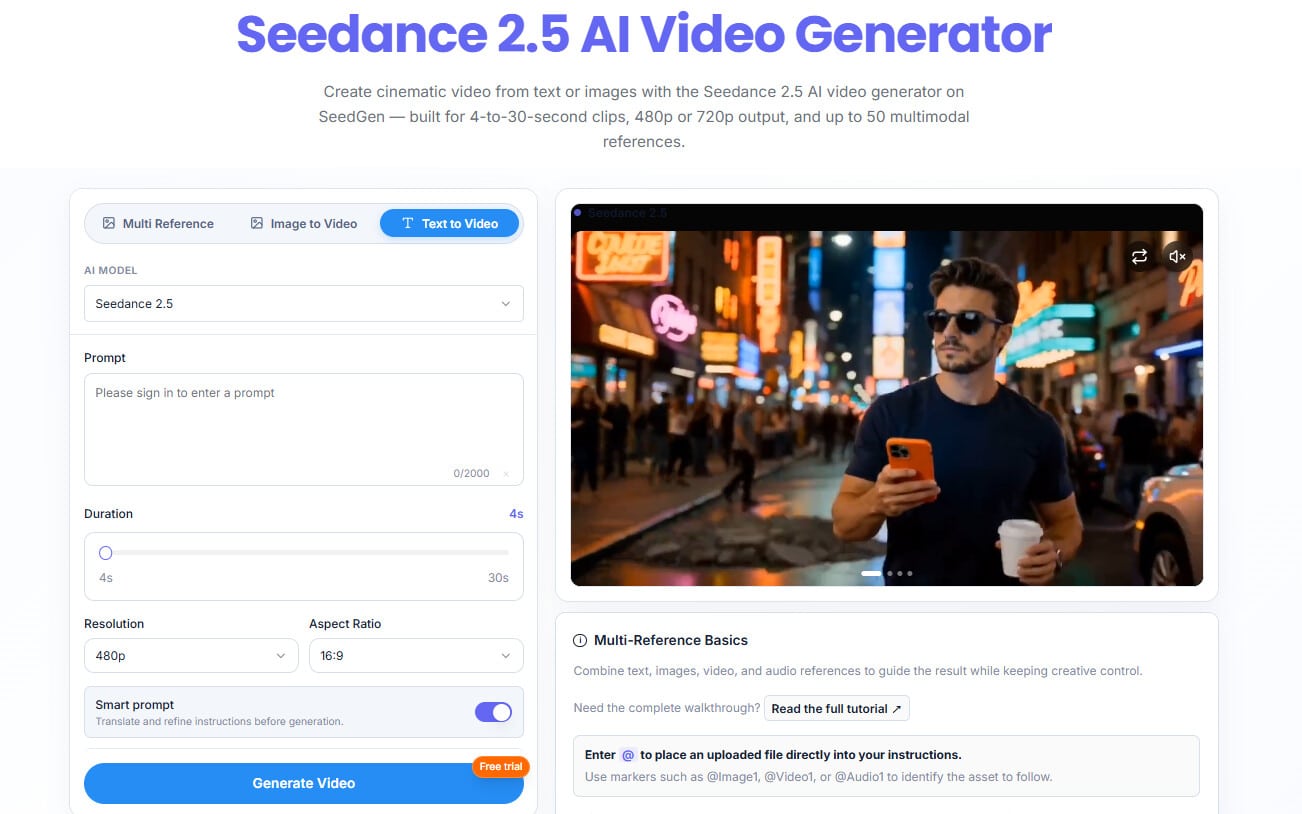
That gap matters when a review mentions a model such as Seedance 2.5. One polished output shows what happened once. It does not show how often the same brief works, how much intervention was needed, or whether the task resembles normal use.
This article is not a controlled benchmark of Seedance 2.5 or any competing model. It is a practical way to decide whether an AI video test contains enough evidence to support buying advice.
1. Check Whether the Test Matches a Real Job
A test should begin with the buyer’s task, not the model’s most dramatic demo.
Suppose a small coffee shop wants a vertical social clip. The cup needs to remain recognizable, the logo should not change, the pouring action must finish, and the composition needs room for a caption.
A wide shot of a futuristic city may look more impressive, but it answers none of those questions.
The tester should define the job before generating anything:
- What is the clip meant to do?
- Which details must remain stable?
- What references will be used?
- Which format and duration are required?
- What would make the result unusable?
“Looks realistic” is too vague. “The cup and logo remain recognizable, and the pouring action finishes within 10 seconds” is something a reviewer can check.
Comparisons also need reasonably similar conditions. One model should not receive a detailed prompt, several references, and repeated attempts while another gets a short prompt and one try.
If identical conditions are not possible, the difference should be stated. Otherwise, the comparison may reflect the setup more than the models.
2. Ask What Happened to the Other Attempts
The best clip is usually the easiest one to publish. The rejected clips often contain the information a buyer actually needs.
Output can vary even when the prompt and settings stay the same. One attempt may follow the camera direction. Another may add an unwanted object. A third may change the subject near the end.
Imagine the coffee shop generates four versions of its pouring scene. The first adds a second cup. The second alters the logo. The third stops before the pour is complete. The fourth works.
Showing only the fourth version makes the process look immediate.
A fair account does not need to display every discarded file. It should still explain how many attempts were made, how many were usable, why the others were rejected, and which problems appeared more than once.
Patterns matter. A logo that changes in most attempts deserves more attention than a one-off error. A subject that stays recognizable while standing still but drifts during fast movement gives readers something practical to plan around.
If only one generation was made, it can still be shared as an example. It should be called a sample or first impression, not proof of reliability.
3. Follow the Clip Beyond the Generator
Many demonstrations end as soon as the output appears. A real project does not.
Before generation, someone may need to clean up reference images, shorten a script, remove private information, or decide what each reference is supposed to control.
Afterward, the selected clip may need trimming, captions, audio correction, resizing, or work in another editor. Names, dates, prices, product details, and on-screen text may need to be checked against the original source.
That work affects the value of the tool.
A result that needs 30 minutes of repair may still be useful. It is simply different from a result that can move directly into review. The tester should say what happened between download and publication instead of presenting the raw output as a finished asset.
Costs should be treated the same way. If four generations were needed to obtain one usable draft, all four belong in the calculation. A low-resolution test also should not be used to estimate final production cost if the finished clip requires a longer duration or higher setting.
The useful question is not “How much did one generation cost?” It is “What did it take to reach a result the team could actually use?”
4. Separate the Model From the Service Used
A model and the service used to access it are not the same part of the experience.
The same model may appear through a website, application, API, or several account plans. Each route can offer different settings, queues, prices, usage rules, and editing options.
This matters when reviewing a Seedance 2.5 AI video workflow. The report should identify the provider, plan, model label, visible settings, and test date—not just the model name.
ByteDance’s official July 31, 2026 launch announcement describes generation of up to 30 seconds in one pass. It also lists reference inputs of up to 30 images, 10 video clips, and 10 audio clips. ByteDance further describes timestamp-level control for targeted editing and other reference-based editing functions.
These are published model specifications, not findings independently verified in this article. Their availability and implementation may differ across services.
A particular provider may expose a different set of resolutions, durations, reference options, prices, or account requirements. Its interface may also include conveniences that come from the provider rather than the underlying model.
Without that distinction, a reviewer can make two mistakes: crediting the model for a feature supplied by the interface, or blaming the model for a restriction created by a plan.
Service conditions change as well. Naming the provider and date lets readers check the current details before buying credits or uploading production material.
5. Decide Whether the Result Can Be Published Responsibly
A convincing clip is not automatically appropriate for publication.
Start with what the video appears to prove. A generated scene of a shoe gripping wet pavement does not demonstrate real slip resistance. A synthetic software screen does not confirm how the actual product works. A generated before-and-after sequence is not evidence that a product caused the change shown.
These clips may work as clearly presented concepts or illustrations. They should not replace verified demonstrations, measurements, or documentary footage.
Source material needs a separate review. Photographs, recordings, music, logos, scripts, and client files should only be uploaded when the relevant permissions cover external AI processing and the intended derivative use. Permission to publish the original material may not cover every new use.
Identifiable people and voices require particular care. A provider may restrict real-person references, and authorization may still be needed even when an upload is technically accepted. Copyrighted characters, branded assets, confidential files, and private locations create similar concerns.
Usage rights should be checked through the service used before commercial publication. They may vary by provider, account type, location, and source material.
The full clip should also be reviewed after every revision. A change aimed at one element may affect lighting, motion, composition, audio, or another detail elsewhere.
Commercial relationships matter too. Payment, free credits, affiliate revenue, ownership, or another material connection can affect how readers interpret a recommendation. Paid placements and other commercial relationships should be disclosed clearly enough for readers to understand them before weighing the advice.
Good Advice Does Not Need a Universal Winner
A tool may suit early concept work but require too much checking for product demonstrations. Another may cost more per attempt but save time during revision. A workflow that works for an individual creator may be unsuitable for a team handling licensed or confidential material.
Those limits are part of the result, not weaknesses to hide at the end.
A perfect demo may earn attention. A useful test explains what was tried, what went wrong, what it took to fix, and where the conclusion stops.