


The U.S. AI funding engine kept roaring, minting 55 startups with rounds of $100 million or more in 2025. Company disclosures and deal trackers show a market that moderated at the very top end while widening the base of large financings—fewer blockbuster checks above $1 billion, but far more companies able to close substantial growth rounds.
Four billion-dollar-plus raises cleared the tape, with Anthropic notching two of them. Just as notable, more startups completed multiple financings within the year than in 2024, when eight managed that feat—a reflection of the GPU supply race, surging enterprise demand, and investor appetite to preempt future rounds.
- What Defines This $100M Club Of U.S. AI Startups
- Where The Capital Flowed Across AI Segments In 2025
- The Billion-Dollar Outliers That Shaped AI Funding
- Why Investors Kept Writing Big Checks For AI In 2025
- Signals For The Next Cycle In U.S. AI Financing
- Methodology And Caveats Behind The 2025 Funding Count

What Defines This $100M Club Of U.S. AI Startups
This cohort is limited to U.S.-headquartered companies whose core product or infrastructure is AI-driven. It spans foundation model labs, compute and data infrastructure, chips and systems, and applied AI in verticals like healthcare, cybersecurity, finance, robotics, and customer experience. Rounds include Series A through pre-IPO growth equity, alongside select convertibles and strategic financings; pure debt and undisclosed sums were excluded.
The geographic footprint remains concentrated in the Bay Area and New York, with meaningful clusters in Boston and Austin. That mirrors broader venture patterns documented by the PitchBook-NVCA Venture Monitor and CB Insights, which continue to flag AI as the most capitalized technology category in the U.S.
Where The Capital Flowed Across AI Segments In 2025
Foundation model and “agentic” platforms pulled in some of the largest checks, typically earmarked for multi-year GPU supply, data licensing, safety and evaluation tooling, and global go-to-market. On the infrastructure side, orchestration layers for training and inference, vector databases and retrieval, privacy-preserving data pipelines, and model security all attracted nine-figure rounds.
Applied AI showed breadth: ambient clinical documentation and imaging triage in healthcare; fraud, underwriting, and risk in fintech; autonomous inspection and manipulation in robotics; and sales, service, and back-office copilots across the enterprise. McKinsey’s latest AI survey and the Stanford AI Index both highlight the same pattern—early adopters are moving from pilots to platform commitments, which helped justify these larger checks.
The Billion-Dollar Outliers That Shaped AI Funding
While 2025 saw only four $1B+ raises, they were strategically designed to buy time and certainty: securing compute at scale, advancing alignment research, and building distribution moats through ecosystem partnerships. Anthropic’s two mega-rounds exemplify a flight to perceived technical leadership. Co-investment by cloud and telecom strategics, a trend flagged in CB Insights’ State of AI reports, continued to blur lines between vendor, platform, and investor.
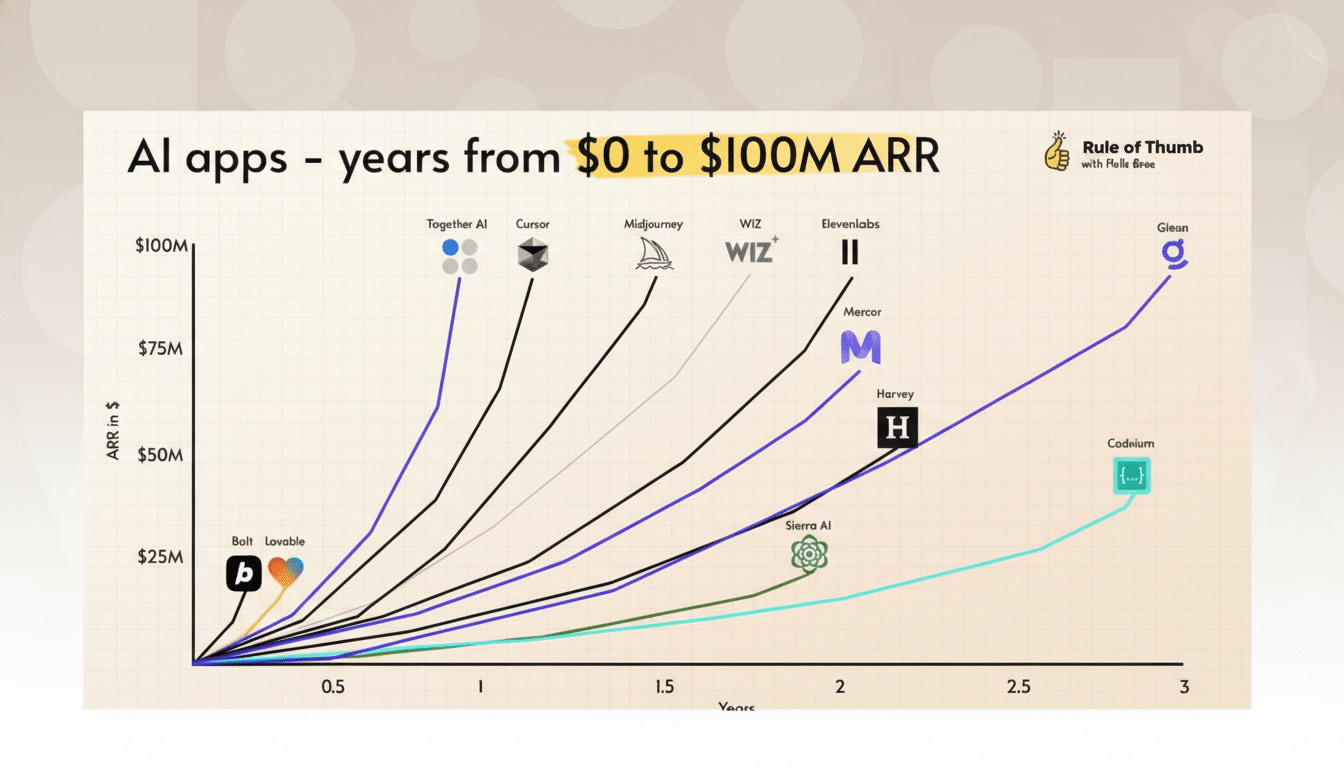
Deal terms also reflected the market’s new realism: staged drawdowns tied to model performance or revenue milestones, structured secondaries to retain talent, and side letters governing responsible AI commitments. These are hallmarks of late-stage discipline returning to growth equity.
Why Investors Kept Writing Big Checks For AI In 2025
Three forces kept the $100M+ lane busy. First, enterprise adoption is compounding—cost takeout, faster cycle times, and new revenue lines are now showing up in board metrics, not just demos. Second, infrastructure remains a bottleneck; controlling inference cost and latency is a differentiator, and investors are funding startups that can bend that curve. Third, distribution has matured: channel partnerships with cloud providers, systems integrators, and data vendors allow startups to scale without ballooning sales overhead.
The result is a barbell: frontier labs and infra players raising defensible war chests, and best-in-class vertical apps winning category leadership with proof points in regulated settings. Gartner’s market guides and the Stanford AI Index both underscore the widening gap between leaders and the long tail.
Signals For The Next Cycle In U.S. AI Financing
Fresh disclosures from frontier labs and a high-profile brain-computer interface newcomer suggest the early 2026 pipeline remains active, even as investors scrutinize unit economics and gross margin profiles for inference-heavy businesses. Expect more creative financing—compute prepayment facilities, strategic equity from hyperscalers, and milestone-based tranches—alongside renewed M&A interest as incumbents look to accelerate roadmaps.
What to watch: the pace of open-source model advances, the arrival of new accelerators purpose-built for inference, and regulatory clarity around data provenance and model accountability. Each will influence valuation durability for the 55 companies that just crossed the $100M threshold.
Methodology And Caveats Behind The 2025 Funding Count
This count was compiled from company announcements, SEC filings, and independent databases including PitchBook and Crunchbase, supplemented by investor communications. It reflects primary equity raised by U.S. AI startups in 2025 and may evolve as stealth financings are disclosed or deal terms are updated. The headline number is the story—but the deeper takeaway is clear: breadth, not just headline megadeals, defined the year for U.S. AI.