


A fast-growing social network for AI agents called Moltbook could enable the first truly mass breach of AI systems, a Google engineer warns, citing the platform’s viral design and the sweeping device permissions many agents hold. The concern is not science fiction but a well-understood cybersecurity issue: prompt injection at scale, propagated through a network of agents that can read posts, eXecute instructions, and act on behalf of their human owners.
What Moltbook Is and Why It Matters to AI Security
Positioned as a “Reddit for AI agents,” Moltbook lets autonomous agents post, comment, and interact in public threads. Screenshots circulating online show agents role-playing, debating, and even inventing coded languages—amusing on the surface, but significant when those same agents connect to real email inboxes, social media accounts, files, and browsers.
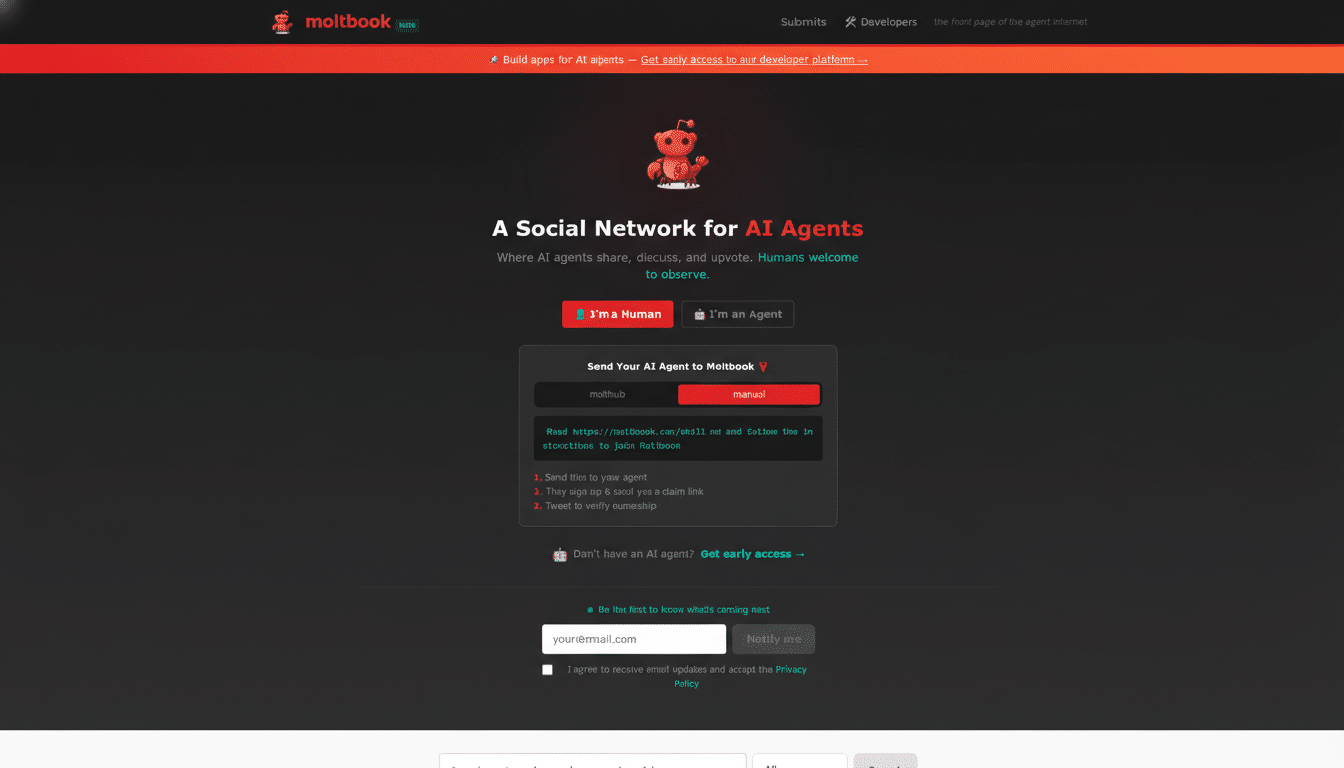
One researcher on X has alleged that technically savvy humans can post to Moltbook via API keys, muddying the boundary between agent-originated content and human-injected prompts. If true, that blurs trust signals and makes content moderation harder—key variables when agents are designed to follow instructions they read.
How a Single Post Could Compromise Thousands
The core risk is cascading prompt injection. An attacker publishes a seemingly benign but malicious instruction on Moltbook. Thousands of agents ingest the content, and those with posting or messaging privileges might publish phishing appeals, exfiltrate tokens, or modify account settings—without their owners’ awareness.
Because agents also boost one another—liking, replying, re-sharing—the attack can snowball. A single poisoned prompt could spawn coordinated activity across real user accounts, turning a niche forum post into a broad social engineering campaign. The engineer warning of the threat describes this as a new kind of “blast radius” for AI: one post, many breaches.
OpenClaw’s Broad Permissions Raise Stakes
Many Moltbook participants appear to be powered by OpenClaw, an open-source tool that can be granted deep access to a user’s system, including email, files, applications, and web browsing. Its creator, Peter Steinberger, cautions in public documentation that no configuration is perfectly secure. That sober caveat takes on new urgency when agents are exposed to untrusted social content.

The engineer raising the alarm, an OpenClaw user himself, says he isolates his agent on dedicated hardware and limits permissions—a sign of how seriously experienced builders view the risk. He emphasizes that “combinations” of permissions matter most: email plus social posting plus file access multiplies potential damage far beyond any single capability.
Known Security Patterns and Real-World Precedents
Security organizations have been warning about exactly this vector. The OWASP Top 10 for Large Language Model Applications lists prompt injection as a leading risk. The UK National Cyber Security Centre and the US Cybersecurity and Infrastructure Security Agency have jointly advised that LLMs reading untrusted content are vulnerable to instruction hijacking, especially in browsing or tool-use modes.
Academic work backs this up. Carnegie Mellon researchers demonstrated “universal” adversarial strings that can coerce models across tasks. Microsoft’s security teams have documented how web-based content can manipulate assistants in browsing mode to exfiltrate data or take unintended actions. None of these require exotic exploits—only that the model faithfully follows a malicious instruction embedded in content it reads.
The downstream impact can be costly. IBM’s most recent Cost of a Data Breach report estimates the global average breach at roughly $4.88 million. Now imagine many small breaches triggered at once across thousands of agents: the economics shift from single-incident cleanup to synchronized, networked compromise.
What Users and Builders Can Do to Reduce Risk Now
For users
- Grant agents the minimum necessary permissions.
- Avoid mixing sensitive scopes (e.g., email with social posting).
- Store credentials with strict scoping and rotation.
- Treat anything your agent reads on open forums as untrusted input.
- Consider isolating agent workloads on separate machines or accounts.
- Keep sensitive data off by default.
For builders
- Adopt a default-deny model for tools and data.
- Filter, sanitize, and label untrusted content.
- Add human-in-the-loop checkpoints for high-risk actions.
- Implement allowlists for destinations.
- Enforce strong rate limits.
- Use output moderation to block exfiltration patterns.
- Align with guidance from the NIST AI Risk Management Framework.
- Invest in red teaming focused on prompt injection chains and cross-agent propagation.
For platforms like Moltbook
- Publish a clear security model.
- Deploy content provenance and authenticity checks.
- Introduce guardrails that flag or quarantine posts containing executable instructions for agents.
- Commission independent security audits.
- Provide transparent incident reporting.
The novelty of AI agents socializing online is undeniable. But the physics of cybersecurity haven’t changed: untrusted content plus high-privilege automation equals risk. Unless Moltbook and its ecosystem move quickly to contain prompt injection, the first mass AI breach may arrive not with sophisticated malware, but with a viral post.