


MediaTek’s new Dimensity 9500 is a clear swing at the top end of the Android stack, combining significantly reduced on-device AI power with real camera and gaming improvements. Friends in high places include Oppo and Vivo, suggesting a wide take-up in Asia and Europe, if more US-bound flagships are likely to continue relying on Qualcomm.
Continuous low-power AI for everyday experiences
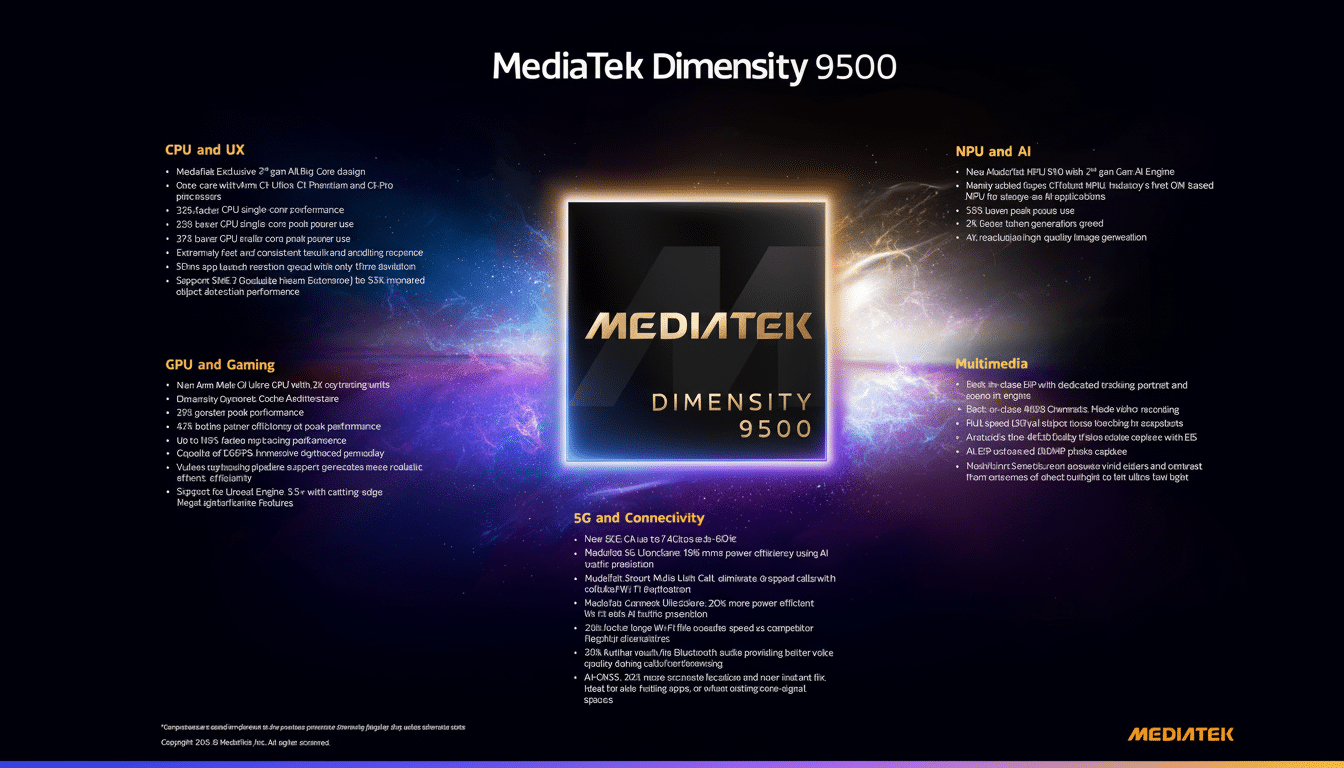
Topping it all off is a new neural processing unit that MediaTek says is “super efficient,” which ought to reduce power draw enough for models to keep running perpetually in the background without pounding the battery life. That one is important for everyday features such as live transcription, on-device translation, camera scene understanding and offline assistants that can summarize or sort content, tell you how to make a cocktail or jog your memory without a network connection.
- Continuous low-power AI for everyday experiences
- CPU and GPU gains oriented towards sustained performance
- Camera pipeline designed for 200MP and cinematic portrait video
- Who will adopt Dimensity 9500 — and in which regions
- Competition from all sides as rivals push AI silicon
- What to watch for in independent performance reviews
Anticipate this to be closely tied into Android’s on-device AI frameworks so you can invoke your quick-resume task or context-aware function without a cloud ping. The real-world test will be whether such phones are able to support always-on AI — for example, semantic photo indexing or voice-triggered agents — without a perceivable battery hit or runaway thermals. If MediaTek’s performance claims are accurate, that could change how much OEMs default local AI to server-side compute.
CPU and GPU gains oriented towards sustained performance
The Dimensity 9500 debuts MediaTek’s third-generation all-big-core CPU architecture, meaning it should be 32% faster in single-core tasks and 17% quicker with multi-core workloads over last year’s Dimensity 9400, according to its spec sheet. An ‘ultra’ core that clocks up to 4.21GHz is reported to slice peak power up to 55% versus the prior generation, an unusual scenario of more speed at less energy — an increasingly critical advantage in slim phones with thermals that throttle performance well before the CPU’s limit.
Graphics receive similar lift: MediaTek claims 33% higher peak GPU performance, with a 42% increase in power efficiency. The hardware-accelerated ray tracing for mobile will enable more realistic reflections and lighting in compatible mobile titles, running at up to 120 frames per second. But the larger story isn’t those headline frames — it’s sustained frame rates over extended play times, where better perf-per-watt can keep gameplay smoother without turning the chassis into a hand-warmer.
Camera pipeline designed for 200MP and cinematic portrait video
On the imaging side, the 9500’s ISP stack strides into enthusiast territory as well. 200MP sensors are natively supported, so OEMs have the space to pair the chip with Samsung ISOCELL or Sony Lytia sensors, and there’s also improved processing for 4K, 60fps portrait video which can handle real-time subject separation. That’s the sort of feature creators actually feel: stabilized, shallow-depth clips that neither smear hair nor misread edges in demanding light.
Importantly, MediaTek also says more of its computational photography takes place in the RAW domain prior to compression, helping detail and dynamic range for multi-frame HDR and denoising. Practically speaking, night shots should look cleaner and those brightly lit scenes you snap will have less haloing around highlights. The efficacy will depend on OEM tuning, but the silicon foundation is in place for sharper low-light shots and more consistent portrait cutouts.
Who will adopt Dimensity 9500 — and in which regions
Oppo’s Find X9 series and Vivo’s next flagship are also confirmed to be running the Dimensity 9500 — which is probably going to slap a camera and AI stack in our faces first.
In the past, plenty of great phones in China, India and Europe have used MediaTek’s top-end silicon while US carriers look to Qualcomm for high-end products. Don’t be shocked if that division holds.
The broader landscape plays to MediaTek’s advantage as it pushes forward. The global smartphone SoC shipment leaders in the past few years have been MediaTek and Qualcomm, with overall volume shipments still led by MediaTek, taking into account limited volumes of flagship smartphone SoCs including Kirin (HiSilicon) and Exynos (Samsung). Taking an efficiency-first AI and imaging tale to flagships makes sense — and it’s a pressure play on premium incumbents.
Competition from all sides as rivals push AI silicon
The release of the 9500 comes as Qualcomm preps its next Snapdragon 8 Elite and as Apple and Google both work to talk up their custom silicon efforts for AI pipelines and camera. The competitive lens through which devices are now judged is no longer raw TOPS or benchmark peaks, but efficiency under real workloads: how long an assistant can listen, for example, or the latency with which a phone can show you output from a generative filter — or even how solid 60fps portrait video will stay in challenging backlit scenes.
If MediaTek’s specs correlate to retail devices, it could encourage OEMs to dig in more on on-device AI out of the box, cut back dependence on cloud inference for over-and-done-with stuff and hike up computational photography without clunkier batteries.
What to watch for in independent performance reviews
Some of the metrics that will be interesting to follow are:
- Long-term CPU/GPU performance in a 30-minute gaming run
- NPU throughput-to-power-draw ratio during on-device transcription and image rendering jobs
- Capture-to-share latency for 200MP photos
- Edge-case quality of portrait video at 4K/60
How the modem and connectivity in general behave under weak signal (which is often a hidden sucking drain on battery) will also show how well the 9500’s efficiency numbers hold water outside of the lab.
Bottom line: the Dimensity 9500 is more about keeping pace with sky-high peaks rather than going to them, and releasing smarter, longer-running AI and camera features without the hit. If the OEMs deliver on tuning, this chip will enable premium Android phones to feel less hamstrung by thermals and battery anxiety — and more like the pocket studios and assistants they’re supposed to be.