


For mobile vinyl skins, creativity alone doesn’t do the trick. There is no limit to the beautiful artwork you can find; however, if your skin isn’t designed to fit your device precisely, the final product may look cheap, peel around the edges, or block camera buttons. This is why the design of precision is the foundation of any good vinyl skin.
If you’re designing skins to use for personal purposes or managing an enterprise that sells vinyl skins, designing perfect template templates for mobile vinyl is an essential ability. Accurateness builds trust, lowers the risk of returns, and differentiates high-end brands from those that are amateurs.
- Why Precision Matters in Vinyl Skin Design
- Understanding the Anatomy of a Vinyl Skin Template
- Step 1: Measuring the Device Accurately
- Step 2: Working with Curves and Edges
- Step 3: Creating the Digital Template
- Step 4: Designing Camera and Button Cutouts
- Step 5: Managing Tolerances Like a Pro
- Step 6: Test Printing and Real-World Fit Checks
- Step 7: Accounting for Different Vinyl Materials
- Step 8: Preparing Templates for Cutting Machines
- Step 9: Version Control and Template Management
- Common Precision Mistakes to Avoid
- Who Needs Precision Templates the Most?
- The Future of Precision Vinyl Skin Design
- Conclusion
- FAQs
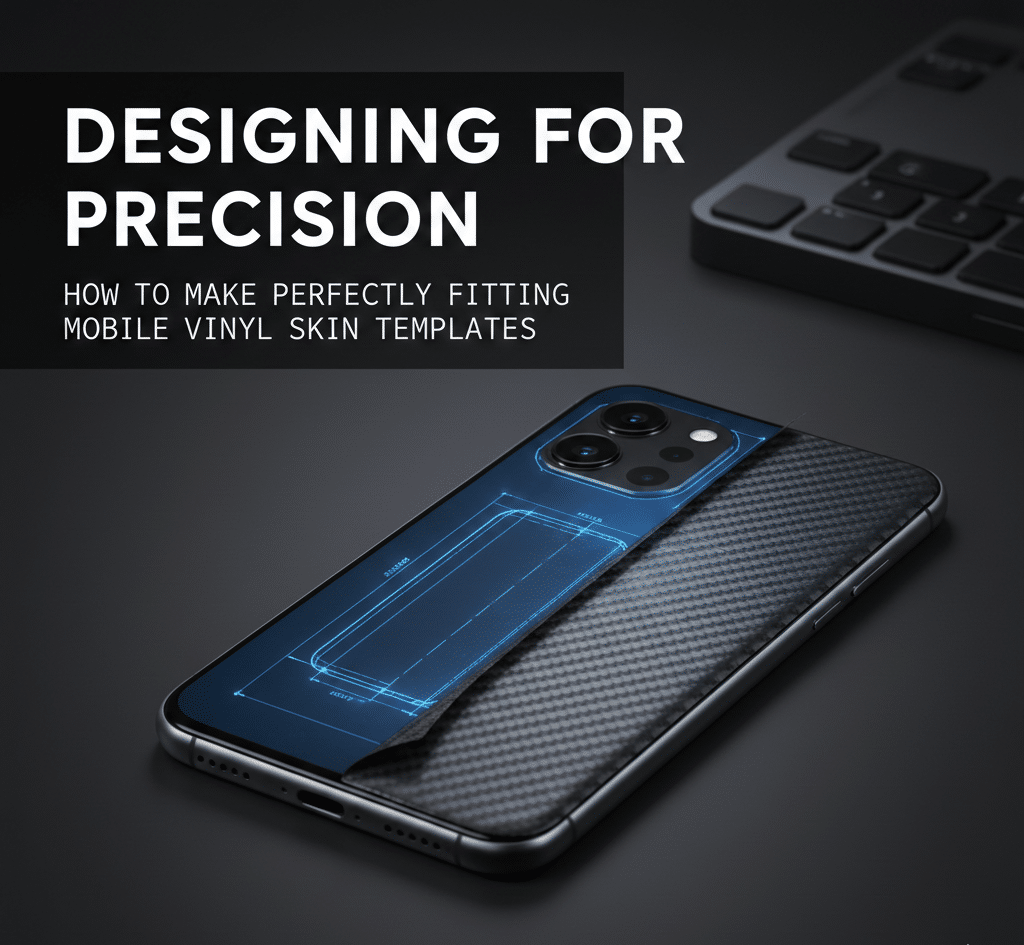
In this article, this guide, we’ll explain the method that professional designers use to create precise, ready-to-use vinyl skin templates, from measuring instruments to dealing with curves, tolerances, and actual testing.
Why Precision Matters in Vinyl Skin Design
The quality of your work doesn’t only affects the aesthetics. It directly affects usability and satisfaction.
An undesigned template could cause:
- Camera cutouts that aren’t aligned
- Microphones that have been covered or buttons
- Peeling edges
- Wrinkles on surfaces with curvature
- Reviews that are negative and refunds
But, on the other hand, an exact template
- The appearance of the phone is smooth and seamless
- It is easy to apply with only a little heating
- Feels premium in hand
- Encourages customers to purchase more often
In short, precision equals professionalism.
Understanding the Anatomy of a Vinyl Skin Template
Prior to designing, it is important to be aware of the elements that make up the ideal template.
The complete Mobile Vinyl Skin Template contains:
- Outer device boundary
- Camera module cutouts
- Port and button openings
- Logo spacing (optional)
- Edge tolerance zones
- Areas of compensation for curves
Every millimeter counts. Modern smartphones come with complex camera islands, curving edges, and asymmetrical backs. Leaving out these particulars is the most effective method to make a poor design.
Step 1: Measuring the Device Accurately
The first step to precision is measurement.
Best Tools for Measuring Phones
- Digital Calipers (highly suggested)
- Precision ruler (backup option)
- Manufacturer CAD files (if available)
What You Must Measure
- The total height and width
- The thickness of the device
- Camera bump width and height
- The distance from the edges of the camera module
- The placement of the button
- The alignment of the speaker and port
Always take measurements using millimeters and not inches.
Pro Tips: Measure the same space at least 3 times and then take the average to avoid human errors.
Step 2: Working with Curves and Edges
Modern phones rarely come with flat backs now. Curves are where the majority of template designs fall short.
Why Curves Are Tricky
Vinyl expands slightly upon heating; however, it is not able to stretch indefinitely. If you make a model that extends all the way towards the curving edge, it’s going to:
- Lift after application
- Shrinkage with time
- Dust off edges
The Professional Rule
Don’t design skins that are completely wrapped around curving edges.
Instead:
- Make sure to leave a 0.5-1 millimeter tolerance gap around the edges
- The skin should end when the curve is about to begin.
- Only use heat to create minor contours
This method creates a smooth and long-lasting surface.
Step 3: Creating the Digital Template
After measurements are taken, you can move on to the designing software.
Best Software for Precision Design
- Adobe Illustrator
- CorelDRAW
- Inkscape (free alternative)
Design Setup Best Practices
- Use millimeter units.
- Only vector files are accepted.
- Use layers (body, cutouts, guides)
- Measurement layers are locked to prevent accidentally shifting the measurement layers accidentally
First sketch the device’s outline Then, add the internal cutouts one after another.
Step 4: Designing Camera and Button Cutouts
Camera cutouts are among the most visible part of skins, and also the most delicate.
Camera Cutout Guidelines
- Make sure to leave 0.3-0.5 millimeters of distance between the lenses
- Use round edges
- Test alignment under real lighting conditions
Ports and buttons:
- Oversized openings (by 0.2-0.4 millimeters)
- Focus on usability, not tight aesthetics.
Skins should not impair function.
Step 5: Managing Tolerances Like a Pro
Tolerance is the key weapon for great template designers.
Recommended Tolerances
- Outside edges 0.5-1 mm
- Camera cutouts: 0.3-0.5 mm
- Ports and Buttons: 0.2-0.4 mm
These tiny gaps
- In exchange for the reduction of inconsistencies, you can be compensated.
- Make sure you account for shrinkage in vinyl
- Increase the success rate of applications
Beginners often design “edge-to-edge” skins–professionals never do.
Step 6: Test Printing and Real-World Fit Checks
Don’t trust digital designs with no physical test.
Testing Workflow
- The template can be printed on uncoated sheet of
- Remove it by hand
- Put it in the original device
- Verify alignment and spacing
- Adjust design accordingly
Only after passing a paper test can you switch to vinyl.
Then:
- Take one sample vinyl
- Use it in full
- Observe after 24 hours
The peeling that occurs after a few days indicates you have a tolerance issue.
Step 7: Accounting for Different Vinyl Materials
Vinyl is not all in the same way.
Material Differences
- 3M Vinyl Forgiving, flexible ideal for phone calls
- Gloss Vinyl: Less stretch, shows errors easily
- Textured Vinyl More thin, requires more tolerance
- Eco Vinyl Might shrink slightly
Always be sure to test each component separately with the same test template.
Professional vendors maintain templates that are specific to the materials they sell..
Step 8: Preparing Templates for Cutting Machines
Designing with precision isn’t enough. It has to be perfect when it comes to cutting.
Cutter Optimization Tips
- Reduce the number of paths (avoid any anchoring points that are not needed)
- Eliminate lines with overlaps
- Use smooth Bezier curves
- Run test cuts before production
Poor vector paths can lead to sharp edges and failed cuts.
Step 9: Version Control and Template Management
Every year, it is essential to organize.
Smart Template Organization
- Name file models by model and Version
- Original and edited versions of the store
- Maintain a change log to track any updates
- Cloud storage for backup templates
Professional brands use templates as fundamental intellectual property.
Common Precision Mistakes to Avoid
Designing edge-to-edge skins
Inattention to camera bump’s height
By using PNG/JPG as vectors instead
Avoiding real-device tests
Each template can be used for different vinyl varieties
Making these mistakes early will put you on the top of your class.
Who Needs Precision Templates the Most?
- Etsy sellers
- Print-on-demand companies
- Custom skin businesses
- Corporate branding, marketing and advertising services
- Skin manufacturers with high volume
When customers pay money, precision is not an option.
The Future of Precision Vinyl Skin Design
Precision design is evolving fast.
The upcoming trends are:
- Artificial Intelligence-Assisted Device Measurement
- Templates for Auto-generated CAD
- Fit previews using AR
- Smart templates to fold devices.
Design professionals who can master the basics today are the ones who will prevail in the future.
Conclusion
Making perfectly fitting mobile skin templates is a craft as well as science. The key to precision is deliberate tolerances, actual tests, and a deep knowledge of the material properties..
In the event that your templates match perfectly:
- Applications become simpler
- They look polished
- Brands are trusted by consumers
- Returns fall significantly
If you’re trying to make an impact on the market for vinyl skins Stop chasing the latest designs by yourself and begin working on precise-first templates. The real way to succeed is through a template.
FAQs
1. What is the tolerance I should leave on the skins on my phone?
Most often 0.5-1 millimeters around edges and 0.3-0.5 millimeters around cutouts for cameras.
2. Is one template suitable for any type of vinyl?
No. Different vinyls shrink and stretch differently.
3. Do skins need to wrap around curving edges?
No. Skins must be stopped prior to curves to ensure longevity.
4. Do you think measuring with a hand is accurate enough?
Yes, you can if you’re using digital calipers, and you measure repeatedly.
5. Are premium templates more precise as free templates?
The majority of paid templates have been tested and are production-ready.