


A data center is judged on a single metric that never sleeps: continuity. Behind the redundant power feeds and the cooling that runs around the clock sits a less visible layer that decides whether that continuity holds, and data center cabling is where reliability is either built in or quietly compromised. Every terminal, every marked conductor, every torqued connection is a potential point of failure in an infrastructure where a minute offline carries a measurable cost.
Why Data Center Cabling Has Become an Infrastructure Priority
The pressure on electrical infrastructure has changed scale. With AI computing driving demand, the number of data centers could triple while their energy draw is set to quadruple, and that growth lands directly on the cabling that distributes power to every rack, cooling unit, and control system. The economics are unforgiving: every minute of downtime is a cost, and a single failure translates into financial loss as well as a threat to the continuity of digital services. Connection quality stops being a construction detail and becomes an operational variable, because the reliability of the electrical path determines how often the facility has to explain an outage.
- Why Data Center Cabling Has Become an Infrastructure Priority
- The Principles That Govern Electrical Wiring Inside a Data Center
- Planning Power Distribution and Cabinet Layout for Uptime and Efficiency
- Choosing the Right Terminal Block System for Data Center Panels
- Connection Technologies Compared: Screw, Push-In, Spring-Clamp, Tension-Clamp
- Labeling, Traceability and Maintenance Readiness
- Wiring Failures That Take Data Center Infrastructure Offline
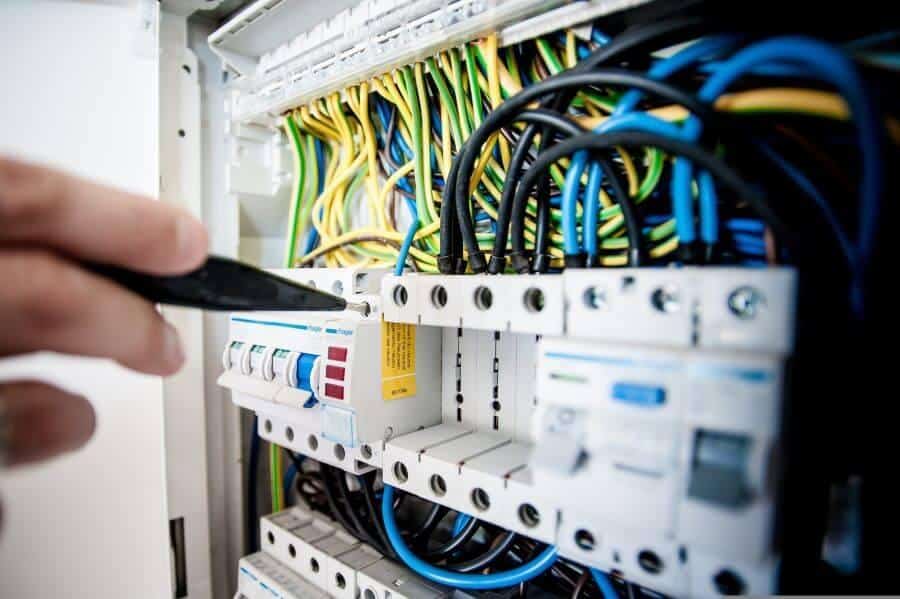
The Principles That Govern Electrical Wiring Inside a Data Center
Separation between power and signal circuits is the first non-negotiable rule. Sharing trays between low-voltage distribution and the low-current lines feeding control and monitoring produces induced noise that surfaces later as unstable readings, hard to trace once the facility is live. IEC 61439 governs the assemblies and their auxiliary circuits, UL 508A covers industrial control panels for the North American market, and ANSI/TIA-942 sets the infrastructure framework specific to data centers, from redundancy tiers to cabling administration. Working against these references means forfeiting both inspection compliance and the traceability that fault analysis depends on. Shielding practice and grounding topology follow the same logic, aimed at keeping interference out of the paths that carry critical signals.
Planning Power Distribution and Cabinet Layout for Uptime and Efficiency
Layout is decided on paper, before a single conductor is pulled. Zoning groups components by function so that power and logic never share space, containing noise propagation physically rather than correcting it afterward. Thermal management carries more weight here than in any industrial panel, because heat is the enemy of both reliability and efficiency: placing power supplies and distribution where airflow is favorable feeds directly into the facility's energy footprint. In a data center the cabinet layout is not an aesthetic choice but a lever on PUE, since orderly routing and controlled dissipation reduce the energy spent moving heat away from live equipment. Maintenance accessibility is designed upstream, so that no terminal becomes unreachable when service has to happen without taking the room down.
Choosing the Right Terminal Block System for Data Center Panels
Inside the distribution panels that feed racks, cooling, HVAC, and building automation, the terminal block system sets both assembly speed and long-term hold. The choice between screw and push-in is a trade-off between certified tightening torque and wiring time, with push-in removing torque variability and handling ferruled conductors well within the declared range. Modularity matters as much as clamping technology: jumpers for bridging, end stops, integrated fuse holders, ground terminals seated directly on the DIN rail, markers aligned to the wiring diagram. A catalog such as DIN rail terminal blocks for industrial panels lets the panel builder keep one family of compatible accessories across every cabinet in the facility, which simplifies procurement and replacement in an environment where standardization is what keeps maintenance fast. A single coherent terminal system across the installation is what turns a rack of panels into infrastructure that a technician can service without decoding a different logic at each cabinet.
Connection Technologies Compared: Screw, Push-In, Spring-Clamp, Tension-Clamp
Four connection technologies divide the field, each with a distinct profile. The screw terminal holds its lead where vibration and certified mechanical hold outweigh wiring speed. Push-in has taken the standard distribution segment through faster installation and the elimination of torque variability, provided conductors stay within the declared range. Spring-clamp offers a middle ground, adapting to flexible unferruled conductors at medium cross-sections. Tension-clamp answers mechanically stressed contexts where constant contact pressure over time is the governing parameter. The decision rests on the vibration profile, the prevailing conductor type, and the target wiring time, not on the unit price of the terminal.
Labeling, Traceability and Maintenance Readiness
A facility without coherent marking pays for it in diagnostic time, and in a data center that time is quantified against the cost of every minute offline. Systematic wire tagging, with codes tied to the updated wiring diagram and to a correspondence database, cuts mean time to repair when a fault has to be isolated under pressure. Thermal-transfer printers and automated marking remove the variability of handwritten labels that fade illegible within a service cycle. As-built documentation is released with the installation, not deferred, so the field and the drawings never diverge.
Wiring Failures That Take Data Center Infrastructure Offline
Ground loops generate voltage offsets between points that should be equipotential, and the resulting drift is exactly the kind of intermittent fault that is hardest to catch in a live facility. Crosstalk from lines run too close injects noise into control and monitoring signals. Inadequate torque on screw terminals creates hotspots that thermography reveals and that lead, under load, to conductor detachment. Flexible conductors terminated without ferrules loosen at the first significant thermal cycle, and in an environment that never powers down, that first cycle always comes.