


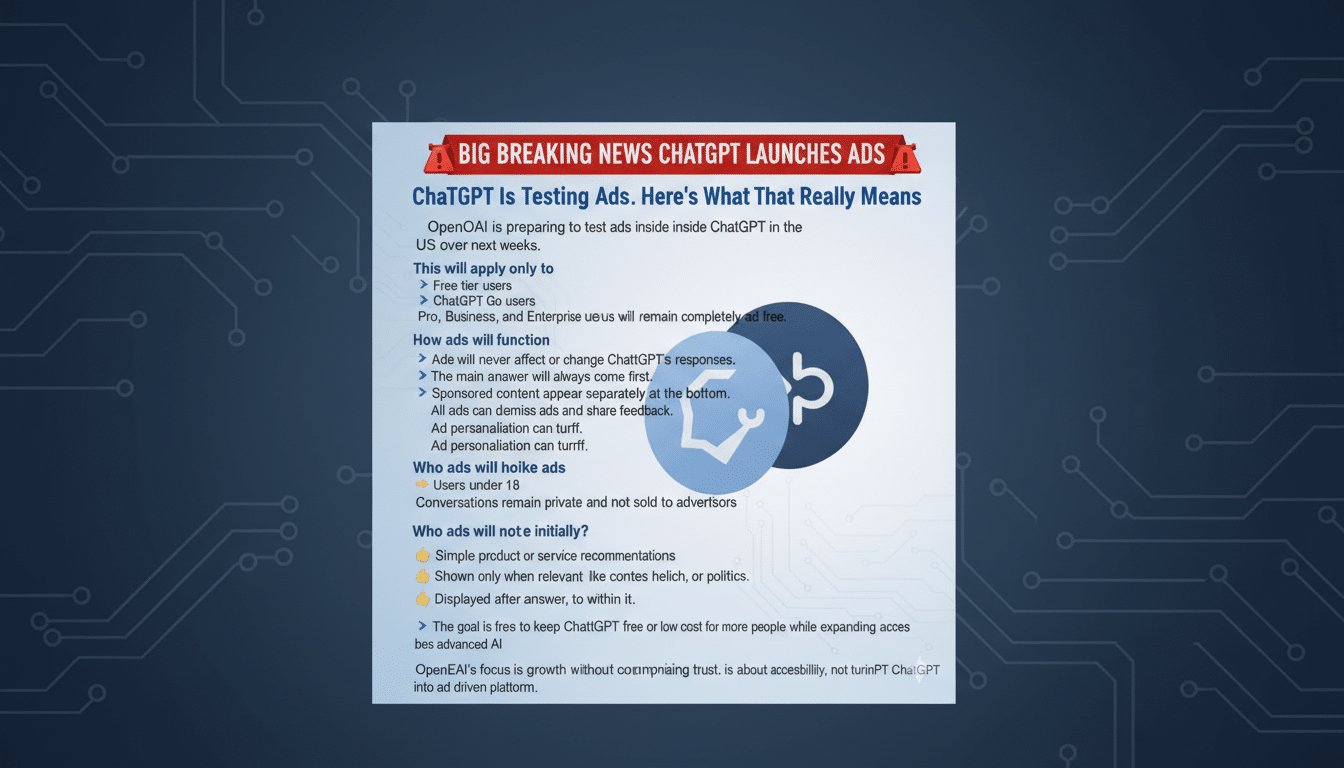
OpenAI has begun testing advertisements inside ChatGPT for users on its Free tier and its lower-cost Go plan in the U.S., marking the first major push to monetize the wildly popular AI assistant through sponsored messages. Users on Plus, Pro, Business, Enterprise, and Education plans will not see ads.
The company says ads will not shape what the model writes, and conversations will remain private from advertisers. Sponsored placements are promised to be clearly labeled and visually separated from organic responses, with controls to dismiss and provide feedback on individual ads.
- Why Ads Are Coming to ChatGPT Now, and Why They Matter
- How ChatGPT’s New Ads Will Work for Free and Go Users
- Early Backlash and Rivalry in the AI Chatbot Ad Wars
- What It Means for Users and Advertisers
- Regulatory and Trust Considerations for ChatGPT Ads
- The Road Ahead for ChatGPT’s Ad-Supported Experience
Why Ads Are Coming to ChatGPT Now, and Why They Matter
Running large AI models is expensive. Every response requires GPU time and infrastructure that doesn’t scale cheaply. While subscription revenue helps, a free product with massive usage needs another pillar. OpenAI previously cited over 100 million weekly active users, a figure that underscores both the reach and the cost burden of maintaining the service.
The Go plan, introduced recently at $8 per month in the U.S., sits below Plus and targets price-sensitive users who still want faster or more capable access than the Free tier. Keeping Free viable while funding ongoing model development is the strategic rationale behind testing ad-supported experiences.
How ChatGPT’s New Ads Will Work for Free and Go Users
OpenAI says ads are matched to context, drawing on the topic of a current conversation and a user’s prior interactions with ads to determine what could be useful. Example: Someone asking for weeknight dinner ideas might see a clearly labeled placement for a grocery delivery service or a meal kit.
Importantly, the company says advertisers will not receive personal conversation data—only aggregate performance metrics such as views and clicks. Users can review and clear their ad interaction history, manage personalization settings, and request explanations of why a particular ad was shown.
There are guardrails: no ads for users under 18 and no placements next to sensitive categories like health, politics, or mental health. These policies mirror long-standing norms in digital advertising and aim to preempt the most obvious risks when pairing sponsored content with personal queries.
Early Backlash and Rivalry in the AI Chatbot Ad Wars
Consumers are wary of ads mixing with AI answers. Late last year, early “app suggestion” experiments drew criticism for blurring the line between help and promotion. Rival Anthropic amplified those concerns with Super Bowl commercials lampooning the idea of clumsy ad insertions inside chatbots. OpenAI’s CEO blasted the spots as dishonest and took a pointed swipe at the competitor in public remarks, signaling how high the stakes have become for brand trust in this category.
OpenAI isn’t alone in testing the waters. Microsoft has run sponsored links in Copilot responses, and Google has explored commercial formats around AI-generated search results. The industry’s larger question is not whether ads will arrive, but how transparently and tastefully they’ll be executed without degrading utility.
What It Means for Users and Advertisers
For users, the experience will hinge on restraint and relevance. Clear labeling, separation from core answers, and consistent opt-outs are table stakes. If sponsored messages help discover useful services at the right moment—and stay out of sensitive contexts—the model’s value proposition can remain intact. If ads crowd answers or influence tone, trust erodes quickly.
For advertisers, AI chats are high-intent environments. Someone asking how to plan a hiking trip might be more receptive to a well-timed gear or lodging offer than in a typical social feed. But the targeting must be privacy-safe and the creative tightly matched to the prompt. Industry groups like the Interactive Advertising Bureau have long emphasized transparent native advertising; those principles will be tested in conversational UI, where the boundary between assistance and promotion is especially thin.
Regulatory and Trust Considerations for ChatGPT Ads
Regulators already scrutinize native ads and dark patterns. The U.S. Federal Trade Commission has issued guidance requiring prominent labels for sponsored content and clear disclosures that don’t blend into the interface. AI assistants raise a fresh challenge: users may treat outputs as authoritative, so any paid insertion has to be unmistakable—visually and linguistically—as advertising.
OpenAI’s rules barring ads near sensitive topics and excluding minors align with broader privacy standards, including concerns about profiling under child-protection laws. As ads scale, audits and third-party verification could help reassure the public that policies match practice.
The Road Ahead for ChatGPT’s Ad-Supported Experience
ChatGPT’s ad pilot will live or die by execution. If OpenAI keeps sponsored content scarce, relevant, and clearly marked—and if paid plans remain ad-free—the company could expand access while funding new features. But a single misstep, such as a poorly placed ad in a sensitive exchange, risks outsized backlash.
The broader market is moving toward monetizing generative AI. The winners will be those who prove they can integrate advertising without compromising the core promise of an unbiased, private, and genuinely helpful assistant.