


OpenAI is rolling out an age-prediction system for ChatGPT that gates mature content for minors, but it acknowledges the model will misclassify some users. If the system decides you look like a teen based on usage signals, your experience tightens, and you may need to prove you’re an adult with a selfie-based check via the identity firm Persona.
The feature is arriving to most accounts first, with a European launch following after additional compliance work. OpenAI says the goal is simple: reduce teen exposure to harmful topics while preserving adult access. The execution is anything but simple.
- How ChatGPT Predicts Your Age Using Behavioral Signals
- What Changes If You Are Labeled a Teen in ChatGPT
- Accuracy and the Risk of Misfires in Age Detection
- Privacy and Compliance Trade-offs in Age Verification
- Why OpenAI Is Tightening Controls for Teen Safety
- Lessons From Other Platforms on Automated Age Checks
- What Families and Users Can Do Now to Stay Informed
- What To Watch Next as OpenAI Expands Age Safeguards
How ChatGPT Predicts Your Age Using Behavioral Signals
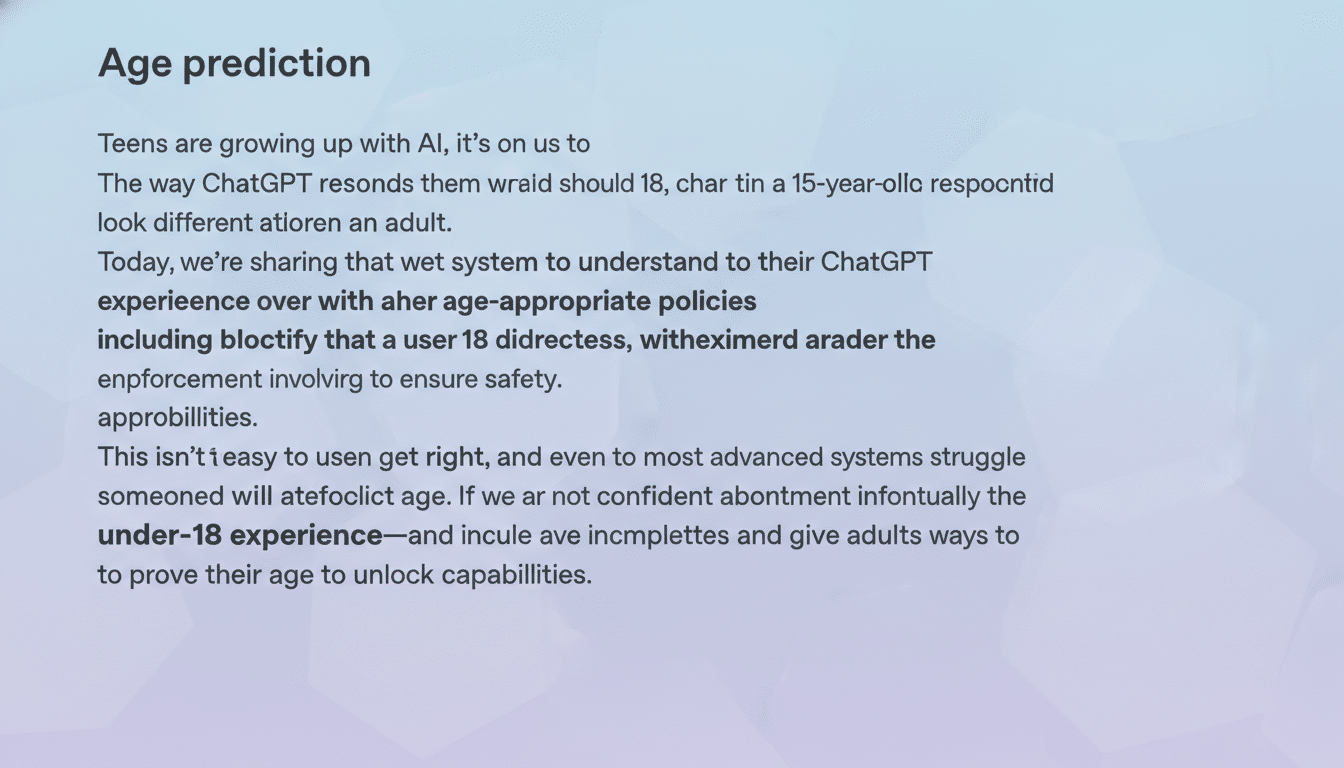
OpenAI’s system estimates whether a user is likely under 18 using cues such as how long the account has existed, typical active hours, usage patterns over time, and any age a user has previously shared. If the signals suggest “teen,” the system applies stricter safety rules by default.
Adults who are incorrectly flagged can appeal in account settings. The current path requires a selfie to confirm age through Persona, introducing a real trade-off: higher assurance for safety versus additional friction and biometric data processing.
What Changes If You Are Labeled a Teen in ChatGPT
Under the teen experience, ChatGPT treats conversations about graphic content, risky viral challenges, sex, self-harm, and unhealthy body ideals with added caution or refusal. OpenAI says it consulted the American Psychological Association and grounded responses in research on adolescent risk perception, impulse control, and emotional regulation.
The model is designed to avoid engaging in flirtatious talk with teens and to steer them away from self-harm content. Adults retain broader latitude for sensitive topics, though the system is meant to avoid step-by-step harmful instructions for everyone.
Accuracy and the Risk of Misfires in Age Detection
OpenAI has not disclosed an accuracy rate. That matters because text- and behavior-based age inference is inherently noisy. Academic work over the past decade has shown that age prediction from digital traces often misfires when people exhibit atypical hours, jargon, or niche interests that mimic younger cohorts.
The consequences are practical. Adults may see refusals on legitimate research or health queries, and they may have to upload a selfie to restore full access. Teens mislabeled as adults could encounter looser guardrails than intended. Any automated gate swings both ways.
Privacy and Compliance Trade-offs in Age Verification
Biometric verification through a vendor like Persona raises questions about retention, deletion timelines, and cross-border data handling. OpenAI says it will refine the model over time, but users will want clarity on what is stored, for how long, and who can access it.
The staged European rollout underscores regulatory pressures, including the EU’s Digital Services Act and the UK’s Age-appropriate Design Code, which expect platforms to mitigate risks to minors. In the US, COPPA and rising state-level rules add further incentives to demonstrate “reasonable” age assurance.
Why OpenAI Is Tightening Controls for Teen Safety
OpenAI faces mounting scrutiny from families, researchers, and regulators over teen safety. The Federal Trade Commission has opened an inquiry into AI companions’ effects on minors. Lawsuits have accused chatbots of mishandling self-harm conversations. To its credit, OpenAI has acknowledged tensions between privacy, free inquiry, and the need for stronger youth protections.
Competitor analyses have also raised alarms about the ease with which some models comply with dangerous requests. While vendors dispute each other’s findings, the trend is clear: stronger defaults for younger users are becoming a baseline expectation.
Lessons From Other Platforms on Automated Age Checks
Roblox’s experience is a cautionary example. Automated age checks and ID verification have struggled against real-world behavior: parents verifying children as adults, black-market account sales, and mislabeling that undermines safety goals. ChatGPT’s approach will face similar adversarial pressures from determined users.
What Families and Users Can Do Now to Stay Informed
Parents can link accounts, set quiet hours, and restrict features like voice mode and image creation. They won’t see daily transcripts, but OpenAI says it may notify guardians if systems detect acute safety risks. Families should still treat the chatbot as a tool, not a counselor, and discuss how to handle upsetting or persuasive responses.
Adults who are misclassified should use the in-app age confirmation; those uncomfortable with selfie verification can try adjusting account details and usage settings, but the current recovery path is ID-based. As investor Mark Cuban put it on social media, no parent will trust that kids can’t slip past age gates—so layered supervision remains essential.
What To Watch Next as OpenAI Expands Age Safeguards
Key indicators will be transparency on error rates, clearer policies for data retention in selfie verification, and evidence that teen protections reduce exposure to harmful content without overblocking adults. Another open question is how anonymous sessions are handled and whether sophisticated users can reliably bypass the gates.
Age checks are becoming standard across AI platforms, but precision and accountability will separate a good safeguard from a frustrating barrier. OpenAI’s system is a step toward youth safety—just be prepared for the occasional wrong turn.