


The Centers for Disease Control and Prevention has reported a sharp early-season increase in domestically acquired cyclosporiasis, a diarrheal illness caused by the microscopic parasite Cyclospora. In a July 14 health alert, the agency said it had received reports of 1,645 laboratory-confirmed domestic cases since May 1 from 34 states—far above the 249 cases reported nationally by a comparable point in 2025.
The increase has prompted public-health officials to urge clinicians to consider targeted testing, because common laboratory examinations may miss the parasite. It also overlaps with a separate Food and Drug Administration investigation of illnesses epidemiologically and traceably linked to recalled iceberg lettuce. The two tallies describe different public-health measures and should not be added together as a single national total.

National surveillance shows an unusually large seasonal increase
In its Health Alert Network advisory, CDC said the 1,645 confirmed cases were domestically acquired, meaning they were not known to be connected to travel outside the United States. The agency defines the annual U.S. cyclosporiasis season as May 1 through Aug. 31, a period when cases historically rise and often prompt investigations involving fresh produce.
The 34-state figure is the supported case-location count in the CDC alert. It should not be confused with CDC’s separate description of jurisdictions where cyclosporiasis is reportable: 47 states, the District of Columbia and New York City. A reporting requirement does not indicate that confirmed cases occurred in each of those places.
CDC said it also knew of more than 5,100 additional reports that required analysis before officials could determine whether they represented domestically acquired cyclosporiasis. That backlog is one reason a surveillance number is a snapshot rather than a final accounting. The agency also cautioned that the actual number of illnesses is probably higher because infections can be underdiagnosed and underreported.
Of the 1,645 confirmed domestic cases with hospitalization information available, 141 people, or 9%, were hospitalized, CDC said. It reported no deaths in that group. The hospitalization measure does not show how severe every reported illness was, but it underscores that the infection can lead to substantial illness, particularly when diarrhea causes dehydration.
FDA’s lettuce investigation is a separate, later count
On Aug. 20, the FDA updated its outbreak investigation to 10,930 reported illnesses in 17 states, including 454 hospitalizations and two reported deaths. The agency said epidemiologic interviews and traceback information pointed to shredded iceberg lettuce sourced from growers in central Mexico and supplied by Taylor Farms de Mexico.
Those numbers are much larger than CDC’s July 14 count, but they do not replace it or provide a like-for-like comparison. CDC’s figure was a nationwide surveillance total of laboratory-confirmed domestic infections at one point in the season. FDA’s figure, published more than five weeks later, concerns a defined multistate outbreak investigation. Investigators can add cases as reports arrive and as they decide whether illnesses fit the outbreak pattern.
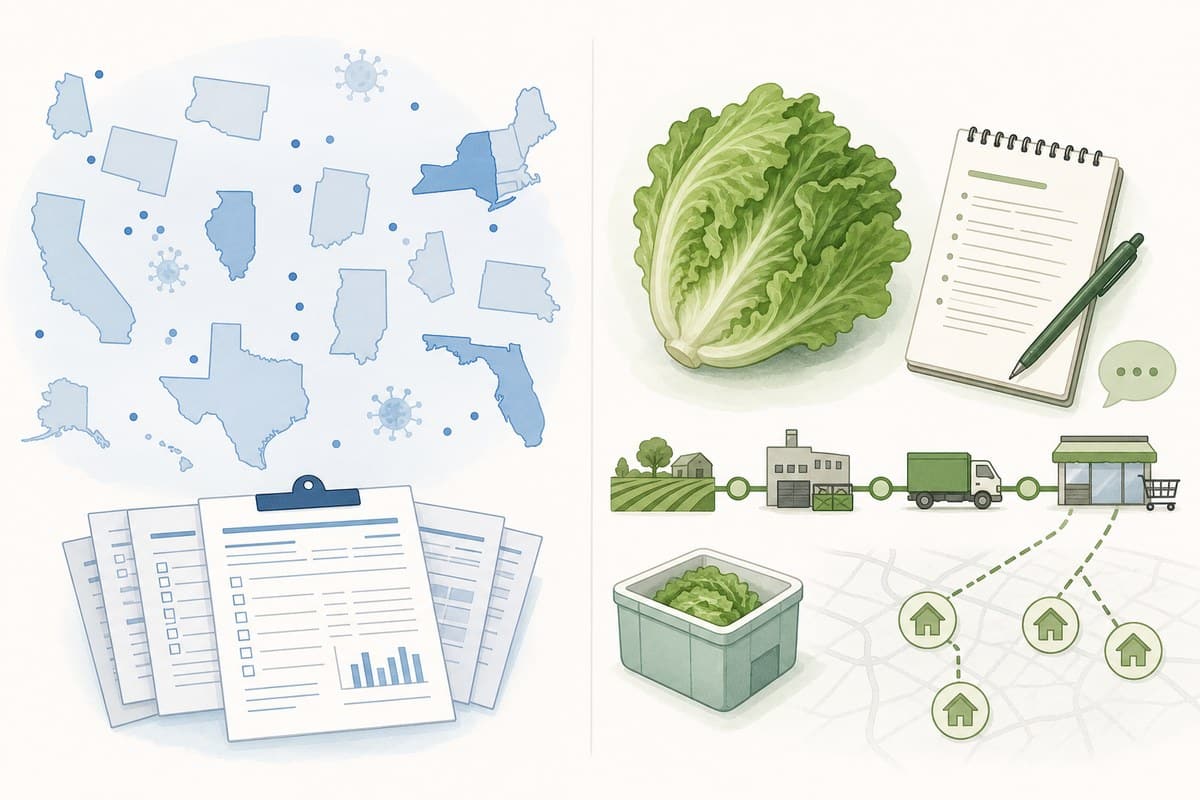
Taylor Farms de Mexico voluntarily removed implicated iceberg lettuce from the U.S. market and initiated a recall on July 17, according to FDA. The regulator’s attribution is based on the convergence of epidemiologic and traceback evidence, rather than a confirmed finding of the parasite in a tested lettuce product. FDA said an earlier reported positive lettuce sample was determined on review to be a false positive, and that it had no confirmed positive Cyclospora product-test results as of July 19.
That does not negate the food-safety investigation; epidemiologic and traceback evidence can identify a likely common source even when laboratory testing of a product is negative or unavailable. But it limits what can be concluded from the testing record. The investigation supports a link between the defined outbreak and implicated lettuce, not a finding that every domestic case recorded during the broader seasonal surge came from that product.
FDA said the two deaths occurred in Michigan. Both people had significant underlying health conditions that may have been adversely affected by cyclosporiasis and dehydration, the agency said. The agency did not state that the infection alone caused either death.
Why diagnosis and case matching can take time
Cyclosporiasis commonly causes watery diarrhea, with symptoms that may also include loss of appetite, weight loss, bloating, nausea and fatigue. CDC said symptoms generally begin about a week after exposure, though they can occur two to 14 days afterward. Illness can be prolonged or relapse after seeming to improve.
Routine ova-and-parasite examinations may not reliably detect Cyclospora, CDC said. The agency advised clinicians to specifically request testing for the parasite when the illness and exposure history make it clinically plausible. That testing limitation can delay diagnosis and complicate efforts to determine whether cases scattered across states share a source.
North Carolina illustrates how an outbreak picture can change as evidence develops. On July 14, the state had reported 307 cyclosporiasis cases and 13 hospitalizations since May 1. The North Carolina Department of Health and Human Services said then that most of its cases had no common source and had not been linked to outbreaks in other states. FDA later added North Carolina to its lettuce-associated investigation on Aug. 5.
The changing classification does not mean the earlier state assessment was necessarily wrong. It reflects the time required to interview patients, compare food histories, trace supply chains and determine which illnesses meet the definition of a particular outbreak. CDC’s alert, meanwhile, indicates that the broader seasonal rise includes confirmed infections still being evaluated for possible connections.