


California voters have approved Proposition 38, authorizing the state to issue up to $8.4 billion in general-obligation bonds for immunology and immunotherapy research. As bonds are issued, the borrowing would create debt-service costs for the state, while providing a new public financing stream for research related to cancer, heart disease and Alzheimer’s disease.
The Associated Press called the measure’s passage with roughly 54% voting yes and 46% no, according to CalMatters and the Los Angeles Times. Those were reported election-night figures, not a final certified statewide canvass. Implementation will determine how the money is allocated, what discoveries emerge and whether any eventual revenue offsets a portion of the state’s costs.

What Proposition 38 funds
Under the California Legislative Analyst’s Office analysis, at least $4.2 billion of the bond proceeds must support immunology research involving cancer, heart disease and Alzheimer’s disease. The measure broadly supports work on the immune system and treatments designed to modify or direct immune responses, a field that spans early laboratory science, drug development and clinical research.
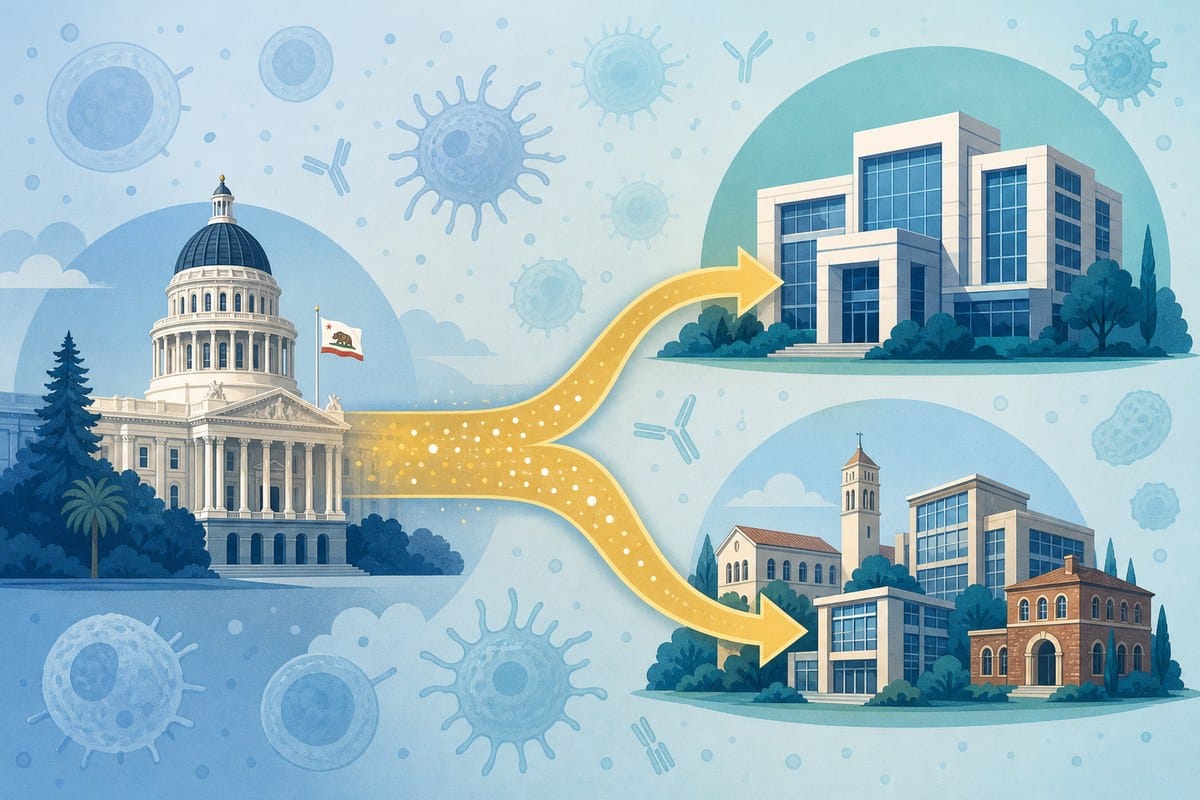
About half of the bond authority is designated for a qualifying immunology and immunotherapy research institute to be selected by the California Department of Public Health. The other half is to be distributed through competitive grants overseen by a council involving University of California campuses and other California universities and research institutions.
CalMatters and the Los Angeles Times reported that the California Institute for Immunology and Immunotherapy was the only institute then identified as meeting the ballot measure’s eligibility standards. That reporting does not mean the institute has been selected: the Department of Public Health is directed to make the formal selection.
The ballot measure also includes a return-to-state provision. It requires 10% of revenue generated from research funded under the program to be paid to California, first to the General Fund until bond costs are repaid. But the analyst’s office says both the amount and timing of any such revenue are uncertain. Research discoveries may never produce a marketable product, and commercial development can take many years.
Borrowing authority and repayment costs
The $8.4 billion figure is the maximum principal amount California may borrow, not the total cost to taxpayers. The legislative analyst estimates that repaying principal and interest would cost the state General Fund about $500 million to $600 million each year for roughly 20 years. General-obligation bonds are repaid from the state’s broad tax revenues, as explained in the state’s overview of bond debt.
Debt service becomes an obligation as bonds are issued. The revenue-sharing provision could produce payments to the state, but it does not guarantee that research revenues will equal borrowing costs or arrive on a timetable useful for annual budgets.
Supporters argued that the program would expand California’s research capacity and help turn immunology discoveries into treatments. In a post-election statement, the Yes on 38 campaign said the measure would support a statewide research network and cited what it described as disruption from federal research-funding cuts. Those are prospective claims, not demonstrated health outcomes from the bond.
What the vote cannot establish about future care
Immunology has contributed to therapies that help some patients with cancer and autoimmune disease, but funding a research field is not equivalent to funding treatments with known benefits. Proposition 38 does not itself approve drugs, change standards of care or establish that new therapies will reduce health-care spending.
The state analyst’s office notes that most medical research projects do not make it through every stage from basic research to clinical development and regulatory approval. The measure can support research at different stages, but it does not establish future cures, savings or self-financing.
As implementation begins, California will face accountability questions about institute selection, competitive-grant decisions, spending and any revenue returned to the state. Clinical and fiscal results will depend on future decisions and discoveries.