


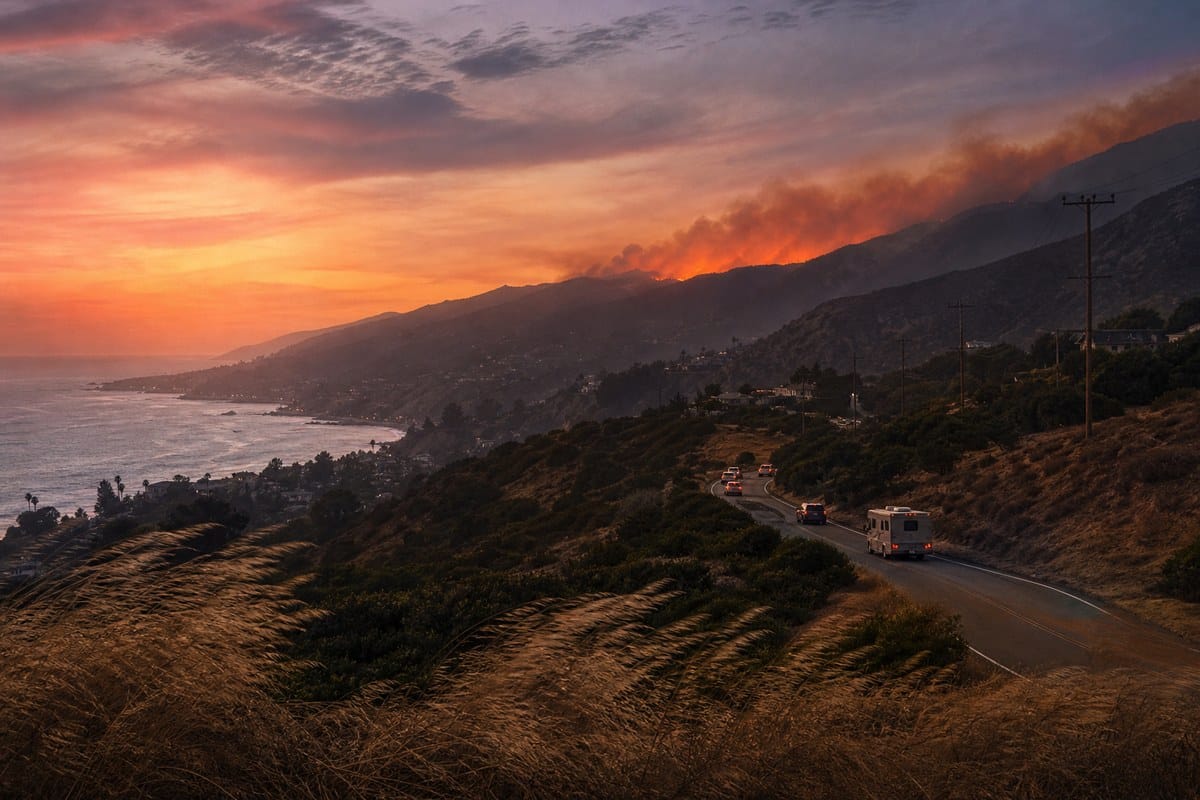
The Bryson Fire in Malibu was 147 acres and 39% contained by Friday evening, Oct. 16, after prompting evacuation orders and warnings during a period of hot, dry, windy weather in the Santa Monica Mountains. A small number of residents remained under evacuation orders, according to the Los Angeles Times.
The improvement in containment was a meaningful operational shift from morning reports, but it did not signal that the fire was out. A Red Flag Warning for Los Angeles and Ventura counties was scheduled to remain in effect through 8 p.m. Saturday, Oct. 17, as Santa Ana winds, low humidity and unusually high temperatures continued to elevate the chance that any new fire could spread quickly.
Containment rose as acreage held steady
The fire began around 5 p.m. Thursday near Encinal Canyon Road and the Camp Kilpatrick area, then expanded through brush as offshore winds blew across the region. Early accounts described a blaze of more than 100 acres; by Friday morning, local reports put it at about 147 acres and 17% contained.
Those figures can seem contradictory beside the later 39% containment estimate, but they reflect the changing status of an active incident rather than competing descriptions of the same moment. The acreage remained at 147 acres in the later update, while firefighters increased the portion of the perimeter they considered contained. Containment generally means crews have built and expect to hold lines around a percentage of the fire’s edge; it does not mean flames have stopped everywhere within that boundary or that fire weather no longer poses a risk.
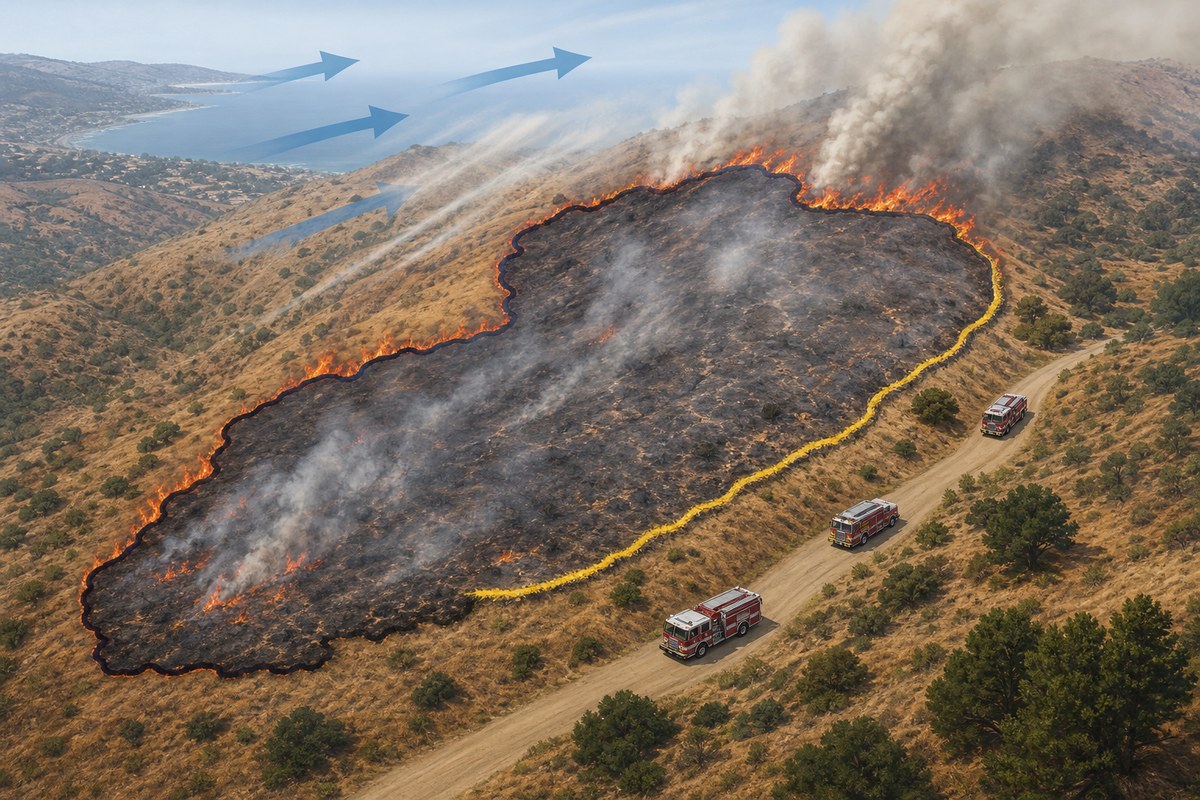
FOX 11 Los Angeles, citing a Cal Fire update and county officials, reported Friday morning that more than 414 firefighters and over 75 ground and aerial resources had been assigned. The station also reported that roughly 100 structures were threatened at that point and that no property damage or destruction had been reported. Those structure and resource counts are incident-specific snapshots that can change as crews map the fire and reassess exposure.
Los Angeles County Fire Chief Anthony Marrone said one firefighter had sustained a minor injury and was taken to a hospital as a precaution, FOX 11 reported. The cause of the fire had not been identified in reporting published Friday, and the available accounts do not establish whether weather, equipment, human activity or another factor was involved in the ignition.
Evacuations and closures extended beyond the fire line
Authorities issued evacuation orders and warnings in the Malibu area as the fire spread. Roads closed during the response included Decker Road at Encinal Canyon Road, Kanan Road at Mulholland Highway, and Mulholland Highway at Westlake Boulevard, according to FOX 11. Evacuation boundaries, road access and return rules can change rapidly during a fire, particularly when winds shift, so residents should rely on current instructions from local emergency authorities rather than earlier maps or social-media posts.
The fire also threatened the Los Angeles County juvenile detention and rehabilitative facility near the ignition area, according to an Associated Press report published by the Santa Monica Daily Press. That earlier report captured the initial expansion beyond 100 acres, before the later 147-acre mapping and containment update.
Wildfire response in the mountains is shaped by more than the size of the burned area. Narrow, winding roads can affect evacuation routes and access for engines; steep terrain and dense vegetation can make direct suppression difficult. Aircraft can help cool hot spots and slow advance, but their usefulness can be constrained by wind, smoke, visibility and aircraft safety rules. Those factors help explain why agencies often order evacuations before a fire reaches developed areas.
Weather and preventive outages created overlapping risks
The Bryson Fire occurred as Southern California Edison carried out precautionary power shutoffs intended to reduce ignition risk during dangerous wind conditions. The Los Angeles Times reported that more than 130,000 customers across the utility’s service area were without power, including about 57,000 households in Los Angeles County.
Such shutoffs are a preventive measure, not evidence that electrical equipment caused the Bryson Fire. They can nevertheless add practical challenges during a heat and wildfire emergency, including loss of air conditioning, refrigeration, communications and charging capacity. People who depend on powered medical equipment or refrigerated medications may face particular difficulties, although the reported outage totals do not indicate how many medically vulnerable customers were affected.
Heat, low humidity and Santa Ana winds can dry vegetation and carry embers ahead of a fire, increasing the likelihood that spot fires will form beyond the main flame front. The conditions reported around Malibu are consistent with heightened fire behavior and more difficult suppression. They do not, on their own, explain how this specific fire began.
The episode came less than two years after the destructive January 2025 Palisades Fire, a recent disaster that left Malibu-area communities especially alert to evacuation warnings and fast-moving weather changes. But each fire differs in ignition source, fuels, terrain, wind patterns and the defenses available at the time. The immediate facts for the Bryson Fire remained more limited: its perimeter was not fully contained, evacuation measures were still in place for some residents, and investigators had not determined a cause.