


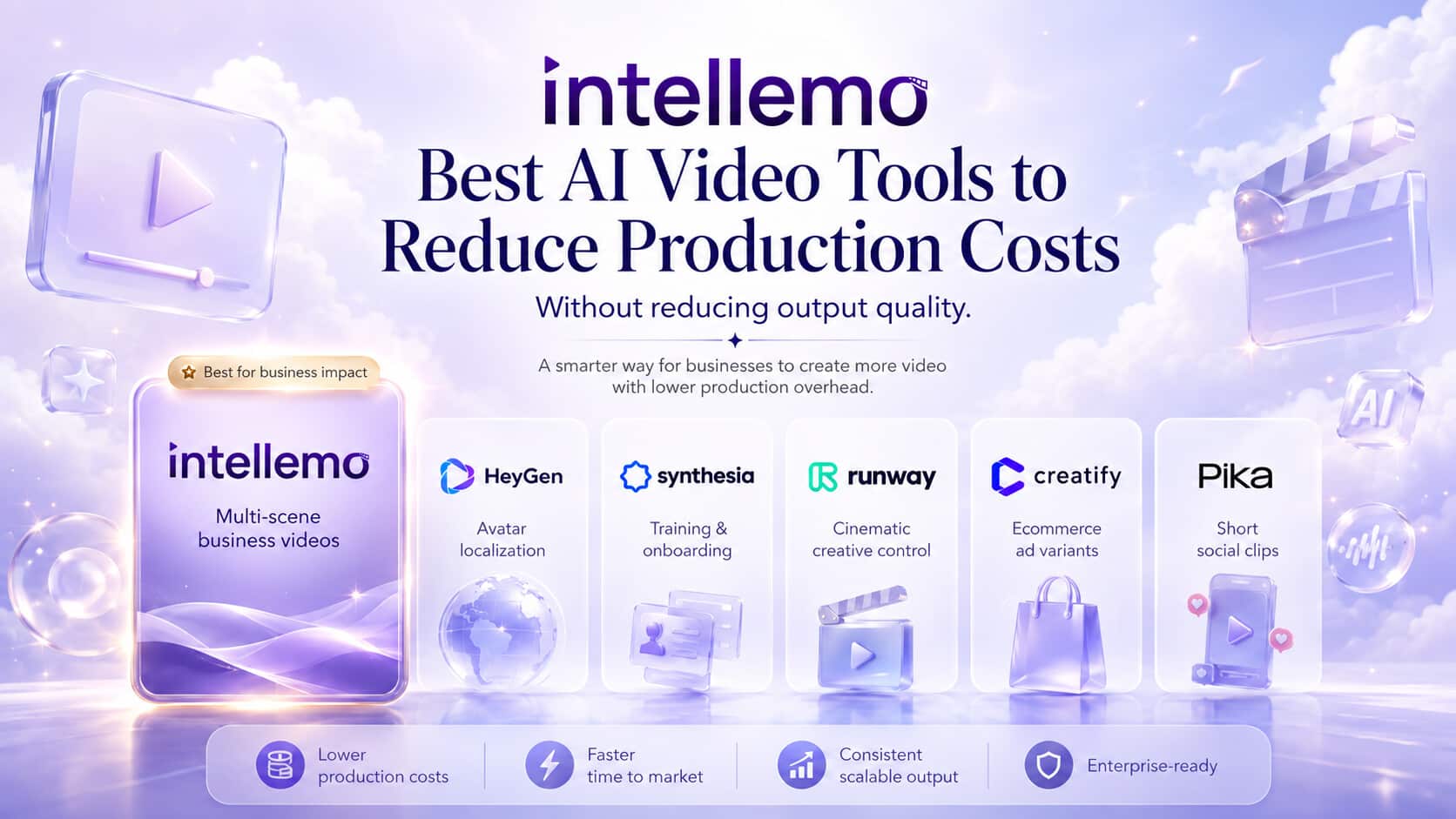
There used to be a time when video was one of the most costly marketing expenses. One product video meant a crew, rentals, editing time, and then additional editing time for the client’s requests for changes. There’s some math that’s changed as businesses are making the same amount of video or more but investing a smaller amount to produce them. The transition is not about compromising on standards but about improving them. It’s more about the way video is produced in the first place, rather than the manual, hour-a-time approach, and moving towards one that incorporates scripting, visuals, voice, and editing all in one. If your team is looking to make that jump, here are six platforms you should know about.
1. Intellemo AI
The core concept behind Intellemo AI is the notion that a business shouldn’t require an entire production team to produce a completed, multi-scene video from a single concept. The platform is quick and processes a prompt through a system of script writing, scene planning, storyboard generation, shot creation, dialogue, background sound, and lip sync. It can also start from a website URL, using available brand information and assets to understand the business context before developing the script and video. AI-generated music can be incorporated within the same production workflow rather than handled through a separate tool.
The video that comes out on the other end has been reviewed at each stage, so you won’t have to worry about weak shots or inconsistent scenes. The workflow includes review points for the script, Audioboard and Storyboard, allowing narration to be checked and individual visual scenes to be revised before final production.
This is where the cost-efficiency of Intellemo AI ad video generator becomes apparent. In place of a complicated process that involves loss of credits at every step, Intellemo ensures you are charged according to your paid plan based on the video clips generated. Middle steps such as creation of elements, creation of scenes, automatic model selection, and clip creation, among other outputs of the production stage, do not involve separate charges.
This structure does not slow anything down on the delivery side. A business can still produce several different videos within minutes of each other, each one running through the full script, storyboard, and quality-review pipeline, without watching the cost climb for every intermediate stage along the way. For marketing teams producing several videos a month, that combination of speed and predictable cost per output can make a practical difference.
2. HeyGen
HeyGen is all about avatar-based video, and one of its greatest assets for businesses that are budget-friendly is language support. A single script can be localized in dozens of languages, with the accompanying lip sync, without having to hire separate voice actors and dubbing facilities for each market. It is critical for a sales team or for global marketing departments when they must convey the same message to different audiences without having to shoot anything again.
The avatars themselves are good enough for external-facing content, and the platform integrates narration and translation within a single workflow instead of handoff between tools. For a company also having a campaign going on in ten regions, that’s a significant decrease in production cost. It’s not the best choice for video that’s intended to be viewed in film settings or is highly stylized, but for repeatable, message-driven video that is meant to be viewed on a large number of occasions, the savings are that you won’t need a localization vendor at all.
3. Synthesia
Synthesia takes a unique approach to a different type of business need: longer, slower-paced video, like training modules, onboarding, and internal communications. Avatars are in a traditional speaker-to-camera position, ideal for compliance training and internal updates, but not as much as social-first content. It also has connectivity for learning management systems, allowing a training department to directly connect the video it produces to the existing training structures.
For businesses that work with teams spread out in various nations, this solution usually supersedes the need to have a complete in-house video staff. Rather than hiring a videographer for each policy change, a group can create a uniform on-brand video in a much shorter amount of time. However, the downside is that Synthesia isn’t designed to create punchy marketing content, which is typically combined with an external tool geared towards customer-facing material.
4. Runway
Runway is the choice for teams that need real creative control over how a video looks, not just what it says. It gives users control over camera movement, lighting, and scene composition, which makes it a better fit for cinematic brand films and campaign visuals where the footage itself needs to feel premium. Agencies producing polished creative work for clients tend to reach for Runway when a templated avatar simply will not carry the visual weight the brief calls for.
The learning curve is steeper than avatar-based platforms, so it works best when someone on the team is comfortable directing shots rather than relying on default settings. The cost savings here come less from speed and more from not needing a full film crew and post-production house to get a cinematic result. For businesses producing a handful of high-impact videos a year rather than dozens of quick ones, that tradeoff usually makes sense.
5. Creatify
Creatify is built for volume, specifically the kind of volume that direct-to-consumer brands and performance marketing agencies need. It can pull product visuals directly from a landing page and generate ad variants across different formats and aspect ratios without starting from scratch each time. For e-commerce teams running paid social campaigns, this is where the cost math changes the most.
Ad creative fatigues fast on platforms like Meta and TikTok, and refreshing a winning ad used to mean another round of shooting or editing. With Creatify, swapping the hook, the actor, or the background and producing new variants happens in minutes rather than days. That turnaround speed is what keeps a paid social account profitable instead of watching performance decay while a new creative gets produced the traditional way.
6. Pika
Pika is built for short, fast, social-first content rather than long-form or brand-heavy video. It includes effects for transforming elements within a clip and swapping specific parts of a scene, which makes it useful for businesses that need quick, attention-grabbing content for platforms like Instagram Reels or TikTok. The output is not meant to carry a full campaign on its own.
Where Pika earns its place in a business toolkit is speed and low cost per clip. A social media team that needs to test several creative ideas in a single week can do so without booking any production time at all. It is not the tool for consistent, long-running brand video, but for disposable, high-frequency social content, it keeps both cost and turnaround time low.
Choosing the Right Tool for Your Budget
Picking the right platform comes down to matching the tool to the type of video a business actually produces most often, rather than picking whichever one looks the most impressive in a demo. A few things worth considering before committing to one:
- How often does the content need to change? High-frequency social content has very different cost drivers than a training video that gets used for a year.
- Does the video need to stay consistent across a campaign? Character, product, and location consistency matter more for brand storytelling than for one-off clips.
- Is the audience internal or external? Internal training tolerates a simpler visual style. Customer-facing content usually needs more polish.
- What does the pricing model actually charge for? Some platforms charge per generation attempt; others charge per final output. That difference adds up quickly at scale.
Most businesses end up using more than one platform, choosing based on the content type rather than trying to force every video through a single tool.
FAQs
Do AI video tools actually reduce costs compared to hiring a production team?
Yes, for most repeatable video formats. Businesses save on crew, studio time, and revision cycles, though highly custom or one-off cinematic projects may still benefit from traditional production.
Can these tools maintain brand consistency across multiple videos?
Some platforms like Intellemo AI support saved references for characters, products, and logos, which helps keep the same look and voice across a full campaign instead of starting from scratch every time a new video is needed.
Does a lower-cost AI video tool mean lower quality output? Not necessarily. Cost differences usually come down to what is being billed, such as final output only versus every generation attempt, rather than a direct tradeoff with quality.
Moving Forward
The gap between AI-assisted video production and traditional production budgets is not closing. It is widening, and the businesses seeing the biggest gains are the ones treating these platforms as proper production systems rather than one-off generators. That means understanding what each tool actually charges for, matching the right platform to the right content type, and building a workflow around it instead of testing one video and hoping it scales. As more of these tools clarify their pricing and add stronger consistency features, the cost argument for sticking with traditional production keeps getting harder to make.