


The human urge to wager on the unknown is as old as civilization itself. Long before the invention of intricate card decks or precision-weighted dice, our ancestors looked to the simplest objects in their environment to settle disputes and test their luck. In the ancient world, the concept of “chance” was often inextricably linked to divine will. Whether it was the toss of a marked stone or the flip of a shell, the outcome was seen not as a mathematical probability, but as a direct message from the gods.
The most enduring of these early games is undoubtedly the coin toss. While modern players often focus on the complex algorithms of a digital platform, the fundamental thrill remains the same as it was thousands of years ago. Enthusiasts who appreciate the history of wagering often seek out modern environments that reflect this legacy of fairness and clarity. Platforms such as Live Casino Xon Bet highlight transparent mechanics and straightforward outcomes that echo the simple nature of ancient chance games. By prioritizing accessibility and clear rules, contemporary casino experiences help preserve the spirit of the earliest forms of gambling.
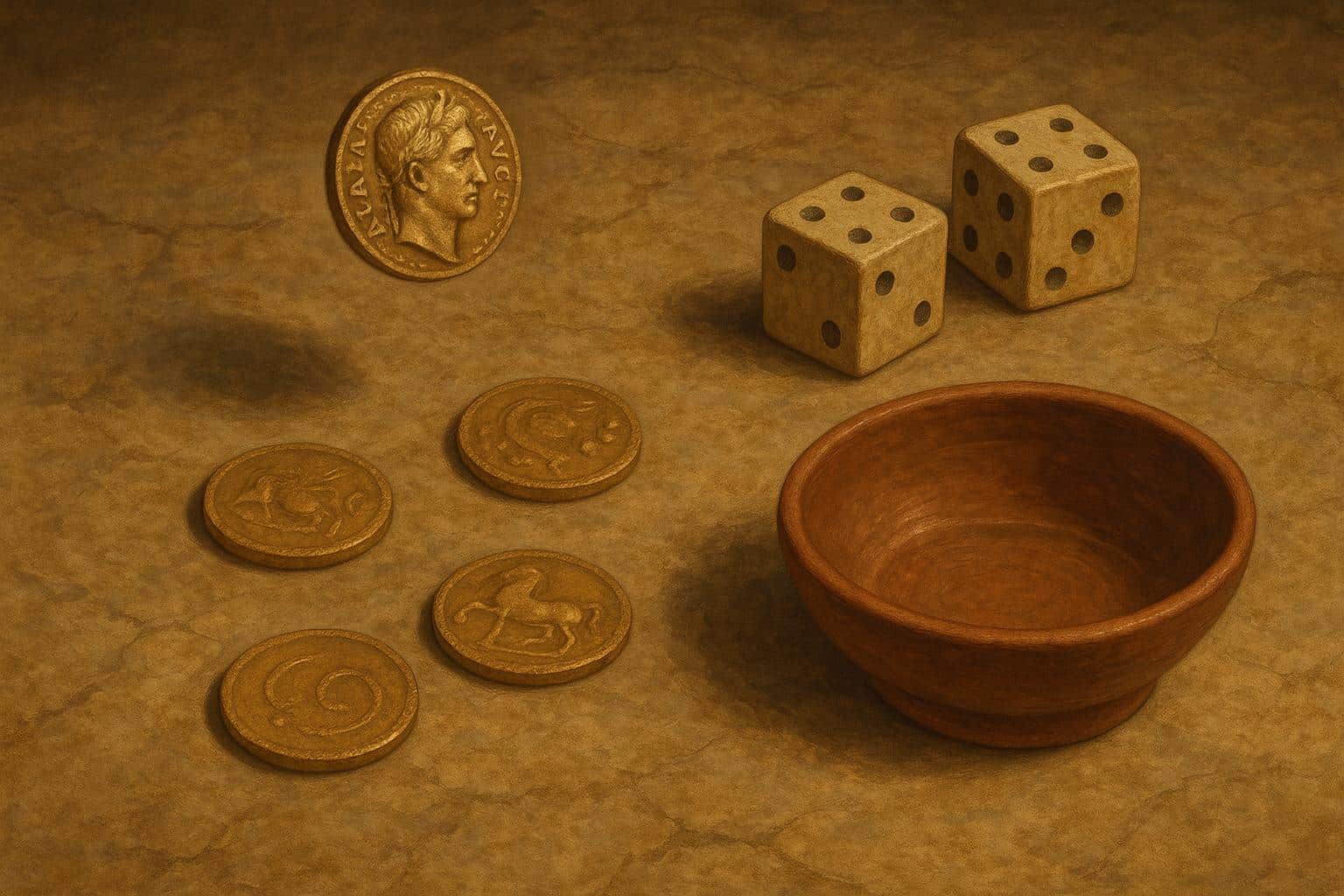
As coinage became a standard part of trade in the 7th century BC, the “heads or tails” mechanic evolved from using natural objects to utilizing minted currency. This shift turned a simple decision-making tool into a formalized gambling pastime that permeated every level of society, from the bustling marketplaces of Greece to the imperial palaces of Rome.
Navia aut Caput: The Roman Obsession
In Ancient Rome, the practice of flipping a coin was known as navia aut caput, which literally means “ship or head.” This name was derived from the common design of early Roman bronze coins, which frequently featured the two-faced god Janus on the obverse and the prow of a galley ship on the reverse. Unlike modern sports, where a coin toss simply decides who goes first, the Romans used the practice to settle legal disputes, determine property ownership, and engage in high-stakes wagering.
The Roman elite were particularly fond of this game, often viewing the outcome as an omen of the Emperor’s favor. Legend suggests that Julius Caesar himself would occasionally settle judicial stalemates with a flip, believing that the “head” of the coin represented the state’s divine approval.
To understand the evolution of this game, it is helpful to compare how the coin toss has changed over the centuries:
| Era | Primary Name | Equipment Used | Purpose |
|---|---|---|---|
| Ancient Greece | Ostrakinda | Shells (Black/White) | Children’s games and minor bets. |
| Ancient Rome | Navia aut Caput | Bronze Sestertii | Legal disputes and elite gambling. |
| Middle Ages | Cross and Pile | Silver Pennies | Settling accounts and street games. |
| Modern Day | Heads or Tails | Standard Currency | Sports starts and binary decisions. |
This historical progression shows that while the “hardware” of gambling has improved—moving from shells to minted bronze and eventually to digital credits—the psychological core of the game remains untouched. The human brain is still wired to feel the same rush of dopamine when a rotating object finally comes to a rest.
From Shells to Knucklebones
Before the widespread availability of metal coins, ancient cultures utilized whatever was at hand. In Greece, a popular precursor involved coating one side of a seashell with black pitch and leaving the other white. Players would toss the shell into the air, and the color facing up would determine the winner. This “binary” form of gambling was the direct ancestor of the coin flip, providing a clear, indisputable result that required no complex scoring.
Another significant step in the evolution of gambling was the use of astragali, or knucklebones. While these functioned more like proto-dice, they shared the coin toss’s reliance on physical “casting.” Players would throw four knucklebones at once, hoping for the “Venus Throw”—an outcome where each bone landed on a different side. This transition from one-sided objects to multi-faceted bones eventually led to the development of the six-sided dice we recognize today.
The transition between these different tools highlights a fascinating trend in human history:
- Simplicity: The earliest games required almost no setup and could be played by anyone, regardless of wealth.
- Symbolism: Coins and shells were often imbued with religious meaning, making the gamble feel like an act of faith.
- Portability: These games were the original “mobile” entertainment, easily carried in a pouch or pocket across borders.
By the time playing cards appeared in the 9th century, the cultural foundation for gambling was already rock-solid, thanks to these early “toss” mechanics. The move toward cards and dice simply added layers of strategy to what was originally a pure test of fate.
The Psychological Legacy of the Flip
Why has the coin toss survived for over two millennia when so many other ancient games have vanished? The answer lies in its perfect balance of speed and finality. In a world that can be frustratingly complex, the coin toss offers a moment of absolute clarity. It removes the burden of choice and places the responsibility on the shoulders of luck—a concept that remains as seductive in 2026 as it was in 200 BC.
Modern gaming continues to draw on this psychological heritage. Even the most advanced video slots or table games are, at their base, sophisticated versions of the coin flip. They provide a quick result, a clear outcome, and the opportunity to “try again,” creating a cycle of engagement that has defined human recreation for as long as we have had something to wager.
Understanding the Roots of Modern Gaming
The journey from the Roman “heads or ships” to the high-tech gaming of today is a testament to the enduring nature of human curiosity. By understanding the simple origins of coin toss gambling, we gain a better appreciation for the complex systems we enjoy today. Whether you are flipping a sestertius in a Roman forum or engaging with a modern interface, the thrill of the “catch” remains one of our most ancient and shared experiences.