


The Bank of England held its benchmark interest rate at 3.75% but revealed a more divided Monetary Policy Committee, with three members voting for an immediate quarter-point increase. The Sept. 17 decision leaves borrowing costs unchanged for now, yet the split vote and a higher inflation outlook underline the pressure confronting U.K. policymakers as energy prices rise.
The MPC voted 6-3 at its meeting ending Sept. 16 to maintain Bank Rate, according to the Bank of England’s September monetary-policy summary and minutes. In a separate unanimous decision, the committee approved a multiyear plan to reduce the Bank’s monetary-policy holdings of U.K. government bonds, or gilts, to zero by the end of 2034.

Inflation forecast moves further from target
Consumer-price inflation stood at 3.1% in August, well above the Bank’s 2% target. The central bank now expects inflation to climb to about 3.75% in the fourth quarter and to slightly above 4% in the first quarter of 2027. Those forecasts would put inflation roughly 1.75 percentage points above target late this year and more than two percentage points above target early next year.
The projections are not current inflation readings. They are conditional forecasts using energy-price assumptions available on Sept. 14, when the Bank cited Brent crude at $106 a barrel and U.K. wholesale gas at 207 pence per therm. The MPC said higher and volatile energy prices, amid protracted conflict in the Middle East as well as conflict involving Ukraine and Russia, had become a major source of uncertainty and were directly adding to the expected inflation overshoot.
Officials said risks around their inflation projection were tilted to the upside, more so than in the July Monetary Policy Report. At the same time, the minutes said there was little evidence so far that the energy shock had generated material second-round effects in domestic wage and price setting. That assessment helps explain why a majority chose to wait rather than raise rates immediately, without establishing that the six members who backed a hold would oppose an increase at a later meeting.
The MPC said it would remain focused on signs that higher energy costs were feeding into broader inflation persistence, including pay-setting and companies’ pricing behavior. It said policy would be set to return inflation sustainably to target, and that it stood ready to act as necessary. That is a contingency statement, not a commitment to a future rate increase.
A hold that markets had anticipated becomes a divided decision
The decision itself had been widely anticipated. The Bank said nearly all respondents to its September Market Participants Survey, which closed Sept. 4, expected no change in Bank Rate at this meeting. The official result nevertheless contained a clearer near-term tightening signal than a unanimous hold would have: one-third of voting members favored taking Bank Rate to 4% immediately.
Financial markets saw an increase at one of the next two meetings as more likely than not, according to ABC News coverage of the decision and market expectations. Such pricing reflects investors’ estimates of future policy, rather than a forecast endorsed by the Bank. The MPC’s own published position is narrower: inflation risks have risen, evidence of domestic persistence remains limited so far, and the committee will respond to incoming data.
The timing also clarifies the evolution of the decision. The Bank’s market survey closed before its Sept. 14 energy-price reference point. The MPC completed its deliberations on Sept. 16, and the Bank published the vote, forecasts and balance-sheet decision the following day. For households and companies, Bank Rate remains the immediate reference point for many variable borrowing rates and for the pricing of new credit, while the inflation forecast will shape expectations for where those costs may go.
The balance-sheet plan is separate from Bank Rate
Alongside the rate vote, the MPC unanimously agreed to eliminate the Bank’s stock of monetary-policy gilt holdings through a plan extending to the end of 2034. The Bank described the intended pace as an average £46 billion a year, including £20 billion of annual gilt sales as bonds also mature.
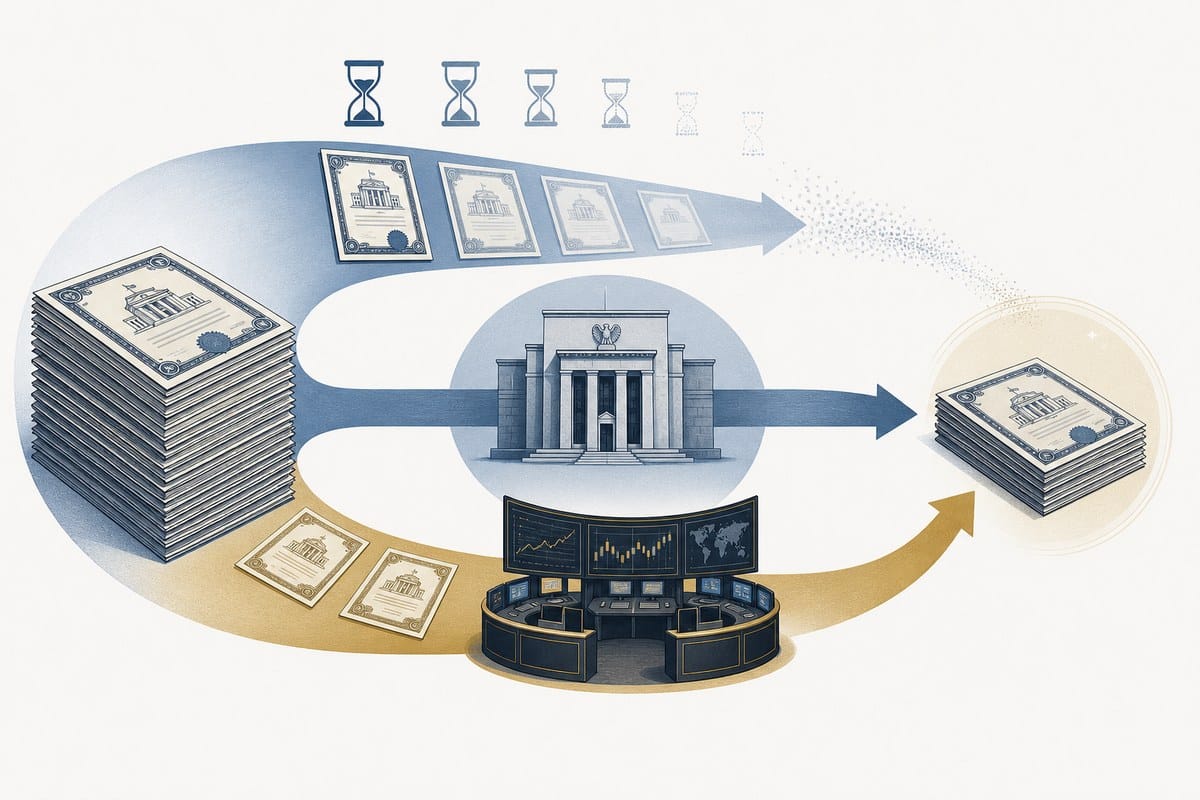
The two instruments work differently. Bank Rate is the policy interest rate that directly influences the cost of short-term borrowing across the financial system. Quantitative tightening reduces the central bank’s bond portfolio: gilts can leave the balance sheet when they mature and are not replaced, or through active sales. The £20 billion sales component means the programme does not rely solely on maturities, while the overall £46 billion annual pace incorporates both channels.
The decision therefore separates the committee’s near-term judgment on interest rates from its longer-term plan for assets accumulated under earlier monetary-policy operations. The rate was held in a divided vote; the runoff plan was unanimous. By setting a route to zero holdings through 2034, the Bank has supplied a concrete timetable for the eventual withdrawal of this part of its monetary-policy balance sheet, even as the outlook for Bank Rate will remain dependent on inflation, energy markets and evidence from wages and prices.