


Renewed wage protests in Bangladesh forced 679 garment factories to suspend production on Nov. 2, reversing a brief reopening and widening a disruption in an industry that supplies global apparel buyers. The closures followed road blockades and clashes with police in and around Dhaka, Ashulia and Gazipur, according to CNA reporting.
The immediate dispute is over pay, but the commercial exposure is far broader. Bangladesh’s ready-made-garment industry employs about 4 million people, generates more than 80% of the country’s export earnings and contributes roughly 10% of economic output. A prolonged loss of factory time could interfere with production schedules for international buyers, although delayed shipments and lost orders had not been established as outcomes in the reports.
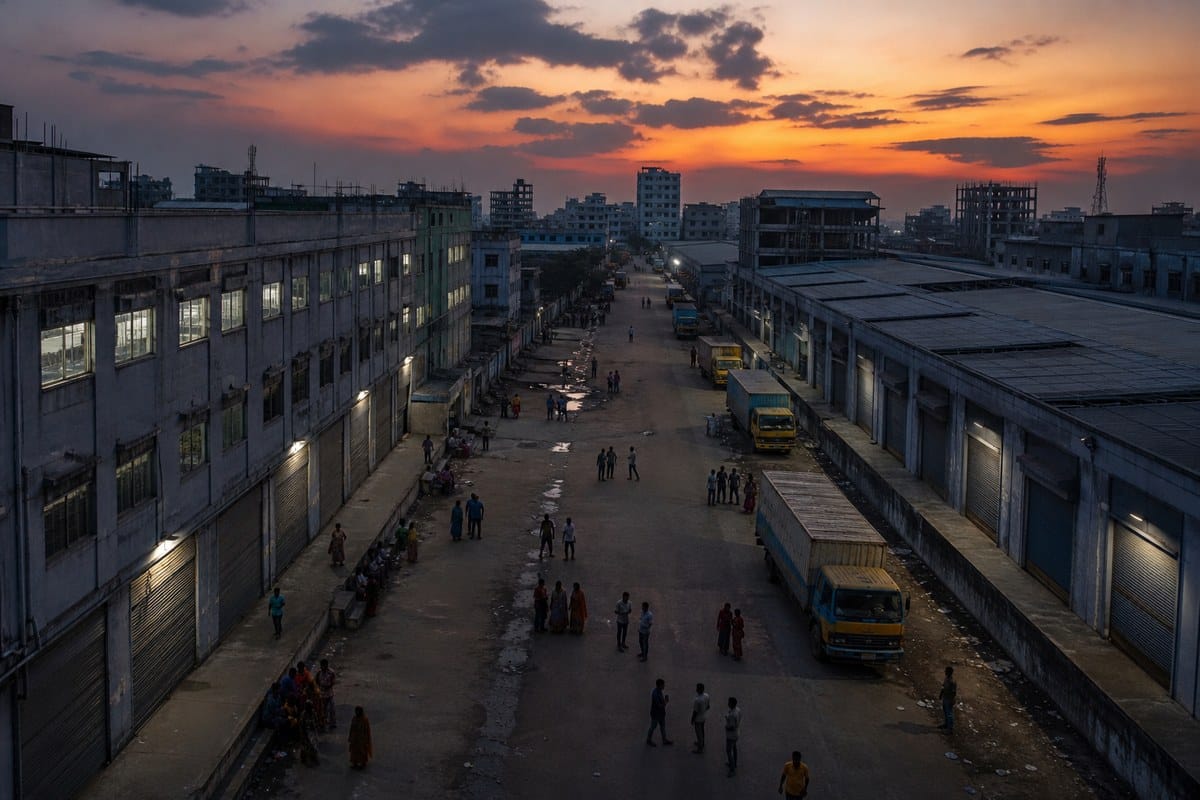
Closures escalated after an earlier shutdown
The 679-factory figure describes the second phase of the unrest, not a competing estimate of the same moment. On Nov. 1, Bangladesh formed a six-member wage board after demonstrations had already shut more than 500 factories. A Reuters report carried by 740 The Fan put closures in that earlier phase at 529 plants.
Factories then briefly resumed work before fresh demonstrations led to the larger reported suspension total on Nov. 2. CNA reported that workers attempted to block roads and that police used tear gas. The unrest was concentrated in industrial districts near the capital, including Ashulia and Gazipur, where a dense network of suppliers and garment plants makes transport access central to keeping production moving.
Read in sequence, the two counts show escalation rather than a discrepancy that can be resolved by choosing one number. The 529 total belongs to the initial shutdown and the government’s wage-board response; the 679 total applies to the renewed stoppage after the reopening. Neither report provides a plant-by-plant official registry, so the figures should be treated as reported operational counts for their respective dates rather than a cumulative tally of permanently closed factories.
The turbulence also carried costs beyond lost workdays. Mahmud Hasan Khan, president of the Bangladesh Garment Manufacturers and Exporters Association, told CNA that about 20 to 25 factories had been vandalised and that an office at a leather-goods factory was attacked. Those allegations were attributed to industry officials; the reports do not establish responsibility for each incident across the wider protest movement.
Wage demand would more than double the current floor
Workers are seeking a monthly minimum wage of 30,000 taka, compared with the current 12,500 taka. The requested increase is 17,500 taka, or 140% above the existing level; the proposed floor would be 2.4 times the current wage. That arithmetic explains why the dispute has become both a labor issue and a pricing problem for an export industry where factory owners compete for orders on cost, delivery reliability and compliance.
The government’s decision to establish a six-member board is a concrete response, but the available reports do not set out a binding timetable, proposed wage level or detailed mandate for the panel. It also does not mean an agreement has been reached. Workers continued their demonstrations after the board was announced, and the subsequent shutdown indicates that the intervention had not restored operations across the affected factories by Nov. 2.
Both sides have made arguments that rest partly on conditions still to be tested. Selim Raihan, an economics professor at the University of Dhaka cited by CNA, said higher pay was understandable amid elevated inflation but could raise production costs and pressure margins. Separately, Salim Rahman, a vice president of the garment manufacturers association, said the 30,000-taka demand was not feasible for producers facing narrow margins and competition from other apparel-exporting countries. Those assessments frame the negotiation; they are not evidence that a specific wage increase would cause lost business.
Export schedules are the near-term business risk
For overseas brands and retailers, a factory closure does not automatically translate into a missed shipment. Suppliers may have inventory, unfinished orders can sometimes be redistributed, and the effect depends on how long individual plants remain closed. But garment production depends on tightly sequenced cutting, sewing, finishing, quality inspection and transport work. Road blockades can disrupt those steps even at plants that are technically open.
Labor and Employment Minister Ariful Haque Choudhury said, in Reuters reporting, that extended disruption could delay export shipments and payments from international buyers. CNA likewise flagged concern about shipment timing and buyer confidence. These are forward-looking risks, not reported cancellations. The available accounts did not identify brands that had withdrawn orders, revised sourcing plans or imposed penalties on Bangladeshi suppliers.
That distinction is important in an industry of Bangladesh’s scale. More than four-fifths of export earnings are tied to ready-made garments, leaving the country unusually exposed to interruptions in a single manufacturing chain. Yet the same concentration gives employers, the government and labor representatives a strong incentive to contain the dispute: workers depend on steady wages, factories depend on continuous orders, and public export revenue depends on both.
The next practical test is whether the wage board can produce terms that workers consider credible enough to end the stoppages while keeping producers able to meet buyer prices. As of CNA’s Nov. 3 report, the salient operating fact was that 679 factories had halted again after the prior day’s reopening, leaving the industry without a reported settlement.