


A Balanced Scorecard (BSC) is a strategic management framework that helps organisations track and manage progress against their goals.
In simple terms, it turns strategy into clear objectives, measurable performance, and focused action. It not only defines what an organisation wants to achieve but also shows how well that strategy is being executed in a single, connected view.
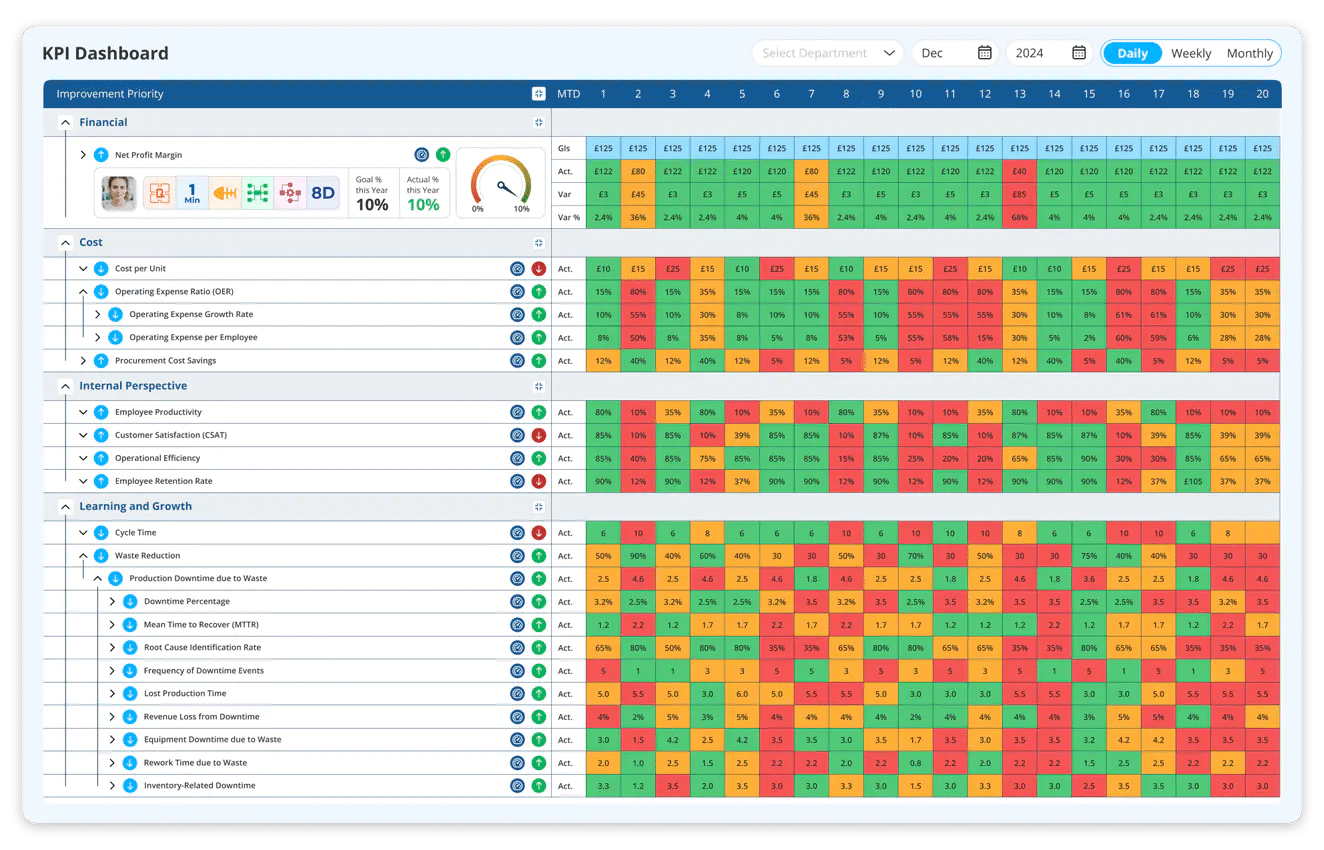
The Balanced Scorecard is based on two ideas:
- Balancing: Performance is viewed across four linked perspectives: financial, customer, internal processes, and learning & growth, ensuring no area is managed in isolation.
- Scoring: Each perspective is measured using a small set of meaningful KPIs that translate strategic goals into practical, trackable results.
Balanced Scorecard for C-suite executives
The Balanced Scorecard gives executives a clear view of whether their strategy is delivering results — and where adjustments are needed.
For example:
- CEOs can see whether strategic priorities are translating into real performance.
- CFOs can understand how financial results connect to operational efficiency and investment returns.
- COOs can monitor workflow efficiency and identify bottlenecks across value streams.
- CIOs can track technology KPIs linked to innovation, system reliability, and user adoption.
How the BSC supports forward-looking and accountable leadership
Senior leaders juggle goals across growth, efficiency, innovation, and risk. The Balanced Scorecard makes these priorities actionable by converting them into balanced, role-specific KPIs that teams can execute against.
It enables:
- Clarity – Visibility into the key drivers of strategy across the organisation.
- Alignment – Every department works toward the same outcomes.
- Focus – Initiatives stay tied to strategic priorities rather than side projects.
How leaders use the BSC to drive accountability and ROI
The Balanced Scorecard Software assigns ownership to every KPI, linking measures to specific teams or individuals. This ensures that strategic initiatives are not only launched but delivered with measurable results.
To evaluate ROI, leaders can monitor:
Project performance against budget and timelines
KPI trends and performance shifts
Returns from investments such as digital transformation or sustainability programmes
Example: A CIO can assess the value of a cloud migration not just by cost reduction, but by improvements in uptime, speed, and innovation — all captured within the Balanced Scorecard.
LTS Data Point Balanced Scorecard for strategic planning and execution
LTS Data Point Balanced Scorecard software provides a cloud-based digital framework designed to connect strategic goals with operational performance. It combines real-time KPI dashboards, ERP and MES integrations, mobile access, and enterprise-grade security to give leaders clear, reliable insight across the organisation — supporting daily performance management and long-term strategy in one system.
Why use LTS Data Point Balanced Scorecard software?
- Connect strategy to daily execution: Link high-level objectives to live KPIs, dynamic dashboards, and visual strategy maps so teams can see how their work contributes to strategic outcomes.
- Designed to fit your operations: Create scorecards, boards, and workflows that match the needs of manufacturing, pharma, healthcare, finance, and other operationally driven industries.
- Supports structured performance management: Use digital visual management boards, daily SQCDP tracking, and other structured performance methods within a single platform.
- Built for enterprise scale and collaboration: Align teams across sites and functions, automate data updates, and share live performance information securely across the organisation.