


AYANEO has finally answered the question that matters most to mobile gamers: what silicon will power its sliding Pocket Play handset. In a post on X, the company confirmed the device will ship with MediaTek’s Dimensity 9300, ending speculation around whether it would target Qualcomm’s latest or a 2024 refresh. The pick isn’t the newest chip on paper, but it sets clear expectations for real-world performance—and hints at how AYANEO plans to balance speed, thermals, and battery life with a uniquely controller-forward design.
Dimensity 9300 Sets the Pace for Sustained Frames
MediaTek’s Dimensity 9300 debuted with an all-big-core CPU layout—four Cortex-X4 and four Cortex-A720 cores—fabricated on TSMC’s 4nm process. In independent testing from outlets like Notebookcheck and AnandTech, the chip has traded blows with Qualcomm’s Snapdragon 8 Gen 3 in CPU-heavy workloads, often landing within single-digit percentage differences. That matters for emulation and physics-heavy games, where raw CPU throughput can dictate smoothness as much as GPU muscle.
On the graphics side, the Immortalis-G720 GPU in the 9300 has demonstrated strong peak performance, with results in UL’s 3DMark Wild Life Extreme that are competitive among 2023–2024 flagships. The challenge—and the opportunity for AYANEO—has historically been heat. Many passively cooled phones throttle to roughly 60–70% of peak in extended 3DMark stress loops; devices with active cooling or more aggressive thermal envelopes can hold closer to the 85–95% range. AYANEO has already confirmed active cooling for the Pocket Play, a notable advantage for keeping frame rates stable during hour-long sessions of titles like Genshin Impact or demanding emulators.
MediaTek’s APU also brings modern on-device AI features that can accelerate upscalers and image pipelines in supported titles. While few Android games fully exploit these hooks today, the headroom helps for post-processing, frame pacing, and background tasks when streaming via services like GeForce NOW or Xbox Cloud Gaming.
Controller-First Hardware Built for Play
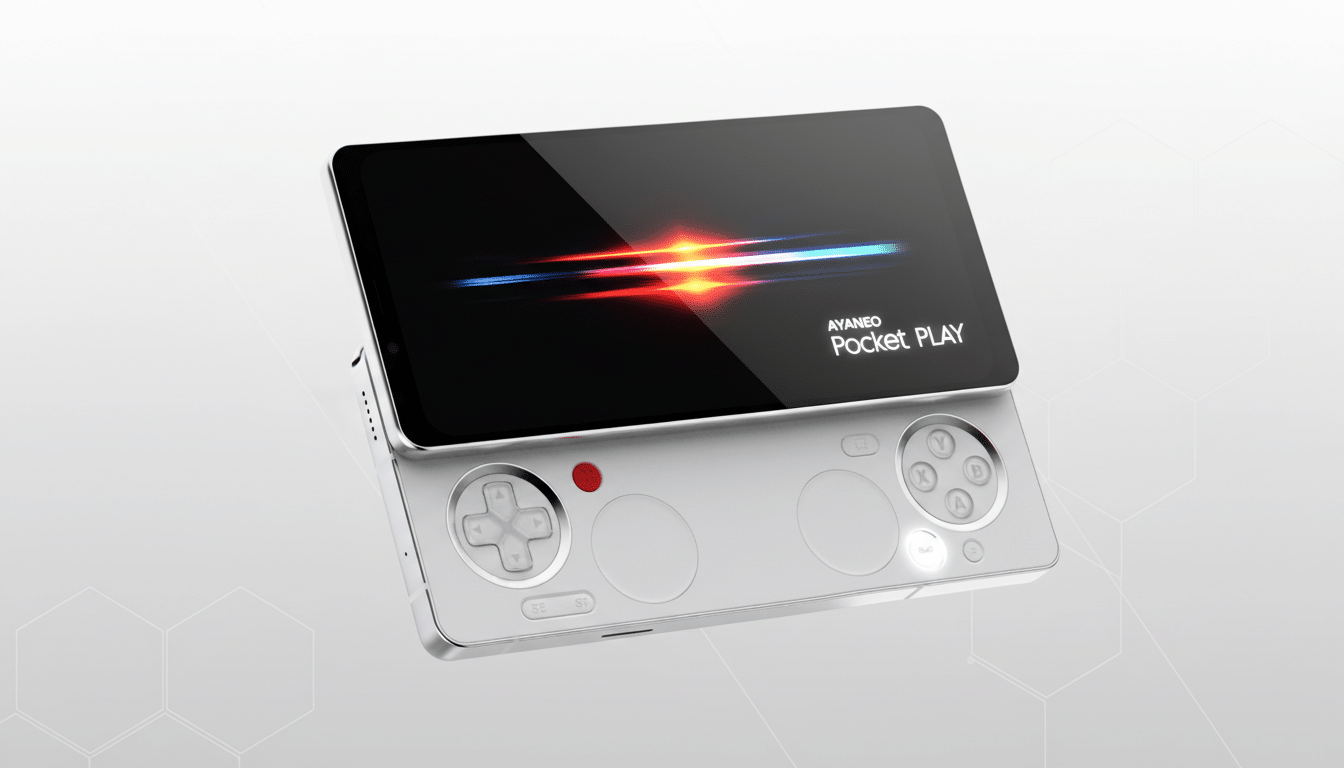
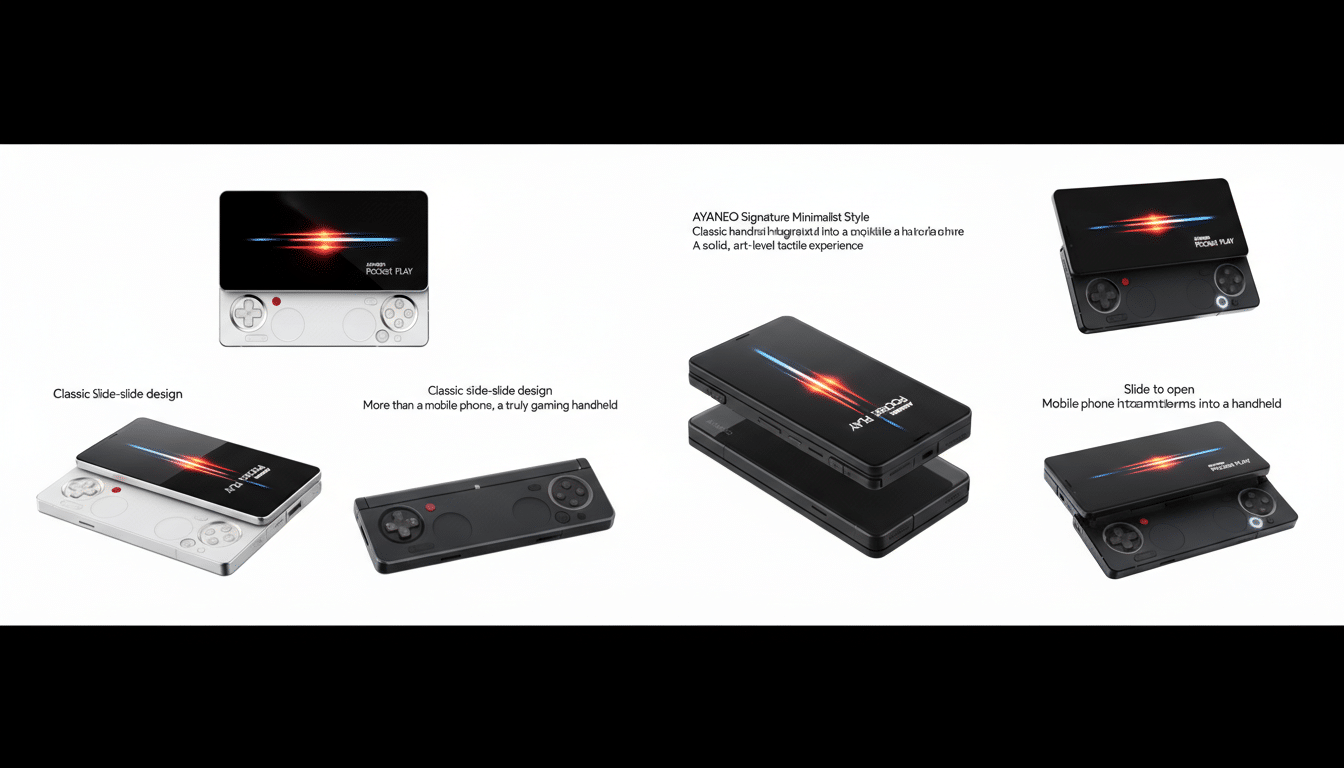
The Pocket Play leans into Xperia Play nostalgia with a sliding gamepad, but AYANEO isn’t stopping at buttons. Dual touchpads, physical face buttons, and shoulder triggers suggest a control scheme closer to a PC handheld than a typical phone clip setup. That’s a big deal for emulation, where touchpads can double as mouse inputs for UI-heavy launchers and retro titles.
AYANEO has also confirmed a 6.8-inch OLED with a 165Hz refresh rate, positioning the display for both high-FPS indie games and smooth UI scrolling. A bezel-mounted selfie camera keeps the game canvas uninterrupted—no punch holes drifting into your aiming reticle—and the rear camera array is intentionally modest to prioritize thermal space and battery. Active cooling should help the Dimensity 9300 maintain clocks and keep palm temperatures in check, an ergonomics win for a device built around long sessions.
Why This Chip and Not the Latest Refresh
Some enthusiasts hoped for Snapdragon 8 Gen 3 or MediaTek’s later 9300+ refresh. There are practical reasons to land on the 9300. First, supply and cost: stabilizing a product around a widely shipped, well-characterized SoC can reduce component risk and improve launch timelines. Second, drivers and thermal tuning: GPU drivers and game compatibility mature over months, and a known thermal profile helps AYANEO dial in fan curves and surface temperatures. Finally, the all-big-core CPU design of the 9300 maps well to emulation workloads that love peak per-thread performance, a key use case for a handheld phone with physical controls.
In short, if AYANEO’s cooling and power delivery are up to snuff, the 9300 should deliver flagship-class gaming without chasing marginal gains that could complicate costs or thermals.
Kickstarter Launch Plans and Service Pledge Details
The Pocket Play is still slated to debut via Kickstarter. AYANEO recently paused its crowdfunding plans while outlining a service improvement roadmap focused on better communication and shipping transparency. That context matters: crowdfunding veterans know that even reputable hardware makers can face delays. AYANEO has shipped multiple Windows handhelds, and the public pledge to tighten operations is a positive signal for backers weighing early commitment versus retail patience.
What Gamers Should Expect From AYANEO Pocket Play
Expect performance roughly in the flagship tier for 2023–2024 chips, with the bonus of sustained frame rates thanks to active cooling. Emulation for platforms like PSP and GameCube should be comfortably within reach, and many PS2 titles via AetherSX2 derivatives are likely to run well with sensible settings. Competitive shooters and MOBAs will benefit from the 165Hz panel, while the slide-out controls and touchpads promise precision without Bluetooth accessories.
The bigger story is focus: by pairing a controller-first design with a proven SoC and cooling, AYANEO appears to be optimizing for consistency over spec-sheet one-upmanship. If the Kickstarter rollout matches the service pledge, Pocket Play could emerge as one of the most thoughtfully balanced gaming phones this cycle.