


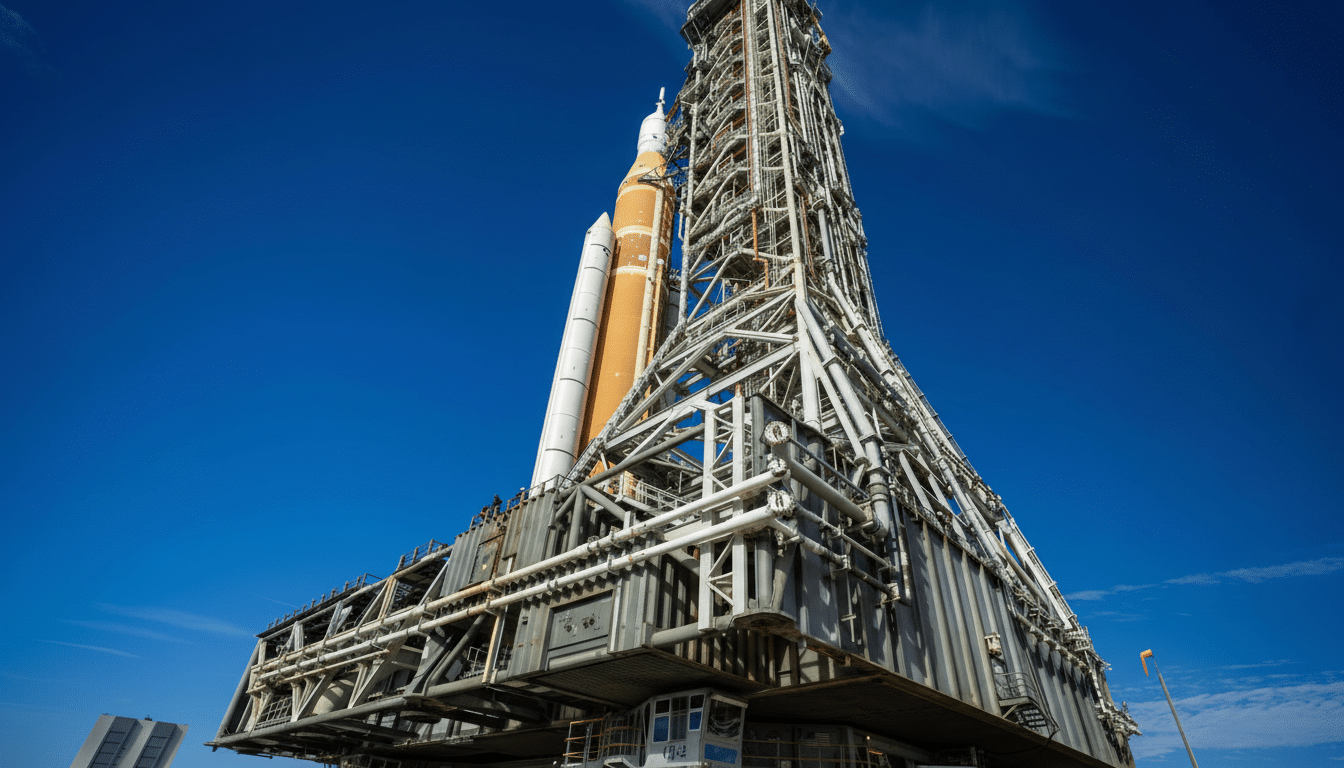
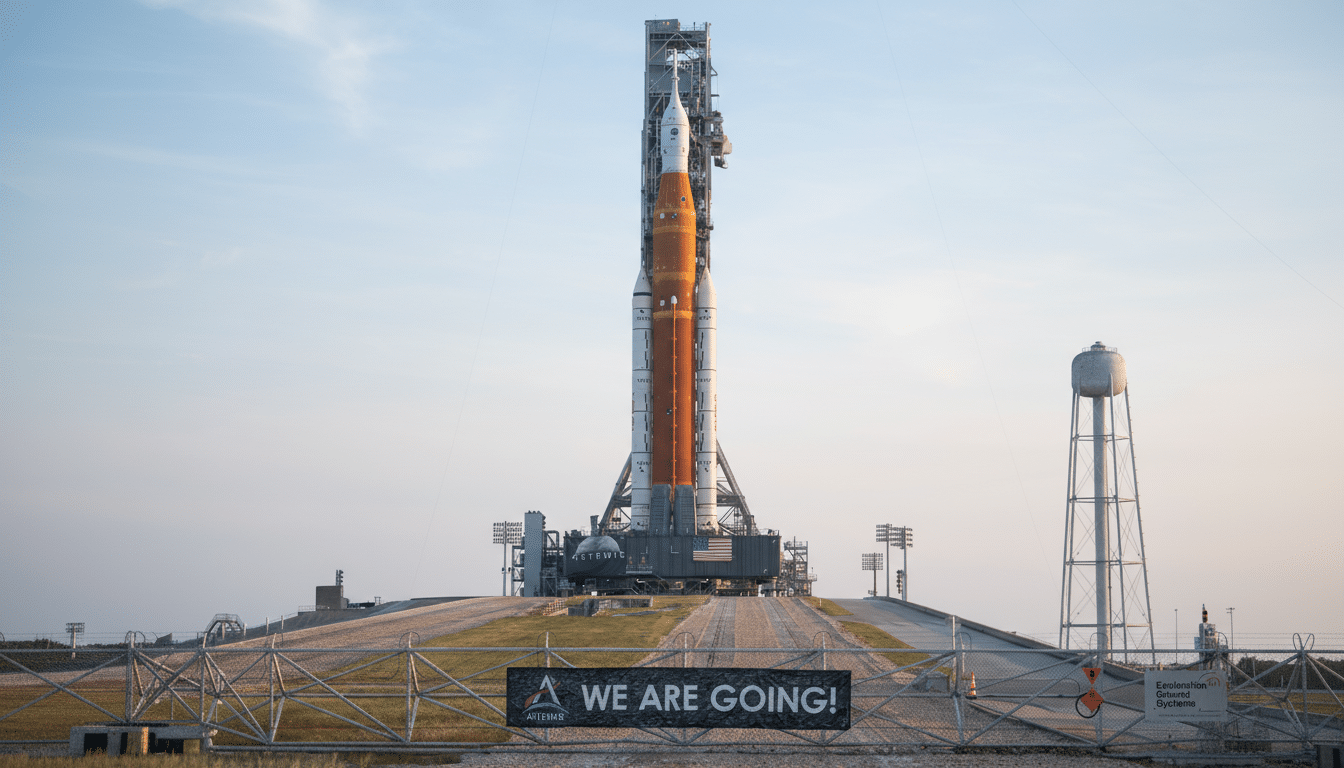
With the Space Launch System now standing tall at Launch Complex 39B, NASA’s next decisive milestone for Artemis 2 is a full-up wet dress rehearsal — the high-pressure fueling and countdown drill that will determine how soon four astronauts can begin a lunar flyby mission.
The 322-foot rocket, topped by the Orion spacecraft, completed its four-mile crawl from the Vehicle Assembly Building, a trek that marked the program’s shift from assembly to flight-readiness. Artemis 2 will send NASA’s Reid Wiseman, Victor Glover, Christina Koch, and the Canadian Space Agency’s Jeremy Hansen on a roughly 10-day journey around the moon before returning to Earth.
What the Wet Dress Rehearsal Will Prove for Artemis 2
During the wet dress rehearsal, teams will load about 700,000 gallons of supercold liquid oxygen and liquid hydrogen into the SLS core stage and upper stage, run through the entire countdown, and purposefully stop just short of engine ignition. The practice run culminates near T-29 seconds, exercising launch-day software, hardware, and team choreography under flight-like conditions.
Engineers will be watching several “go/no-go” technical gates: stable propellant temperatures and pressures, no hydrogen leaks above allowable limits at quick-disconnects, proper chilldown of the four RS-25 engines, clean performance of the core stage and Interim Cryogenic Propulsion Stage valves, and flawless timing between the ground launch sequencer and onboard flight computers. The swing arms on the mobile launcher, including the crew access arm, will be commanded through retract motions to verify pad mechanisms behave as expected.
Success means the team can validate replenish rates, confirm that hazardous gas concentrations stay within constraints, and verify the terminal count’s automated safing logic. In practical terms, this is the closest NASA can get to liftoff without lighting the rocket’s 8.8 million pounds of thrust.
Fixes Carried Over from Artemis I to Strengthen Artemis 2
Artemis 2 is built on lessons learned. The uncrewed Artemis I campaign exposed hydrogen leak sensitivities in umbilicals and taught operators how to tame thermal gradients in propellant lines. NASA changed seals on key quick-disconnects, adjusted torque and alignment on ground umbilical plates, and refined load sequences to reduce the chance of temperature-induced leaks during fast fill.
Controllers also updated software to better manage engine bleed flows and propellant conditioning, areas that prompted scrubs and recycle attempts in 2022. The agency has said it reworked and cryogenically tested a previously finicky valve, aiming to improve margin during the final minutes of tanking. Ground systems at Kennedy Space Center were upgraded as well, including enhancements to hazardous gas detection and the launch control system.
Independent oversight bodies have underscored the value of this rigor. The Government Accountability Office and the Aerospace Safety Advisory Panel have urged schedule realism, pointing to the complexity of integrated testing across rocket, spacecraft, and ground infrastructure. A clean wet dress is the confidence builder that those panels — and the crew — want to see.
After the Rehearsal, What Comes Next for the Crew and SLS
Once tanks are drained and the vehicle is safed, engineers will sift through terabytes of data. If trends are nominal — no leak signatures, stable pressures, responsive valves, and clean countdown automation — managers can pivot to final launch preparations. Those include full mission simulations, range readiness checks with Space Launch Delta 45, and integration of ordnance and the flight termination system per Eastern Range certification timelines.
For the crew, the next phase brings pad ingress rehearsals, communications end-to-end checks with the Deep Space Network, and environmental control verifications inside Orion’s cabin. Weather modeling also becomes pivotal; Florida’s rules on lightning, anvil clouds, and upper-level winds are unforgiving, and probability-of-violation forecasts often swing between 30% and 60% on any given attempt.
NASA’s launch philosophy remains unchanged: data will decide the date. If wet dress surfaces any anomalies, teams will fix them — at the pad or in the Vehicle Assembly Building — rather than press toward a premature attempt. The goal is straightforward but non-negotiable: launch once, launch right, and bring the crew home safely.
Why This Test Sets the Pace for Artemis 2 Launch Readiness
Artemis 2 is the human shakedown of a lunar transportation system meant to fly for decades. The mission will validate crewed operations for SLS and Orion, from ascent performance to deep-space navigation and reentry, laying groundwork for a later landing attempt. A smooth wet dress rehearsal doesn’t just tick a box — it sets the tempo for everything that follows, from the final countdown to the first views of Earth receding in Orion’s window.
If the rehearsal runs clean, the path opens. If it doesn’t, the rehearsal will have done its job anyway, revealing what must be fixed before four astronauts strap in. Either way, the next steps are clear, and they now unfold on the pad — where practice becomes performance.