


As generative AI moves from novelty to necessity, two ancient thinkers offer a surprisingly timely operating manual. Aristotle teaches us to aim machines toward human flourishing, while Socrates shows us how to interrogate answers rather than outsource thinking. Together, they outline a practical path for using AI to sharpen judgment instead of dulling it.
This is not a thought experiment. After a lightning-fast rise — including analyst estimates that ChatGPT hit 100 million monthly users within two months of launch — organizations are racing to operationalize AI. Early studies show strong productivity gains in well-defined tasks, yet neurocognitive signals raise caution. Brain-scan research presented by a Google DeepMind engineer suggests reduced activity when people draft with LLMs versus pen-and-paper, echoing a broader worry: convenience can crowd out competence.
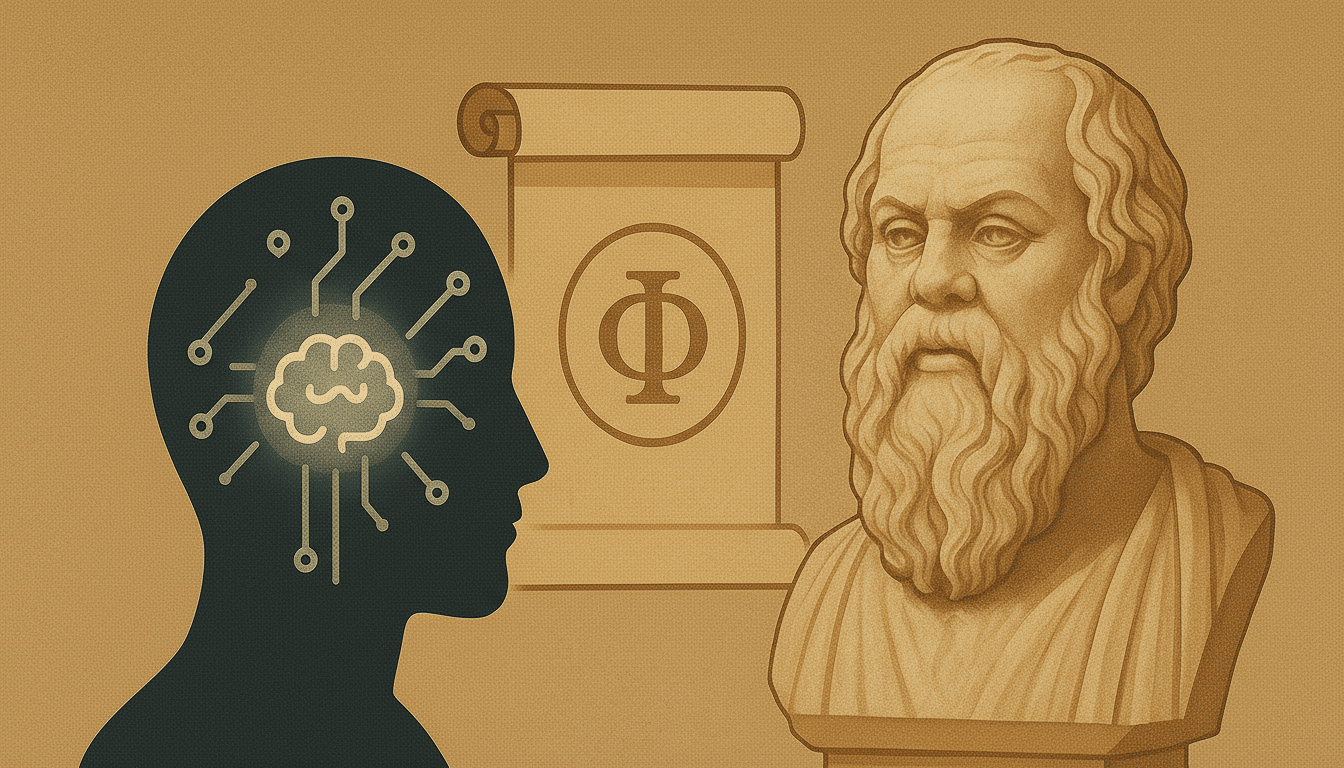
Aristotle’s Playbook for AI: Purpose, Habits, and Wisdom
Aristotle distinguished among three forms of knowing: episteme (principles), techne (craft), and phronesis (practical wisdom). Generative AI is powerful at episteme and techne — summarizing knowledge and producing drafts — but it cannot supply phronesis, the context-sensitive judgment rooted in values and lived experience.
Applied to AI strategy, Aristotle would demand clarity on telos, the purpose. Are we chasing clicks and cost cuts, or cultivating outcomes that actually matter — safer products, better decisions, and more capable teams? In modern terms: set success metrics that reward quality, safety, and learning, not just velocity.
He would also insist on habit formation. Competence comes from repeated, effortful practice. If AI becomes a perpetual shortcut, we train ourselves to accept plausible answers. If it becomes a training partner, we build skill. The design choice is ours.
Socratic Mode Over Autocomplete: Ask, Test, Verify
Socrates advanced knowledge by elenchus — probing questions that surface contradictions — and by maieutics, the “midwifery” of drawing ideas out of the learner. Translated to AI, the goal is not to ask for an answer but to orchestrate a dialogue that pressures the model and the user alike.
That means configuring systems for peirastic use — testing, not just generating. Instead of “Write a policy,” try “List the top three failure modes of this policy, provide counterevidence for each, and ask me for missing context.” You are switching the AI from a producer to a critic, then back again, in short cycles that force attention and memory.
Real-world checks matter. Enterprises deploying copilots report quick wins in templated tasks, but also discover hallucinations and overconfidence. A Socratic workflow inserts verification gates — citations, counterexamples, uncertainty estimates — so drafts become hypotheses to be tested, not outputs to be trusted.
Practical Tactics for Socratic AI Use in Daily Workflows
Design prompts that argue with themselves. Ask models to produce the best case and the strongest rebuttal, then require them to identify the deciding evidence and request data you can actually fetch. This reduces the risk of being seduced by the first fluent answer.

Adopt “explain first, answer second.” Before giving conclusions, have the model share its reasoning tree, references, and assumptions, and encourage it to flag low-confidence steps. Teams in regulated industries are already using this pattern to speed reviews and improve auditability.
Close the loop with reflection. After each assisted task, prompt both human and model with: What was assumed? What changed your mind? What will you test next time? This simple ritual, familiar to continuous improvement teams, converts AI from an autocomplete engine into a cognitive gym.
Use tiered autonomy. Let AI draft and detect “known knowns,” while humans tackle the “unknown unknowns” and feed discoveries back into prompts, retrieval corpora, and guardrails. Security teams already follow this pattern, pairing machine-speed triage with human-led investigation for novel threats.
Guardrails, Ethics, and Ownership in Responsible AI
Aristotle’s virtue ethics starts with character. In AI practice, that means clear data provenance, consent-aware training, and transparent model behavior. Reference established standards from organizations like NIST and ISO to anchor governance beyond marketing claims.
Protect agency. Studies of AI-assisted writing show faster completion times but also a risk of “source amnesia” — users struggle to recall what they produced or why. Counter this by requiring users to annotate key decisions, cite sources, and briefly defend trade-offs in their own words before finalizing output.
Measure what matters. Track not just throughput but error discovery rate, rework reduction, decision lead time, and knowledge retention on post-task quizzes. If metrics only reward speed, you will get speed — and brittle decisions.
What Success Looks Like When AI Amplifies Human Judgment
Picture a product team shipping faster without shipping defects. Their AI assistant generates options, then cross-examines its own logic and asks the team for missing constraints. The team iterates on risks, tests the riskiest assumption first, and documents rationale in plain language. Output rises, so does ownership.
That is Aristotle and Socrates in modern form: tools aligned to purpose, habits that build capability, and dialogue that produces understanding. Generative AI can be an escalator that carries us past hard thinking, or a gym that builds our capacity to think. The choice — and the design — are ours.