


Apple just put the creative world on notice. With the debut of Creator Studio, Apple is packaging its pro-grade apps into an aggressively priced bundle that aims straight at Adobe’s Creative Cloud. The headline surprise: depending on what you make, Apple’s newcomer doesn’t just compete on cost—it can outpace Adobe in everyday speed and simplicity.
Pricing and value: how Apple undercuts Adobe’s subscription cost
Adobe’s Creative Cloud remains the market’s broadest toolkit, but breadth isn’t cheap. The All Apps plan typically sits north of $55 per month in the US, with AI features increasingly tied to premium tiers. Apple undercuts that by a wide margin: Creator Studio lands at $12.99 monthly or $129 annually, with student pricing reported as low as $2.99 per month. For freelancers and studios watching margins, that delta is decisive.
- Pricing and value: how Apple undercuts Adobe’s subscription cost
- Platform reach and ecosystems: cross‑OS support versus Apple-first
- Photo and imaging: Photoshop leads, Apple apps gain speed
- Video editing and collaboration: Final Cut speed vs Adobe scale
- Audio production: Logic for music, Audition for cleanup
- Design layout and motion graphics: Adobe tools remain standard
- AI and cloud workflow: Adobe collaboration vs Apple speed
- File interchange and hiring reality in creative workflows
- The verdict: when Apple wins, when Adobe still makes sense
Adobe still offers individual-app plans, deep student discounts (often up to 70% for the first year), and enterprise controls that Apple doesn’t yet match. But Apple’s flat pricing for a suite anchored by Final Cut Pro and Logic Pro makes the cost-to-output equation hard to ignore.
Platform reach and ecosystems: cross‑OS support versus Apple-first
Here, Adobe keeps a clear edge. Photoshop, Illustrator, Premiere Pro, and After Effects run on both macOS and Windows, with mobile companions on iPadOS, iOS, and Android. That cross-platform reach matters in mixed environments and agency workflows. Research firms like IDC consistently note Adobe’s dominance in creative software, supported by its massive multi-OS footprint.
Apple’s Creator Studio is unapologetically Apple-first. Apps are optimized for Apple silicon, often with striking performance gains, but you’re locked into Macs and iPads. For teams standardized on Mac, that’s a feature; for cross-OS shops, it’s friction.
Photo and imaging: Photoshop leads, Apple apps gain speed
Photoshop remains the industry’s lingua franca, from PSD compatibility to deep masking, compositing, and generative AI via Adobe Firefly. Its file formats and plug‑in ecosystem are ubiquitous across studios and agencies, and that matters as much as features.
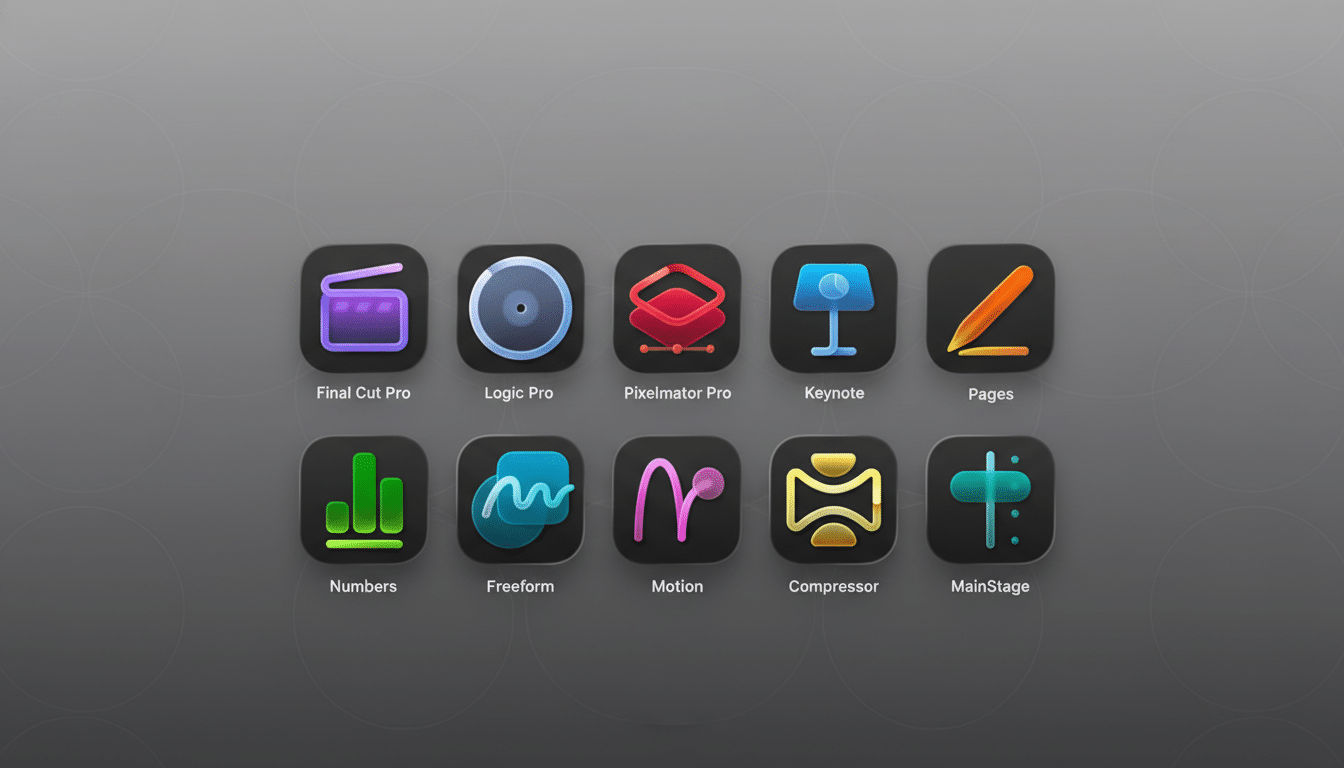
Apple’s bundle leans on third-party stalwarts like Pixelmator Pro for pixel editing, which has grown into a capable, speed-focused tool with AI masking, ML-powered enhancements, and native Apple silicon acceleration. It’s excellent value, but for complex multi-layered composites, Photoshop’s edge is still obvious. For full photography workflow—cataloging, tethering, camera and lens profiles—Lightroom and Lightroom Classic remain the benchmark.
Video editing and collaboration: Final Cut speed vs Adobe scale
This is where Apple shocks pros. Final Cut Pro on Apple silicon chews through ProRes and HEVC, often rendering in faster‑than‑real‑time on high‑end Macs in real projects. Editors moving up from iMovie will find the magnetic timeline a productivity boost, while veterans appreciate granular keyframing and multicam finesse. Compressor deepens delivery options with robust presets and batch control.
Premiere Pro counters with unmatched ecosystem logic: team collaboration via Productions and Team Projects, deep integrations with Frame.io (an Adobe company) for review and Camera to Cloud, and broad hardware flexibility. Independent testing from Puget Systems highlights how Premiere scales on high-core Windows workstations and NVIDIA GPUs. In pure collaboration and heterogeneous pipelines, Adobe wins. In solo or small-team Mac shops prioritizing speed, Apple wins.
Audio production: Logic for music, Audition for cleanup
Logic Pro is a tour de force for composition and production, bundling an immense instrument, loop, and effect library with tight MIDI and scoring. Apple’s AI Session Players accelerate songwriting by generating humanlike performances that follow your tempo and chords. For music-makers, it’s hard to beat.
Adobe Audition shines in a different lane: dialogue repair, spectral editing, and post workflows. It’s a cleaner, faster fix-it tool for podcasts and video post than a full DAW. If you produce albums, choose Logic. If you clean audio at scale, Audition still rules.
Design layout and motion graphics: Adobe tools remain standard
Illustrator and InDesign anchor Adobe’s dominance in vector design and page layout. From typographic micro-control to prepress, they’re the default in agencies and print houses. Apple’s bundle lacks a true InDesign rival, and while Pixelmator Pro handles vectors, it’s not a substitute for Illustrator in complex branding work.
In motion graphics, After Effects remains the job-posting requirement—LinkedIn listings overwhelmingly cite AE. Apple’s Motion is faster to learn and superb for titles, lower thirds, and performant real‑time previews, but it can’t match AE’s expressions, third‑party plug‑ins, and studio-standard pipelines.
AI and cloud workflow: Adobe collaboration vs Apple speed
Adobe’s Firefly models power Generative Fill, Expand, and Recolor across apps, with Content Credentials via the C2PA initiative to embed provenance data—an increasingly important trust signal in media. Creative Cloud Libraries, cloud docs, and Frame.io unify teams from pitch to delivery.
Apple counters with practical, creation-speed AI. In Keynote, outlines can become full slide decks; Numbers offers Magic Fill suggestions; Logic’s Session Players feel like on-demand collaborators. It’s less about flashy prompts and more about shaving minutes off repeated tasks—especially compelling for solo creators.
File interchange and hiring reality in creative workflows
Standards still matter. PSD, AI, INDD, and AEP files are the currency of agencies. ProRes, FCPXML, and Motion templates are common in Apple-centric shops, but cross‑handoff can introduce translation steps. If you frequently inherit or hand off projects across vendors, Adobe’s formats and cloud-sharing tools reduce friction.
On the hiring front, industry surveys and job boards show skills demand clustering around Adobe apps for design and motion roles, with Final Cut and Logic particularly strong in video and music ecosystems. That split reflects the suites: Adobe wins on breadth and compatibility; Apple wins on focused speed and price.
The verdict: when Apple wins, when Adobe still makes sense
If you live in video or music on a Mac, Creator Studio is the surprise value champion. It’s fast, coherent, and dramatically cheaper, with tools that punch above their price—particularly Final Cut Pro and Logic Pro.
If your work spans photo pipelines, vector branding, page layout, motion graphics for agencies, or cross‑platform teams, Creative Cloud remains the safer, more scalable bet. Adobe’s suite is still the industry standard, backed by vast training resources and enterprise-grade collaboration.
The real news is that Apple has forced a conversation about cost and speed. For many creators, the smartest play isn’t either-or: pair Apple’s video and audio strengths with Adobe’s design and photo standards. It’s not the answer purists want, but it’s the workflow that wins.