


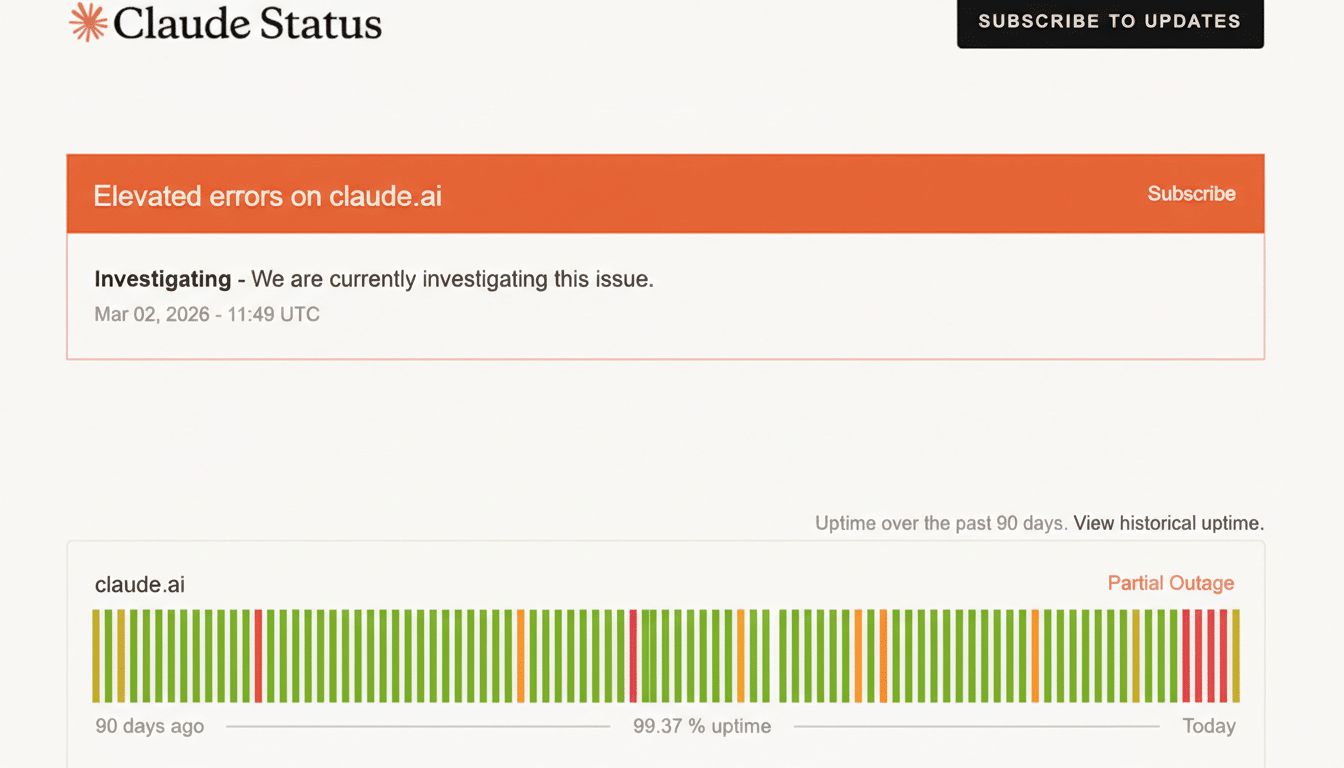
Anthropic’s Claude platform is experiencing a widespread outage, with thousands of users reporting problems accessing the service. Early indications point to issues with the consumer web apps Claude.ai and Claude Code, while the company says its Claude API continues to operate as expected.
On the company’s status page, Anthropic acknowledged the disruption and attributed the incident to failures in the login and logout flows. Engineers say a fix is being implemented, but the root cause has not yet been disclosed.
- What Users Are Seeing During the Current Claude Outage
- Scope and Likely Cause of the Claude Service Outage
- Why Surging Demand May Be a Factor in This Outage
- Impact on Developers and Teams Using Claude Tools
- Reliability Stakes for AI Leaders Amid Claude Outage
- What to Watch Next as Anthropic Restores Access
What Users Are Seeing During the Current Claude Outage
Most complaints center on authentication errors when attempting to sign in, along with sessions being unexpectedly terminated. Users report being unable to access projects in Claude Code and receiving generic errors on Claude.ai despite stable internet connections and valid accounts.
Third‑party outage trackers show an early spike in reports concentrated in North America and Europe, with smaller clusters elsewhere. Enterprise teams that rely on cloud SSO appear especially affected, consistent with an identity or session management fault.
Scope and Likely Cause of the Claude Service Outage
The fact that the Claude API is reportedly unaffected while front‑end apps are failing to authenticate suggests the problem sits in the identity layer—think OAuth/OIDC flows, session cookies, CSRF protections, or a backing store that manages tokens. It looks less like a model inference or data center outage and more like a control‑plane hiccup that blocks user sessions from being established.
Similar patterns have played out before across cloud software: incidents at major identity providers and access gateways have caused front‑end sign‑in failures while background APIs stayed healthy. In those cases, remediation focused on rolling back configuration changes, purging invalid session states, or re‑provisioning certificates that gate login flows.
Why Surging Demand May Be a Factor in This Outage
Claude has seen a surge in attention in recent days as the company’s negotiations with the Pentagon drew public scrutiny. The Claude mobile app climbed to the top of the App Store charts over the weekend, surpassing rival ChatGPT, according to widely observed rankings and mobile analytics firms. Sudden growth can stress shared components like authentication and rate‑limiting systems, even when compute backends are provisioned adequately.
While Anthropic has not tied the outage to traffic spikes, experienced SREs note that login paths often become hot spots during demand surges because they blend cryptography, third‑party callbacks, and multiple data stores. If any step slows or returns inconsistent state, users can be locked out even as the underlying AI endpoints keep serving requests.
Impact on Developers and Teams Using Claude Tools
Disruptions to Claude Code complicate workflows for engineers who use the tool for code assistance and refactoring. Teams that integrated Claude through the API may experience fewer issues today, but they can still be impacted if internal tools rely on browser‑based auth or session refreshes.
Practical workarounds include avoiding logouts on active sessions, using API keys for server‑to‑server calls, and pausing account or SSO changes until the incident is resolved. Organizations should document any service degradation, as vendors typically provide incident reports and may offer service credits depending on SLA terms.
Reliability Stakes for AI Leaders Amid Claude Outage
As AI assistants become everyday tools, uptime has become a competitive differentiator. Major providers target 99.9% or better availability for core APIs, but front‑end availability can lag when identity or billing systems falter. Recent high‑profile outages across the AI sector underscore how fragile orchestration layers can be compared with core inference infrastructure.
Anthropic has built a reputation around model safety and enterprise readiness. Transparent post‑incident reporting—detailing what failed, how it was fixed, and what hardening steps will follow—will be key to maintaining trust with developers and businesses that have deeply embedded Claude into daily operations.
What to Watch Next as Anthropic Restores Access
Users should monitor the company’s status page for confirmation that login and session handling have fully recovered and for any recommended user actions, such as clearing sessions or reauthenticating. A thorough postmortem would ideally explain whether a configuration change, dependency failure, or unexpected traffic pattern triggered the cascade, and what guardrails—such as canary rollouts, circuit breakers, and rate governors—will be strengthened.
For now, the working theory aligns with a front‑end authentication breakdown rather than a core model outage. The fix in progress should restore access, but the long‑term lesson is familiar: in AI platforms, reliability often fails at the seams where identity, billing, and application gateways meet the models themselves.