


Amazon’s autumn parade for Devices & Services is the company’s clearest expression of itself in any 12-month window, and this year we’re seeing hints at a full slate: color-happy Kindle Scribe hardware, a Steam Deck-adjacent take on Fire TV streaming software, all-new Echo gadgets… even some cold hard calculus about Fire tablets.
(I have not been sent a device or even an invitation to a launch event, although at least one has begun circulating among press outlets, as noted by The Verge.)
- Rumors About Kindle And Scribe Color Displays And Tools
- Fire TV And The Vega OS Question: Custom Linux Ambitions
- Echo Family Refresh And Alexa’s Next Step In AI
- Fire Tablets And A Shake-Up In Platform Software
- What Else Could Appear At Amazon’s Fall Hardware Event
- The Strategy Behind The Devices And Amazon’s Ecosystem
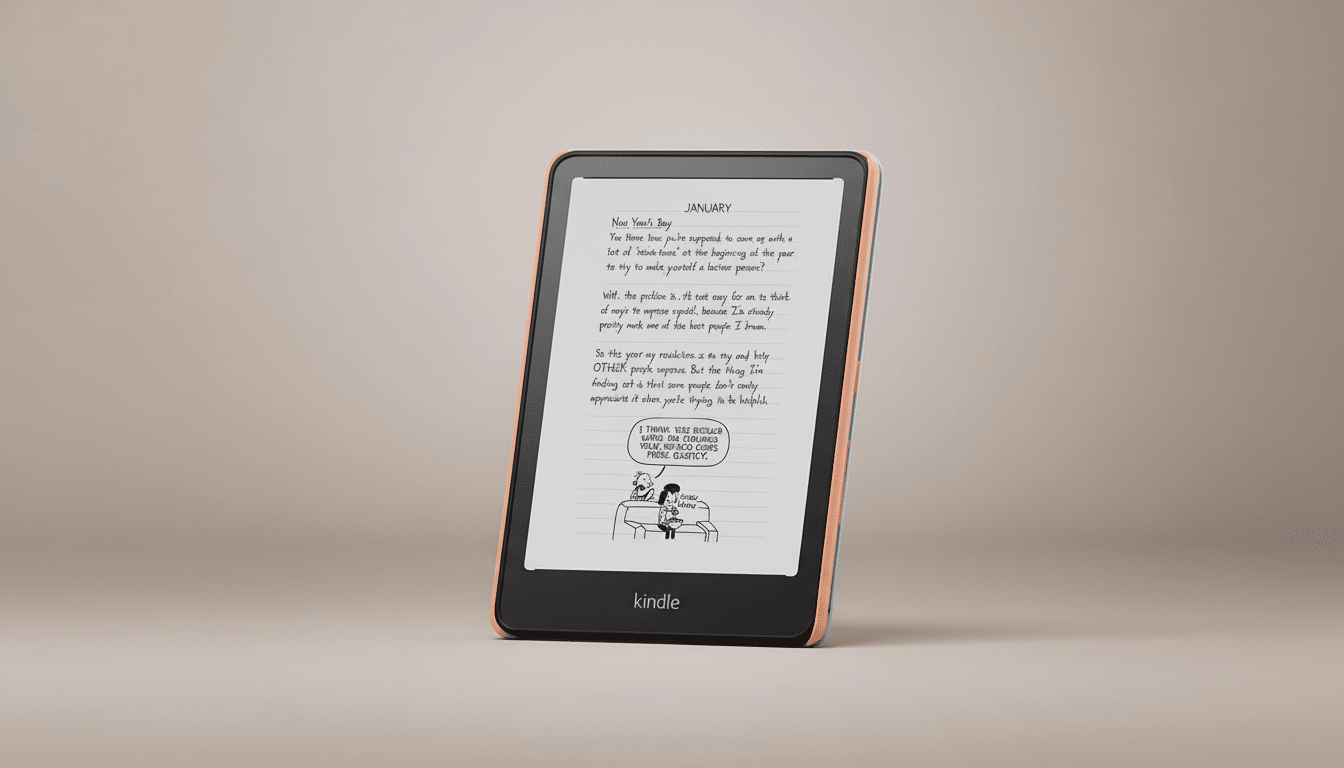
Invitations that are in place indicate — or so I would hope — a four-quadrant lineup of devices, and that is more than sufficient for me to sketch out realistic expectations.
Rumors About Kindle And Scribe Color Displays And Tools
Color has become the Kindle narrative to follow. Since Amazon’s latest run of Colorsoft-branded models expanded its e-reader palette, what better idea than the Kindle Scribe? That invite allegedly has some text on it about “with the stroke of a pen,” a winking reference to the only Kindle with native handwriting support. If that reading is correct, a Scribe will be the one with the color e-paper panel and specialized software for multicolor annotation, highlighting and diagramming.
It would be a good answer to competition. Kobo’s color e-readers, which have been built with E Ink Kaleido technology, have demonstrated there is an audience for low-power, glare-free color that just isn’t served by LCD tablet displays. It’s the same trend in digital note-taking. The trade-off is well-known: color E Ink often comes at the expense of sharp fine details and brightness. Amazon might respond with deeper control over the front light, better color adjustment of PDFs and comics, and stronger syncing between Kindle and Audible for study or research workflows.
Price is the sticking point. Not only does the current Kindle Scribe’s list price start high, but color parts tend to demand a premium. If the delta is consistent with what we’ve seen on other color e-readers, a fully loaded Scribe model brushing past that five-hundred-dollar mark wouldn’t shock industry observers. The upside: a one-trick pony that’s built like a tank and good on the eyes for people who read, study or jot notes in pictures.
Fire TV And The Vega OS Question: Custom Linux Ambitions
The biggest Fire TV news might not be a stick or a box — its software. Several reports, including Lowpass and The Verge, described Amazon’s sustained quest to break free of its Android fork in favor of a custom Linux-based OS known as Vega (or Vega OS). A pivot like that would be meant to cut down overhead, speed up navigation and get Amazon more control over system services, updates, and long-term developer tooling.
If Vega OS becomes a reality, Amazon needs to play up the performance angle — snappier home screens, zippier search, and less stuttering all around on lower-cost hardware — along with backward compatibility for Fire TV apps that are good enough today.

The company won’t be eager to leave its vast user base stranded. The likes of Comscore and Omdia, which follow the industry, have often listed Fire TV among the top streaming platforms in the U.S., so Amazon has plenty of motivation to ensure that it is as easy as possible for customers and partners to make their own moves.
Echo Family Refresh And Alexa’s Next Step In AI
It’s high time the Echo Dot and Echo Pop were updated with processors that lead to a more robust voice assistant experience as well as slightly modified designs with better microphones, strengthened connectivity, and broader support for Matter and Thread. The interesting twist is the middle-of-the-market: as noted by ZDNet, the invite seems to be fashioned in Echo Studio’s silhouette, which is becoming a hard device to come across even on Amazon itself. That void might be a sign of an actual Studio successor with enhanced spatial audio, upgraded drivers and support for lossless streaming that is tuned for Amazon Music’s HD and Ultra HD tiers.
Any Echo refresh will be compared to Alexa’s recent foray into generative AI. Amazon previewed standard language models backing a more conversational Alexa, and now the next step is bringing that kind of responsiveness to everyday use cases with lower latency. Look out for talk of beefed-up on-device processing — an extension of the company’s Neural Edge approach — to address fast requests locally, and pass off to the cloud only when necessary. (CIRP estimates that Amazon still has the largest share of the U.S. smart speaker installed base, in the mid-60s percent range, so even incremental increases ripple across millions of households.)
Fire Tablets And A Shake-Up In Platform Software
For years, Fire tablets have been based on a heavily modified fork of Android, focusing more on lowball prices than app parity. Recent reporting from Android-focused publications indicates that Amazon has been testing a more substantial transition — perhaps to a new baseline for Android, or to a compatibility approach that allows developers to breathe. For consumers, the pitch is simple: faster performance, a wider variety of apps and less adjustment when transitioning between a mainstream Android phone and a Fire tablet.
A high-end Fire could make sense here: a brighter panel for outdoor reading, a faster chipset for multitasking, enhanced stylus compatibility for schooling and jobbing, and an all-day streaming battery. This is where Amazon’s pitch lies — for a tablet that is, in all likelihood, one of the cheapest slabs IDC charts will show steady demand for — its chance to move up the ladder without forsaking the value story that makes Fire hardware so ubiquitous at homes and in classrooms.
What Else Could Appear At Amazon’s Fall Hardware Event
Amazon also fills in the holes with ecosystem glue. Eero could launch Wi‑Fi 7 mesh kits tailored to dense homes and multi-gig service. Ring and Blink may receive modest camera updates using more of the processing found onboard for faster alerts and better privacy controls. On the services front, look for integration of devices with Amazon’s content stack — so Prime Video profiles on Fire TV or Audible widgets on Kindle, or better Alexa Routines that help coordinate lights, thermostats and media across rooms.
The Strategy Behind The Devices And Amazon’s Ecosystem
Amazon’s devices serve to draw customers deeper into its services flywheel — reading with Kindle, listening with Audible and Music, streaming on Fire TV and automating the home with Alexa. That tug-of-war for living room time and voice assistant loyalty has been better chronicled by Canalys, among others; Amazon’s playbook is to make the devices a little faster, friendlier and smarter each cycle. If the company serves up a color Scribe, a sleeker Fire TV OS and one Echo lineup ready to train generative Alexa, it will have set the agenda for the season — and established benchmarks rivals will need to respond to.