


It even has the capability to identify and analyze ingredients such as peanuts, almonds, and hazelnuts.
A pocketable “mini lab” that checks your food for hidden allergens in minutes was one of many desktop health tests taking center stage at CES, introducing a new layer of reassurance for the millions who live with food allergies and celiac disease. A French startup called Allergen Alert has brought out a handheld, battery-powered contraption that’s not much bigger than a paperback book: diners sweep a finger-sized sample of their meal into it and get an analysis for gluten (and the most prevalent allergens) in minutes.
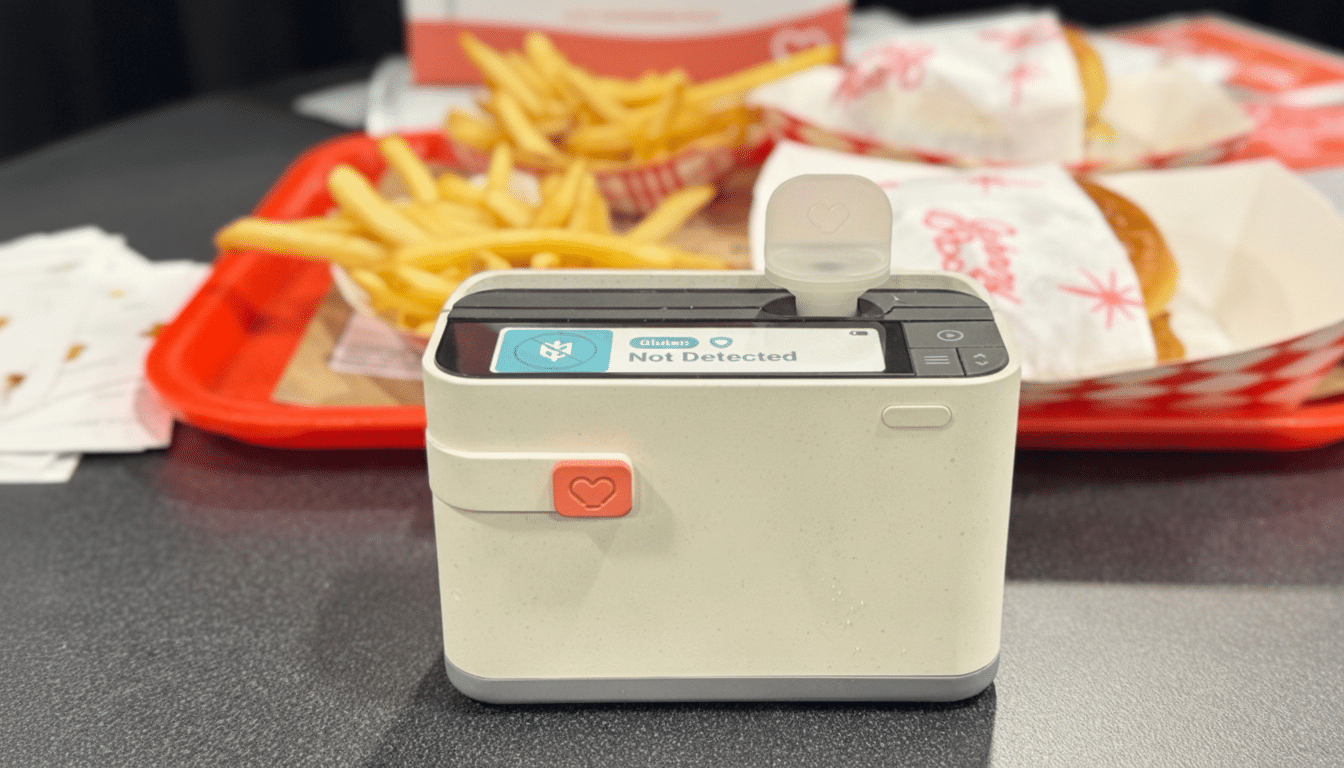
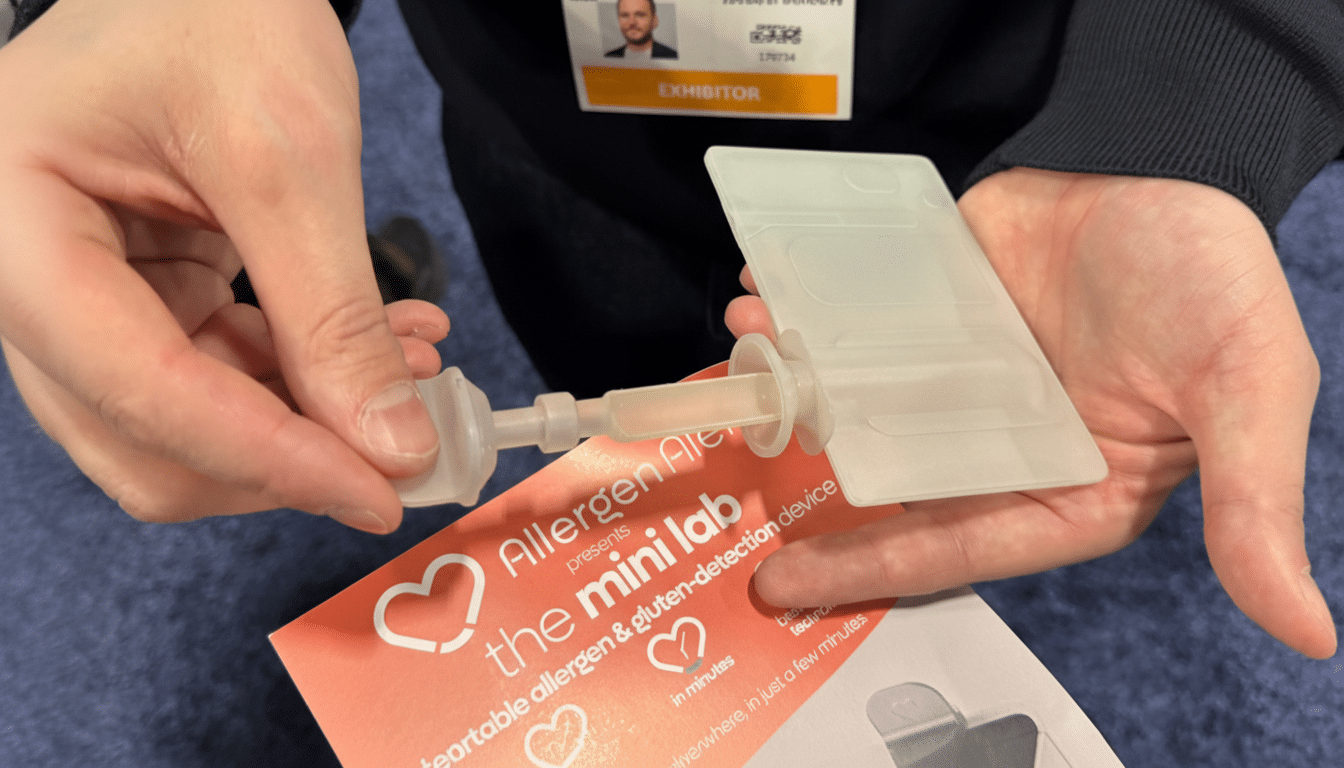
The company markets the device as a means of self-screening restaurant dishes and home-cooked meals, rather than depending on verbal assurances or menu notations that could overlook cross-contact. The prototype on the show floor was a demonstration of that automated workflow: you take a small bite and seal it in a single-use pouch, dock it into the reader in what seemed like half a second (at least from my layman’s eye), and off the system goes to run its testing with few steps for the user.
Bénédicte Astier, the founder and CEO of Allergen Alert, was driven to create the product when her daughter went into anaphylactic shock. The device grew out of an intrapreneurship program at bioMérieux, a global diagnostics company, and was later spun off as its own venture.
How the handheld mini allergen lab works and tests
Allergen Alert calls the reader a device that “automates and miniaturizes” tedious processes employed by professionals who analyze food. The company has not released full technical specifications, but this type of testing frequently uses immunoassay chemistry like lateral-flow or ELISA-based methods, which are aimed at specific allergenic proteins. Test results are shown directly on the device in just minutes.
Each single-use pouch is programmed to address a single allergen. At the outset, the business is concentrating on gluten and high-priority allergens like milk, peanut, and tree nuts, but can expand. Company representatives said that they are considering multiplex testing within a single pouch, depending on whether there is user demand.
The hardware brought to CES was a near-final prototype, with the internal testing chemistry reportedly set and the industrial design still being polished. The handheld reader is rechargeable, and the workflow was made discreet enough for use in restaurants.
Why this technology matters for allergy and celiac safety
Millions of households are afflicted by food allergies, and exposure is often fatal. A study appearing in JAMA Network Open found that 10.8% of U.S. adults have had a food allergy confirmed by a physician, while advocacy organization FARE estimates that 1 in 13 children have food allergies. CDC overviews state there are about 200,000 emergency department visits caused by food allergies in the U.S. each year.
Celiac disease adds another dimension. The University of Chicago Celiac Disease Center says that around 1 percent of the population worldwide has celiac, which is a condition that causes damage to the intestine after even small amounts of gluten are ingested. The standard for “gluten-free” labeling in the U.S. and EU is now 20 ppm, which may or may not be meaningful to people with sensitivities. For detection limits to be useful in the context of a consumer device, this should also compare with analogous thresholds.
Meals in the real world are messy, and protein distribution is uneven. Guidance from food safety bodies in the U.S., the U.K., and the EU rules out any reduction of sampling error: one forkful is just not always like the next. But a portable test will not replace good kitchen practices, standardized supplier controls, or clear labeling. It may, however, serve a last-mile check before one bites into something.
Independent validation needs and important caveats
Claims of “lab-grade” results outside a lab should give you pause. Consumer allergen sensors have come before — Nima has marketed pocket gluten and peanut tests, while Allergy Amulet and others are working on prototypes — showing that people are eager for better information about what they eat and demonstrating the difficulty of consistently detecting allergens in complex foods. Independent validation will be critical.
Experts say that third-party validation (e.g., programs like AOAC INTERNATIONAL’s Performance Tested Methods or testing by certified labs, such as Eurofins) is important, too. Look for clear statements of limits of detection, false positive/negative rates, and known interferences (fatty matrices, heat treatment, and fermentation can degrade proteins or mask them).
Allergen Alert has not yet published these performance results; they would be helpful for clinicians, dietitians, and food safety experts to evaluate utility.
It is important as well to manage expectations. There’s no consumer test that can assure a food is safe for everyone in all circumstances. Best practices include:
- Asking questions
- Checking in on preparation procedures
- Steering away from high-risk dishes
- Treating testing as a bonus checkpoint — particularly during travel or in unfamiliar kitchens
Price, availability, and the subscription testing model
Allergen Alert expects to sell the reader for around $200, with single-use pouches delivered in subscription packs of five to seven. That model prices per test quite well and encourages routine use while dining out. Every pouch now targets one allergen; the company said multi-allergen pouches could come next if users show demand for them.
The startup recently completed a €3.6 million financing to expand the manufacturing process, regulatory and quality systems, and market entry. For consumers, the true test will be performance data and independent reviews when the first units ship.
Bottom line on Allergen Alert’s mini allergen lab
Allergen Alert’s mini lab brings fast allergen screening to the dinner table, in hopes of handing control back to people who live with food allergies and celiac disease. If the company can combine polished hardware and transparent, independently verified accuracy — and articulate clear use cases and limits — it may be pushed into practical daily use in a field where that marginal bite is everything.