


AI-generated content is no longer a novelty—it’s a normal part of how businesses ship writing at scale. Marketers use it to draft landing pages and newsletters. Support teams use it to expand knowledge bases. Product teams use it to turn release notes into customer-facing updates. The speed is real, and so is the temptation to publish what the model produces with minimal editing.
But there’s a downside that shows up slowly: content that feels “fine” yet unconvincing. It may be grammatically correct, but it can sound generic, miss nuance, or quietly drift into shaky facts. And in a world where audiences are exposed to AI-written material daily, trust becomes the differentiator.
- The Real Problem Isn’t “AI”—It’s Unowned Writing
- The 5 Most Common “AI Tells” That Reduce Trust
- The Human & Trustworthy Workflow (6 Steps)
- 1) Use AI for structure, not truth
- 2) Define human constraints before drafting
- 3) Add what AI can’t responsibly invent
- 4) Rewrite for voice and natural cadence (the “human pass”)
- 5) Use AI detection checks as a signal—not a goal
- 6) Final human review: truth, tone, risk
- A Practical Self-Edit Checklist (Copy/Paste)
- Quick Fix Table: “If It Sounds Robotic, Do This”
- What This Looks Like in Real Life (Mini Example)
- Final Takeaway: Trust Is the New Moat
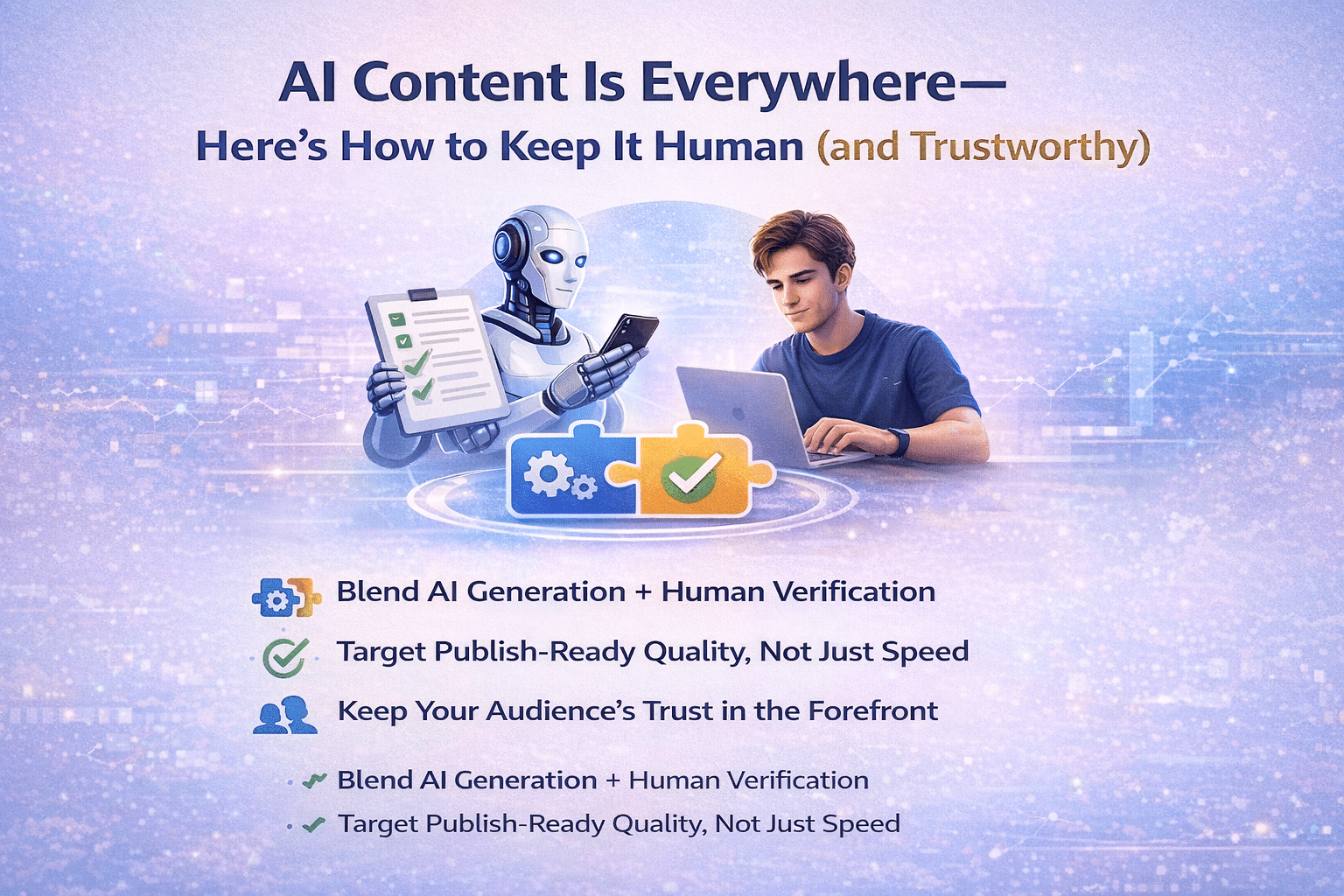
This article is a practical playbook for producing AI-assisted content that still reads like a thoughtful human wrote it—clear, credible, and worth sharing.
The Real Problem Isn’t “AI”—It’s Unowned Writing
The strongest teams don’t use AI to “replace writers.” They use AI to handle the parts of writing that are expensive but not strategic—first drafts, structure, variations, formatting—then humans do the work that actually earns trust:
- judgment (what matters most and what to leave out)
- truth (verifying claims and sources)
- voice (tone, empathy, and brand personality)
- accountability (saying what you can support—and softening what you can’t)
If AI is the author, the result often feels like “content.” If humans are the author and AI is the assistant, the result feels like communication.
The 5 Most Common “AI Tells” That Reduce Trust
Readers may not say “this was written by AI,” but they’ll feel it. These patterns are common and fixable:
| AI tell | What it looks like | Why it hurts |
| Over-polished transitions | “Moreover,” “In today’s world,” “Additionally” | Sounds templated |
| Generic certainty | “This will revolutionize…” | Feels like marketing fluff |
| Uniform rhythm | Similar sentence length all the way through | Creates a machine cadence |
| Repeated rephrasing | Same point said 3 ways | Adds length without value |
| Missing lived detail | No examples, constraints, tradeoffs | Feels untested and shallow |
The good news: you don’t need to “hide” AI. You need to edit like a publisher.
The Human & Trustworthy Workflow (6 Steps)
Use this workflow for blog posts, thought leadership, SEO pages, and newsletter content. It’s built to preserve speed while ensuring credibility.
1) Use AI for structure, not truth
AI is excellent for:
- outlining
- reformatting notes
- turning bullet points into paragraphs
- generating headline options
- creating multiple intro angles
AI is unreliable for:
- statistics and “according to” claims (unless you verify them independently)
- legal/medical advice
- news-like facts and timelines
- “quotes” that aren’t actually quotes
Treat AI like a fast junior assistant: helpful for drafts, not a source of authority.
2) Define human constraints before drafting
Most “robotic” content comes from missing constraints. Before writing, lock in:
- who it’s for (role + context)
- what action you want (subscribe, buy, understand, compare, decide)
- tone (direct, skeptical, friendly, analytical)
- boundaries (what you must not claim, what must be verified)
A constrained prompt creates more specific output—and makes editing easier.
3) Add what AI can’t responsibly invent
To make content genuinely human, add:
- real examples (“Here’s how a SaaS team uses this…”)
- real numbers you can verify
- “what not to do”
- tradeoffs (when this strategy fails)
- decision rules (“If X is true, do Y; otherwise do Z”)
These are the details that separate “generic content” from content that feels authored.
4) Rewrite for voice and natural cadence (the “human pass”)
This is the step that turns a good draft into a publishable one.
Do three edits in this order:
Edit A: delete filler
Remove transitions that don’t add meaning. Delete paragraphs that restate the same idea.
Edit B: add voice
Insert questions, short sentences, and a few “human” phrasing choices you’d actually say out loud. Keep it professional, but not sterile.
Edit C: add specificity
Replace vague claims (“boost results”) with specifics (“increase demo requests,” “improve reply rate,” “reduce support tickets”).
If you want to speed up the “human pass,” tools like TextToHuman can help smooth robotic phrasing while you keep editorial control and final editorial judgment.
5) Use AI detection checks as a signal—not a goal
The goal is publish-ready quality, not “passing detection.”
In practice, detection tools are useful because they can flag sections that are often low-quality for humans too:
- overly uniform writing
- generic filler
- repetitive phrasing
- low-specificity paragraphs
Used correctly, these tools act like a quality signal: “this section reads synthetic—rewrite it more clearly.”
You can run AI detection checks to identify which paragraphs may need more voice, specificity, or restructuring—then revise for clarity and accuracy.
6) Final human review: truth, tone, risk
Before publishing, do a final pass with three lenses:
Truth lens:
- Are facts verifiable?
- Are claims softened when you can’t guarantee outcomes? (“may” vs “will”)
- Are examples honest and realistic?
Tone lens:
- Does it sound like your brand?
- Would you feel comfortable reading it aloud?
- Is it respectful of the reader’s time?
Risk lens:
- Could any sentence be misleading?
- Does it imply results you can’t guarantee?
- Is it missing important caveats?
This step protects your brand more than any tool ever will.
A Practical Self-Edit Checklist (Copy/Paste)
Use this checklist before submitting any AI-assisted article:
Credibility & trust
- Every statistic, date, and “according to” statement is verified.
- Absolute claims are softened where needed (“may,” “can,” “often”).
- At least one concrete example or constraint is included.
Human readability
- Sentence length varies (short + medium + occasional long).
- Filler transitions are removed.
- The article includes questions or direct reader addresses.
Value density
- Each section adds new information (no rephrasing loops).
- “What to do next” is clear.
- Tradeoffs or “what to avoid” are included.
Quick Fix Table: “If It Sounds Robotic, Do This”
| If your draft has… | Replace it with… |
| Generic advice | Step-by-step actions |
| Perfectly formal tone | Clear, human tone |
| Big promises | Cautious claims + reasoning |
| No examples | One real scenario |
| Repetition | One strong point, then move on |
What This Looks Like in Real Life (Mini Example)
Before (generic):
“AI can help businesses improve content production and increase engagement.”
After (human + useful):
“AI can accelerate drafting, but engagement improves when a human editor adds specifics—like the exact audience, the real constraint, and the tradeoff. For example, instead of saying ‘improve conversions,’ say ‘increase demo requests from mid-market teams by making the pricing page clearer and adding a comparison section.’”
This is the shift: from “content” to “communication.”
Final Takeaway: Trust Is the New Moat
When everyone can produce 50 articles a week, volume stops being impressive. The advantage becomes:
- who publishes writing people believe
- who makes complex topics clearer
- who consistently sounds like a real human with real judgment
Use AI to move faster. Use humans to stay trustworthy. The teams that build this workflow now will outlast the next wave of automation.