


Remember that moment your workflow automation actually worked? It likely involved a scheduled task or a bot following a strict script. In 2026, AI chatbot development services delivered by a trusted AI chatbot development company ensure your enterprise systems don’t just respond. They anticipate, decide, and act independently long before you even notice a problem. Business automation has fundamentally evolved, leaving those scheduled workflows and rule-based bots behind.
Chatbots are moving from their passive, assistive roles to become truly autonomous execution engines. The core tension for leaders lies in recognizing that development services today are architecting complex decision-making systems with real operational authority. We will explore the essential paradigm shifts that separate future-ready enterprises from the rest. Consider this your guide to the hidden costs, the necessary measurement pivots, and the critical partner selection criteria that will dictate success in the future.
- Why 2026 Marks the Multi-Agent Revolution in Enterprise Automation?
- The Build-Buy-Build Paradox Enterprises Face with AI Chatbot Solutions
- The Old Binary is Broken
- The Strategic Middle Path
- Guard Your Flexibility
- Task Completion Rates Over Deflection Metrics
- Infrastructure No One Discusses: Data Tolls in Enterprise Automation
- Forward-Deployed Engineers: Your New Edge
- Sustainability Metrics Enter Automation ROI
- Selecting Development Partners for AI Chatbot Development Services in 2026
- Building the Intelligent Enterprise with AI Chatbot Solutions in 2026
- Key Takeaways on Enterprise Automation with AI
- Frequently Asked Questions About AI Chatbot Development Services
- Q. How do you measure the ROI of a multi-agent system versus a simple bot?
- Q. What is the most underestimated cost when scaling agentic automation?
- Q. Can multi-agent systems function with legacy on-premise software?
- Q. What internal changes in skill set are required to manage these systems?
- Q. How do you ensure that different agents from different vendors work together?
- Q. Is there a practical first step to pilot this technology?
- Q. What question should we ask a potential development partner to assess their maturity?
To explore how enterprises implement scalable automation, discover our AI chatbot development services designed to move from conversation to real task execution.
Why 2026 Marks the Multi-Agent Revolution in Enterprise Automation?
The business problems we need to solve are rarely singular. This realization is forcing a fundamental change. The conversation has moved from solo performers to synchronized teams. In 2026, enterprise automation means deploying ecosystems of specialized AI agents that collaborate.
The Solo Bot Falls Short
A generalist agent is a compromise. It has some knowledge of procurement, experience in customer support, and a touch of logistics. This superficial knowledge fails under pressure because complex processes demand depth. Modern custom chatbot development services now architect teams of niche agents. As per DataGlobeHub, businesses that use AI tools see their contact center costs drop by as much as 30%. They also boost their productivity by 15 to 30%, and also improve their customer satisfaction scores to over 90%.
Agents Must Converse Internally
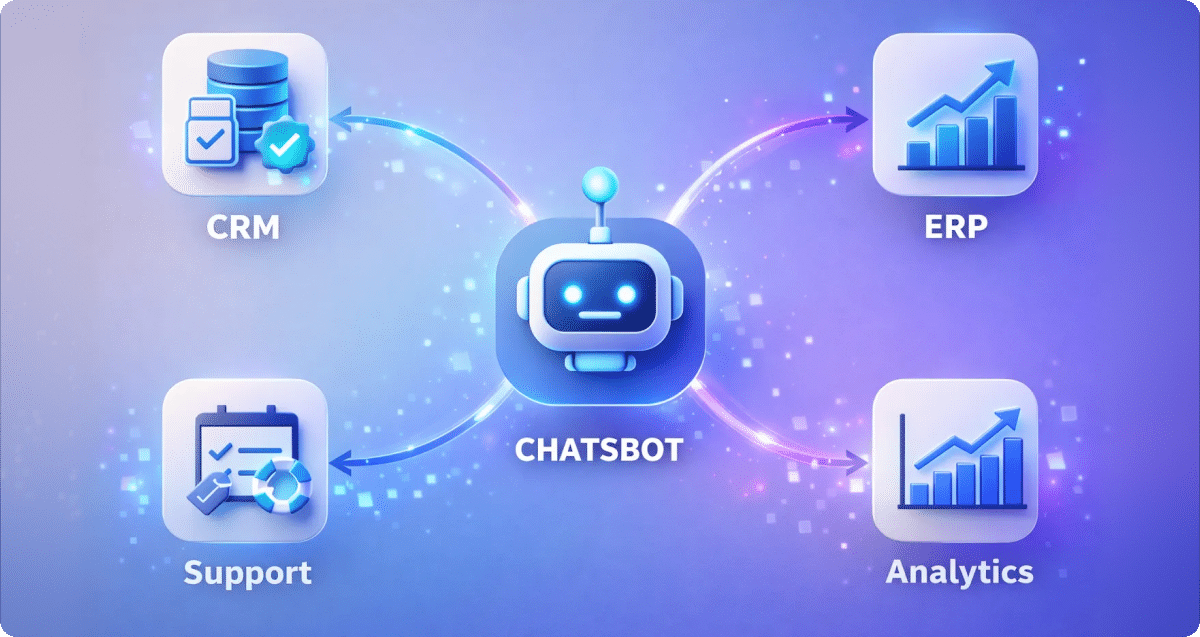
The real breakthrough is not in the agents themselves, but in their quiet communication. Think of a supply chain agent noticing a delay. It does not just alert a human. It initiates a dialogue with the inventory agent and the sales agent. Together, they recalibrate forecasts and adjust customer commitments in real time. This requires a new layer of architecture, building the secure protocols and middleware that allow these distinct intelligences to reason together.
Governance Becomes Programmatic
Granting this level of autonomy feels risky. It is, unless governance is engineered directly into the foundation. The concept of governance-as-code is now paramount. It means your compliance rules, approval thresholds, and ethical guardrails are translated into the very code that guides agent decisions. They also need to show you the framework, how every automated decision leaves a clear audit trail, and how you can adjust the rules of engagement when you hire chatbot developers.
It is redefining operational agility through a coordinated, automated effort that mirrors how your best teams already work. The enterprises that succeed will be those that learn to manage not a tool, but a society of machines.
The Build-Buy-Build Paradox Enterprises Face with AI Chatbot Solutions
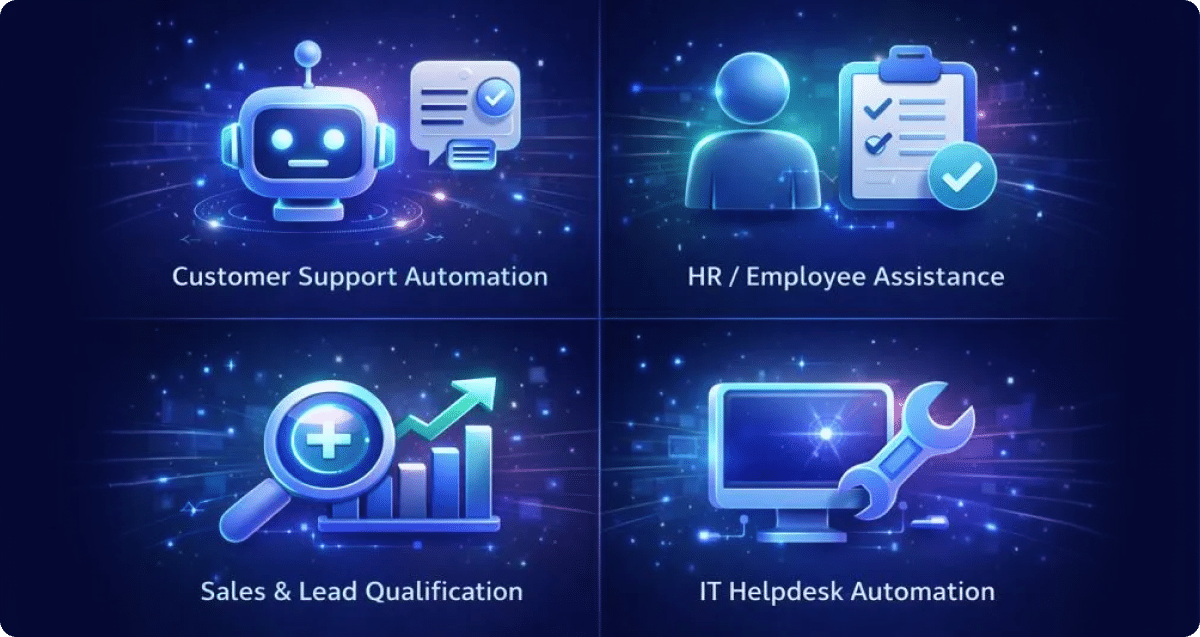
For years, the choice seemed straightforward. You either built a custom solution from the ground up or you bought a packaged platform. That binary decision has dissolved into something more nuanced. In 2026, the winning strategy is neither. It is a hybrid rhythm: buy the foundational platform, but build the unique business logic on top.
The Old Binary is Broken
Building a proprietary NLP engine from scratch is now a questionable endeavor. The cost and computational resources required are staggering. Conversely, buying a completely closed, off-the-shelf chatbot often leaves you with a generic interface that cannot grasp your specific goals. Despite 71% of organizations implementing AI agents, a Camunda report found that only 11% of these use cases reached production last year.
The Strategic Middle Path
Today, the smart investment is in a flexible, LLM-agnostic platform. You license the core intelligence and infrastructure. Then, you deeply customize the agents’ decision-making workflows and knowledge. This is where true value lives. A premier AI chatbot development company does not sell you a black box. They provide a customizable framework where your proprietary data and processes become the central intelligence.
Guard Your Flexibility
A critical warning emerges here. Vendor lock-in presents a massive silent risk. You must insist on platforms that allow you to swap between foundational models, whether GPT, Claude, or a future proprietary model. Your competitive advantage lies in your unique processes, not in your allegiance to a single AI provider. Demand open standards and transparent integration pathways.
This approach balances speed with autonomy. It acknowledges that while the engine might be commoditized, the steering mechanism is unique to your enterprise.
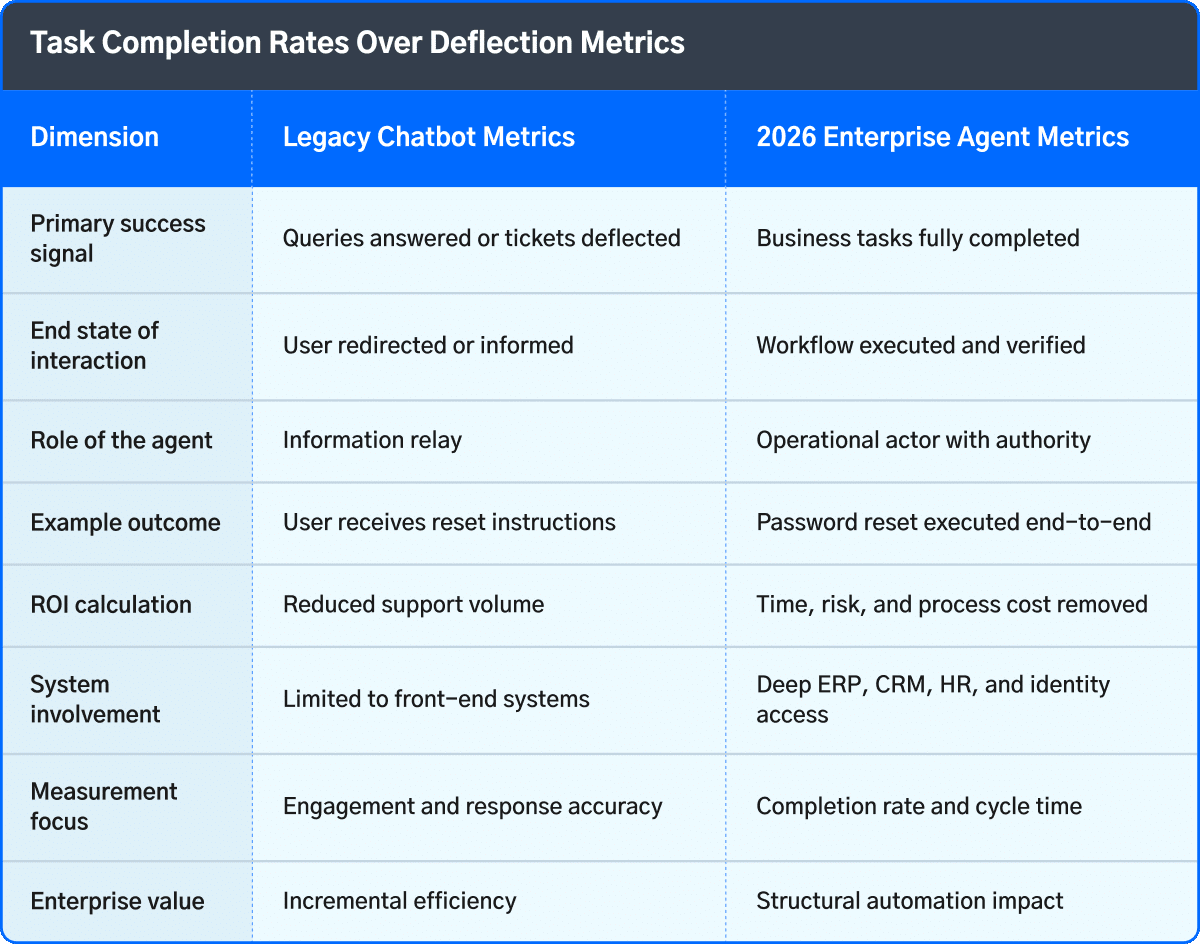
Task Completion Rates Over Deflection Metrics
Infrastructure No One Discusses: Data Tolls in Enterprise Automation
As multi-agent systems weave into enterprise infrastructure, a hidden operational cost is emerging. These are data tolls, the often-overlooked fees for the constant communication between your AI agents and the platforms they rely on in modern enterprise automation.
- Data tolls can emerge as effective connection costs as agent conversations scale across different software systems used in AI automation solutions.
- They are best understood as analogous to cloud egress fees, as a cautionary comparison for how dynamic AI workflows can quietly accumulate cost.
- Each API call between specialized agents can incur a micro-charge from vendor platforms. This creates a silent tax on automation efficiency and can threaten project scalability.
- Strategic data architecture and ownership become critical financial controls as organizations expand AI in enterprise operations. Enterprises must prioritize partnerships with clear data sovereignty policies.
- Development service providers should offer transparent, predictable pricing models for these interactions. Avoid surprise costs that make valuable automation economically unviable.
- When planning your agent ecosystem, direct your development team to map not only the data flow but also the cost flow across AI agents for enterprise automation.
The most elegant automation can be undermined by an architecture of accumulating costs. Your choice in a development partner must include their proficiency in building pathways that are both intelligent and economically sustainable.
Forward-Deployed Engineers: Your New Edge
A new model for technical partnership moves beyond traditional support contracts. The most effective enterprises, such as McKinsey & Company, now integrate external engineers directly into their business teams. These are forward-deployed engineers who possess a deep, operational understanding of your unique company rhythms. This integration creates a significant advantage when scaling enterprise AI chatbot development initiatives.
Beyond Vendor Engineers
A forward-deployed engineer solves problems for your business. They learn the details of your supply chain, the exceptions in your sales cycle, and the unspoken rules in your client interactions. They can anticipate how an AI agent will stumble in your specific environment before it ever happens, especially when deploying advanced AI chatbot solutions.
The New Required Skills
The internal skill set is evolving, too. Your own team must graduate from simply managing tools to architecting agent workflows. It requires mapping complex human processes into structured, automated decision trees used by AI-powered chatbots. A quality development service provides the mentoring and co-development that upskill your staff. The objective is a true knowledge transfer, not a dependency.
Building Internal Capability
The best partnerships intentionally build your internal capability. They treat your team as the permanent owners of the system. Joint development sessions, shared documentation, and paired programming on critical workflows are standard when working with custom AI chatbot solutions for enterprises. This collaborative approach ensures that the intellectual property of your automation resides within your walls.
The Real Competitive Edge
Ultimately, this combination is powerful. You merge external technical excellence with internal domain mastery. Your advantage becomes embedded in the very architecture of your operations. The speed and accuracy of your business responses improve because the people designing the systems truly understand the business and how AI chatbots improve enterprise automation.
Sustainability Metrics Enter Automation ROI
We are entering an era where efficiency is measured in more than speed and savings. Automation projects are now starting to move towards the new variable of environmental impact as part of a broader digital transformation with AI. OpenAI has published initiatives to reduce energy use in AI inference, and Microsoft measures carbon impact across cloud services.
- Consider the energy consumed by constant model inference and data processing. It’s a real operational cost that now extends beyond the electrical bill into corporate responsibility reports for large-scale AI-powered automation.
- The way regulations are heading points to more openness about how digital and AI systems affect the environment. Right now, EU rules make big digital operations tell people about their emissions.
- The concept of “green AI” is maturing from an academic idea into a practical design constraint for development teams who think ahead in generative AI development.
- You should expect potential partners to discuss how they optimize agent workflows. It is not just for speed, but computational efficiency you need when building AI chatbot development services.
- Ask for dashboards that show you the trade-offs. Can you choose a slightly slower process that uses seventy percent less energy?
- This approach represents a fundamental refinement in how we view operational excellence, building intelligently for sustainability and durability.
This vision significantly influences which partners you trust and how you architect for the long term. The goal is to build systems that are not only smart but also inherently responsible, ensuring that growth does not come at an untenable cost.
To align automation with long-term innovation goals, teams increasingly rely on strategic AI solutions for enterprises that balance performance, cost efficiency, and responsible system design.
Selecting Development Partners for AI Chatbot Development Services in 2026
Finding the right AI chatbot development company feels different now.. It is less about purchasing a tool and more about choosing a co-architect for your operational future, especially when investing in AI chatbot development services. The questions you ask need to peel back layers, revealing a firm’s true philosophy on autonomy and integration.
- Look for a narrative of cross-functioning automation, not just isolated bots. Can they discuss designing conversations between agents, not just with users, when building enterprise AI chatbot development systems?
- Insist on proof of model flexibility. Your partner should encourage swapping AI models, not just selling the most functional AI they have.
- Governance needs to be practical, not theoretical. Ask to see how policies are coded into workflows for real clients using AI-powered chatbots.
- Dig into their integration stories. You want evidence of connecting to legacy systems, not just pre-built SaaS kits.
- Be cautious of solutions that cannot explain their own logic. Transparency in decision pathways is non-negotiable.
- Prioritize partners who discuss ongoing learning plans. Systems must evolve from launch, not just be maintained.
- Include sustainability and cost control in your requests. Their architecture should inherently address efficiency, not just capability.
- Structure your pilot as a miniature operational test. Measure a complete business task from trigger to verified outcome.
The ideal relationship mirrors a seasoned guide. They provide the map and the tools, but you know the territory. They should leave your team more capable, not more dependent. Your final choice will determine whether your automation is a static cost center or a growing, intelligent asset.
Building the Intelligent Enterprise with AI Chatbot Solutions in 2026

The transition from assistive chatbots to autonomous, multi-agent systems redefines the operational core of an enterprise. Success now hinges on integrating several critical paradigms: the measurable completion of closed-loop tasks, the governed orchestration of specialized agents, and the strategic management of hidden costs like data tolls and environmental impact. These elements form a new architecture for intelligence in modern enterprise automation.
Your imperative is to evaluate potential through this integrated lens. Move beyond conversational demos to pilots that quantify end-to-end process completion within a governed framework supported by AI chatbot solutions. Seek partners who provide not just tools, but the transparent architecture and strategic depth to navigate this compound complexity. The outcome is a capability, a deeply embedded, self-improving operational layer. That is the true inflection point. Begin by demanding that your next automation project not only communicates but conclusively executes.
Key Takeaways on Enterprise Automation with AI
- Enterprise automation in 2026 is not about chatbots answering questions. It is about autonomous agents completing entire tasks through AI-powered automation.
- The focus moves from conversation to execution. Success is measured by closed workflows, not deflected queries.
- Solo AI tools are being replaced by coordinated teams of specialized agents that collaborate across your business.
- A new hidden cost, data tolls, emerges as agents communicate. Your architecture must manage these micro-transactions.
- The build versus buy debate is outdated. You now need adaptable platforms where you build your unique logic on top.
- Your development partner must provide forward-deployed engineers who understand your operations, not just their technology.
- Sustainability metrics are becoming part of the ROI calculation, influencing both design choices and partner selection.
- Selecting a partner requires evaluating their multi-agent orchestration and governance frameworks, not just language skills.
- Ultimately, this transition changes your company’s operational DNA. It offers a compounding advantage to those who start with a pilot focused on task completion.
Frequently Asked Questions About AI Chatbot Development Services
Q. How do you measure the ROI of a multi-agent system versus a simple bot?
A: Forget deflection rates. The primary metric becomes task completion velocity. Calculate the fully-loaded cost of the human workflow the agent replaces, including delay and error rates. Measure the agent’s throughput and success rate for that same workflow. The ROI lies in the net time and operational risk eliminated.
Q. What is the most underestimated cost when scaling agentic automation?
A: Data tolls. Each API call between agents and core systems, and between agents themselves, can incur micro-costs. As your ecosystem grows, these tolls compound like cloud egress fees. Architecting for efficient, minimal-agent data exchange is crucial for sustainable scaling and predictable economics.
Q. Can multi-agent systems function with legacy on-premise software?
A: Yes, but it defines the implementation path. It requires robust middleware, often custom-built, that allows modern agent platforms to securely interact with older systems. This integration layer becomes the most critical component, turning legacy data into actionable fuel for autonomous decision-making.
Q. What internal changes in skill set are required to manage these systems?
A: Your team must evolve from bot managers to workflow architects. This requires understanding process mapping, system integration points, and basic principles of AI governance. The focus moves from training dialogues to designing clear decision trees and audit trails for autonomous actions.
Q. How do you ensure that different agents from different vendors work together?
A: You mandate adherence to open standards and API-first design during procurement. The centralisation layer becomes the universal translator, requiring most control. Avoid vendors who cannot operate in a multi-agent ecosystem without proprietary lock-in.
Q. Is there a practical first step to pilot this technology?
A: Identify a single, high-frequency internal workflow with a clear completion trigger and outcome. Pilot an agent team to own it fully. Examples include employee onboarding, IT setup, or purchase order reconciliation. This tests integration depth and real task completion, not just conversation.
Q. What question should we ask a potential development partner to assess their maturity?
A: Ask them to describe a past failure. Inquire about an automation project where the logic failed in production. Listen for their diagnosis process, how they handle governance breaches, and how they redesigned the system’s decision pathways. This reveals their experience with real-world autonomy.