


Andreessen Horowitz’s Speedrun accelerator has become one of the toughest tickets in startups, with an acceptance rate reported at roughly 0.4% from a pool exceeding 19,000 applicants. For founders intent on cracking the shortlist, the program’s playbook is increasingly clear: bring a complementary team, show a small but undeniable spark of traction, and communicate with precision.
What Speedrun looks for in founding teams and early traction
Speedrun is optimized for very early-stage companies, which puts the spotlight on the founding team. Program leaders prioritize complementary strengths and self-awareness over rigid role boxes. They’re less concerned with labels like “business” or “technical” and more focused on whether the team collectively covers key capabilities without glaring gaps—and has a realistic hiring plan to fill what’s missing.
- What Speedrun looks for in founding teams and early traction
- How the Speedrun selection process works from application to offer
- How to position your Speedrun application for maximum impact
- Team construction and technical edge that Speedrun favors
- Traction and validation benchmarks that strengthen Speedrun bids
- Costs, terms, and how Speedrun compares with Y Combinator
- How to make the most of a16z’s platform and operator network
- A real founder example illustrating Speedrun’s interview depth
- Bottom line for applicants aiming to join a16z’s Speedrun
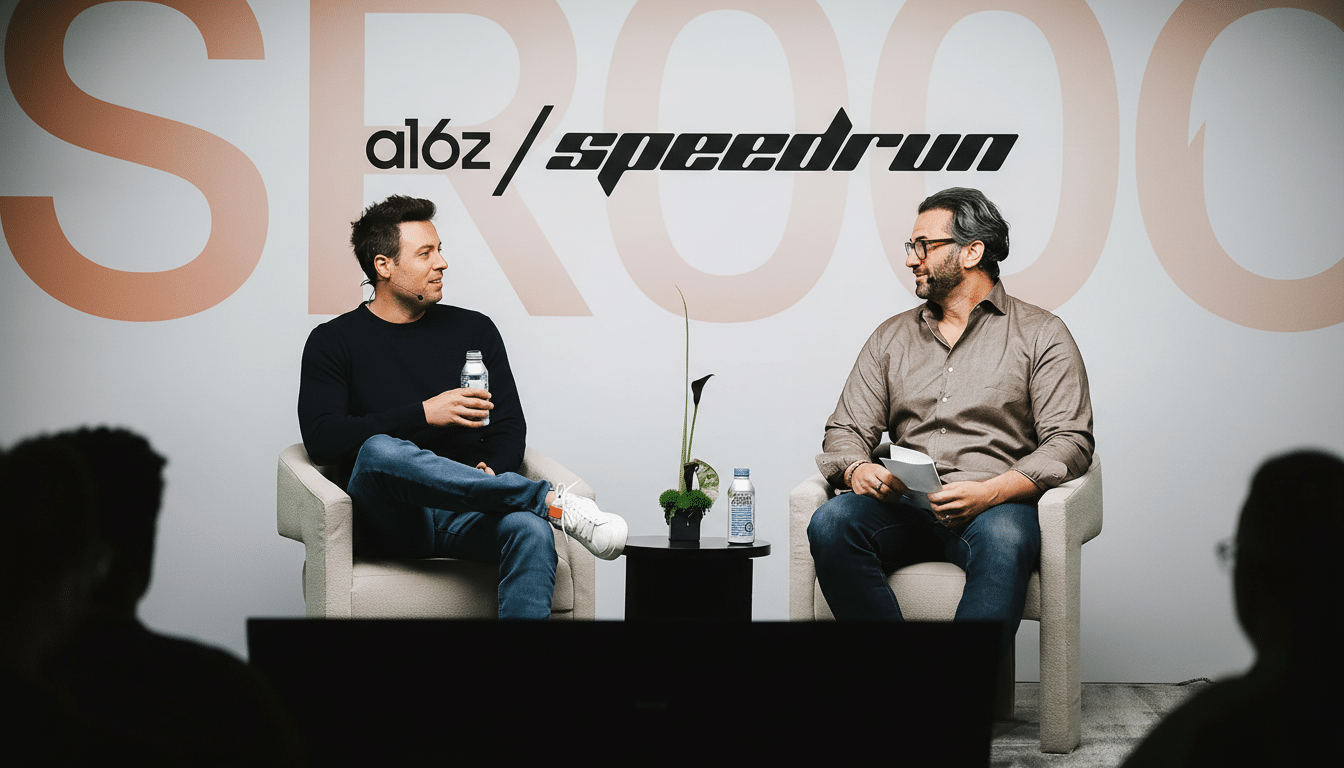
Teams with shared history get a meaningful edge. Prior collaboration signals the ability to disagree productively, resolve conflict, and execute at speed. While AI tools have lowered build barriers, technical depth still matters; the program favors teams that can prototype quickly, test hypotheses, and iterate without external dependencies.
How the Speedrun selection process works from application to offer
Most applicants never reach a live conversation. Only about 10% make it to the video-call stage, typically fielding questions from two to three investors. Expect follow-on screens before final decisions. Founders are encouraged to use AI to clean up the written application—no typos or meandering prose—but they must be able to explain the business crisply in real time. Overreliance on AI-generated narratives gets exposed quickly in interviews.
How to position your Speedrun application for maximum impact
Skip the essay on market theory. Speedrun’s reviewers want to know why your team is the right team for this specific problem—and to see tangible signals that the idea is working. Treat the application like an internal strategy memo: state the problem plainly, explain why it’s structurally hard, outline your wedge, and show what’s working, what isn’t, and the plan to close gaps.
Replace hype with evidence. Even modest proof beats ambition alone:
- Week-over-week activation improvements
- Early paid pilots
- Retention curves
- A waitlist that converts
- Credible letters of intent
If you’re pre-product, show disciplined customer discovery and a build plan tied to milestones, not vanity metrics.
Team construction and technical edge that Speedrun favors
Speedrun backs teams that can ship. That often means at least one founder who can build core product, integrate models, wrangle data, or own infrastructure. But it’s not only about code; commercial instincts matter, too. What stands out is explicit division of responsibility, evidence of working cadence, and clarity on how the team will handle the next 6–12 months of company-building.
Highlight prior collaborations, open disagreement loops you’ve resolved, and decisions you’ve reversed based on data. This signals maturity and reduces perceived execution risk.
Traction and validation benchmarks that strengthen Speedrun bids
Speedrun looks to “pour gasoline on a small fire,” not ignite a cold start. Strong candidates show at least one compelling spark:
- Daily or weekly active usage with improving retention
- A signed pilot with a demanding design partner
- Measurable time-to-value for users
- Technical differentiation that’s hard to copy (unique data access, performance outliers, or an IP pathway)
For AI-first startups, reviewers scrutinize:
- Data strategy
- Model performance relative to baselines
- Latency and cost per inference
- A credible path to defensibility beyond prompt engineering
Being explicit about trade-offs and constraints lands better than hand-waving about “secret sauce.”
Costs, terms, and how Speedrun compares with Y Combinator
Speedrun invests up to $1 million per company. The typical structure: $500,000 up front for 10% via a SAFE, with an additional $500,000 if you raise a subsequent round within 18 months at the terms set by that round’s investors. Compared with Y Combinator’s common structure—$125,000 for 7% plus a separate $375,000 uncapped MFN SAFE—Speedrun is intentionally more equity-expensive.
What do founders get for the premium? Access to a16z’s operating network—reportedly around 600 people, the vast majority are operators across go-to-market, marketing, finance, and talent—plus perks like up to $5 million in vendor credits from partners such as AWS, OpenAI, Nvidia, and Deel. Founders who “over-ask” and make specific, repeated use of these resources tend to extract the most value.
How to make the most of a16z’s platform and operator network
Arrive with a target map of who you need:
- Design partners by industry
- Senior technical advisors
- Distribution channels
- Critical executive hires
Set weekly requests, share short progress updates, and instrument experiments so operating experts can see cause and effect. Treat the program like a force multiplier, not a curriculum.
A real founder example illustrating Speedrun’s interview depth
Consider Smart Bricks, a proptech startup that recently announced a $5 million raise with Speedrun participation. Its founder approached the application as a clear internal memo—not a pitch deck stuffed with buzzwords—spelling out why the problem mattered, where the product was already working, and where help was needed. Interviews reportedly went deep on architecture, data strategy, and long-term ambition, mirroring a partner-level discussion rather than a surface screening.
The takeaway: intellectual honesty and precision win. Don’t inflate; calibrate. Depth beats polish when the reviewers are testing how you think under pressure.
Bottom line for applicants aiming to join a16z’s Speedrun
To break into a16z’s Speedrun, lead with team quality and proof of momentum, not theory. Write tightly, speak clearly, and show a spark that can scale. If you earn a spot, be relentless about tapping the operating bench. The program rewards founders who know exactly what they need and move fast to get it.