


For most of cinema’s history, bringing a film to life required a large team: writers, directors, cinematographers, editors, sound designers, VFX artists, and production crews working across months of planning and execution.
AI is changing how filmmakers approach that process. It does not replace storytelling, creative judgment, or the craft of filmmaking. Instead, it gives filmmakers new ways to develop ideas, visualize worlds, experiment with sequences, and move from concept to finished film faster.
- 1. Understanding the Modern AI Filmmaking Workflow
- 2. Pre-Production: Building the Creative Foundation
- Developing the Story
- Building a Visual Language
- Storyboarding and Shot Planning
- 3. Production: Creating Footage with AI
- Generating Shots
- Maintaining Continuity Across Scenes
- 4. Post-Production: Turning Shots into a Film
- Building the First Cut
- Where AI Agents Fit Into the Filmmaking Workflow
- 5. A Practical AI Filmmaking Workflow
- 6. What AI Still Cannot Do
- Creative judgment
- Storytelling
- Human performance
- Taste
- 7. Getting Started
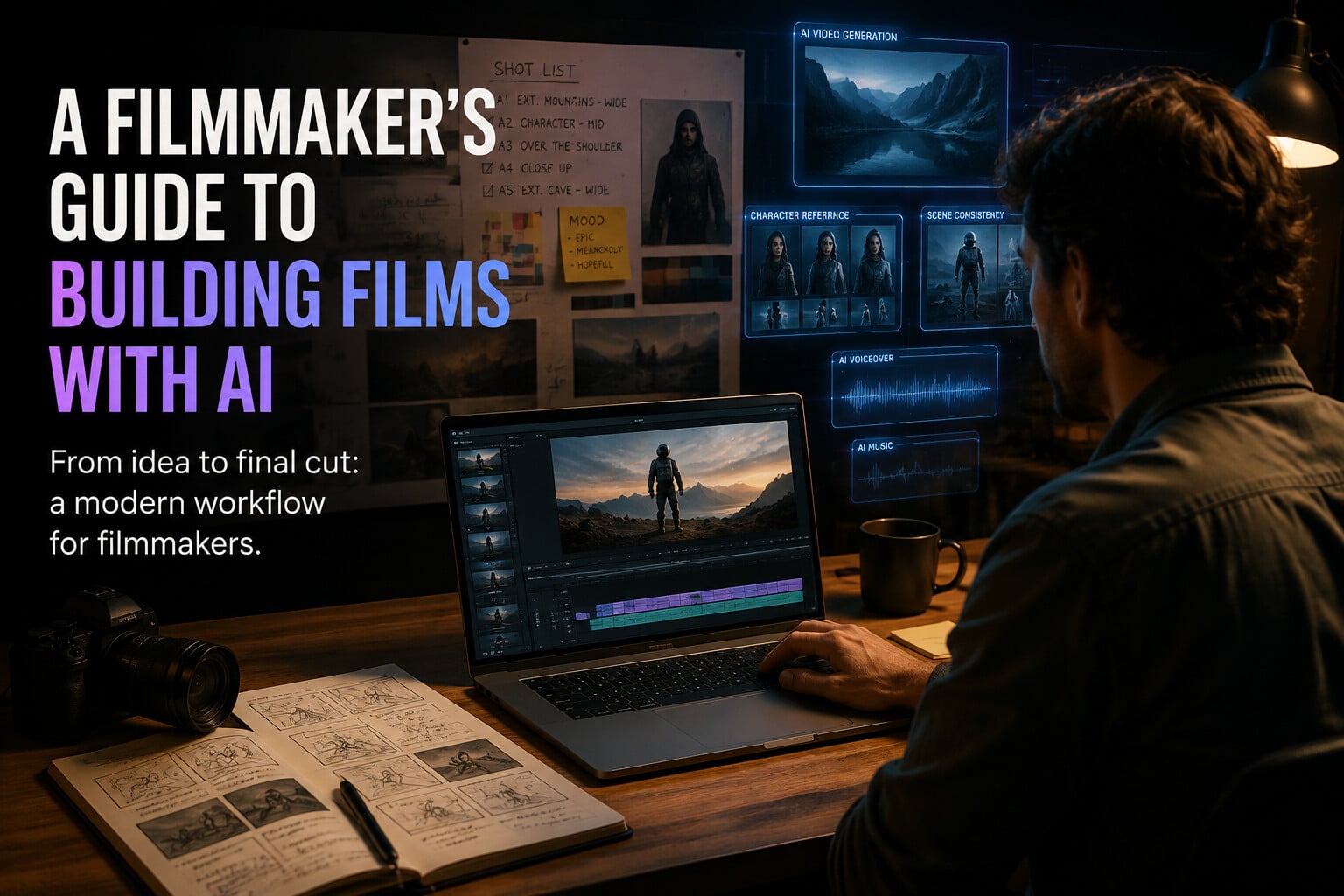
A filmmaker with a laptop and the right workflow can now develop a concept, build a visual language, generate or capture footage, edit sequences, and finish projects that previously required much larger teams and budgets.
The craft remains human. Story, pacing, emotion, and taste still determine whether a film works. What has changed is how much of the production process a filmmaker can explore, iterate on, and execute.
This guide walks through the modern AI filmmaking workflow, from developing the first idea to creating the final cut.
1. Understanding the Modern AI Filmmaking Workflow
AI filmmaking is not one tool or one generation step. It is a chain of creative decisions across multiple stages:
- Developing the story and creative direction
- Building a visual language and reference library
- Planning shots and sequences
- Generating or capturing footage
- Refining visuals, performance, and sound
- Editing and finishing the film
The biggest shift is not simply that AI can generate better images or video. The challenge is connecting all parts of a production together, keeping characters, visual rules, references, and creative decisions consistent from the first scene to the last.
Professional filmmaking has always depended on systems that preserve creative intent: scripts, storyboards, production bibles, continuity notes, and communication between departments. AI filmmaking requires the same discipline.
2. Pre-Production: Building the Creative Foundation
Developing the Story
AI can be useful during development, but not as a replacement for the filmmaker’s voice.
The strongest use cases are as a creative collaborator:
- Exploring story directions
- Testing different structures
- Improving dialogue
- Finding weaknesses in a scene
- Developing character motivations
A filmmaker should treat AI like a writers’ room partner: something to challenge ideas, explore possibilities, and refine decisions.
The world, characters, tone, and emotional direction still come from the filmmaker.
Building a Visual Language
Before generating footage, filmmakers need a clear visual foundation.
A strong AI filmmaking workflow begins with references:
- Character designs
- Locations
- Lighting styles
- Color palettes
- Camera language
- Mood references
A lookbook of 15–20 images can help establish the visual identity of a project before production begins.
For longer projects, this becomes a production bible, a reference point for characters, locations, visual rules, and creative decisions that need to remain consistent throughout the film.
Storyboarding and Shot Planning
AI can help filmmakers move faster through early planning.
Some tools can analyze scripts and suggest the following:
- Shot ideas
- Camera movement
- Scene coverage
- Visual approaches
These suggestions are not a replacement for storyboarding. They are a way to explore options earlier and make stronger decisions before production begins.
3. Production: Creating Footage with AI
This is where AI has introduced some of the biggest changes in filmmaking.
Instead of treating every generation as a final shot, filmmakers increasingly use AI like a creative production process: exploring options, creating variations, and selecting the strongest results.
Generating Shots
A practical AI filmmaking workflow often starts with controlling the visual foundation first.
A common approach:
- Create a reference image to define composition, lighting, and character appearance.
- Use image-to-video workflows to introduce motion and camera movement.
- Generate multiple versions of the shot.
- Select and refine the strongest take.
This mirrors traditional filmmaking. Directors rarely rely on a single take, they explore options and choose the version that best serves the story.
Maintaining Continuity Across Scenes
One of the biggest challenges in AI filmmaking is consistency.
A film is not a collection of disconnected clips. Characters, locations, costumes, lighting, and visual style need to remain coherent across an entire sequence.
Character references and visual guides help, but consistency is also a workflow problem.
Filmmakers need systems that preserve:
- Approved references
- Creative decisions
- Visual rules
- Scene relationships
- Project history
The future of AI filmmaking is not only about better generation. It is better continuity between every stage of production.
Combining AI and Real Footage
Many of the strongest AI-assisted films combine generated content with traditional production.
Filmmakers often use real footage for:
- Human performances
- Emotional moments
- Dialogue scenes
- Physical interactions
AI can expand what is possible through:
- Environment creation
- Establishing shots
- Background extensions
- Period settings
- Complex visual effects
The goal is not choosing between AI and traditional filmmaking. It is combining both where each works best.
Voice and Performance
AI voice tools can support:
- Narration
- Temporary dialogue
- ADR workflows
- Synthetic characters
However, human performance remains one of the hardest parts of filmmaking to replicate. Subtle emotion, timing, and chemistry between performers still depend heavily on human direction.
4. Post-Production: Turning Shots into a Film
Generating footage is only one stage of filmmaking. The final film is created through editing decisions.
Building the First Cut
Editors use the timeline to discover what works:
- Does the story flow?
- Does the pacing feel right?
- Are the strongest moments placed correctly?
- Does the sequence create the intended emotion?
Traditional editing platforms such as DaVinci Resolve, Premiere Pro, and Final Cut Pro remain powerful environments for detailed finishing.
At the same time, AI-assisted workflows are helping filmmakers speed up early assembly, version creation, and repetitive editing tasks.
Where AI Agents Fit Into the Filmmaking Workflow
As AI filmmaking becomes more advanced, the challenge is no longer only creating individual shots. It is managing the entire creative process.
AI agents can help filmmakers maintain project context, organize references, track creative decisions, and move between stages of production without repeatedly rebuilding the brief.
For example, invideo agent is designed around a workflow where project context, references, and creative decisions remain connected throughout production. Agent Intelligence uses concepts like Context and Briefs to help maintain the rules of a project over time, rather than treating every session as a fresh start.
For editing and finishing, invideo Semantic Editor extends this workflow into an editable timeline where creators and AI agents can work together. Filmmakers can make manual edits or ask the agent to make changes while keeping those changes visible and editable on the timeline.
The goal is not removing the filmmaker from the process. It is reducing repetitive work so more attention can go toward creative decisions.
Sound Design and Score
AI music and sound tools can help filmmakers explore:
- Temporary score ideas
- Ambient sound design
- Foley concepts
- Audio variations
They are especially useful during experimentation and early cuts, while final sound decisions still depend on the filmmaker’s creative direction.
Color and Finishing
AI-assisted color tools can help balance footage from different sources:
- AI-generated shots
- Camera footage
- Phone footage
- Stock material
The goal is creating a unified visual experience rather than a collection of disconnected clips.
5. A Practical AI Filmmaking Workflow
A complete workflow might look like this:
- Develop the concept
Define the story, characters, world, and creative direction. - Build the visual foundation
Create references for style, lighting, locations, and characters. - Plan the production
Develop storyboards, shot lists, and sequence structures. - Generate and refine footage
Create shots, explore variations, and select the strongest results. - Organize creative decisions
Maintain references, approved assets, and project rules. - Assemble the first cut
Build the sequence, test pacing, and explore different versions. - Finish the film
Refine editing, sound, color, and final details.
6. What AI Still Cannot Do
AI can accelerate filmmaking, but it does not replace the filmmaker.
Creative judgment
AI can create options, but filmmakers decide which choices have meaning.
Storytelling
A model can generate scenes, but it does not understand why a moment matters to an audience.
Human performance
Emotion, timing, chemistry, and subtle expression remain difficult to reproduce.
Taste
The difference between a collection of generated shots and a film is still the filmmaker’s ability to make decisions.
7. Getting Started
You do not need every AI tool available to begin.
A practical starting workflow includes:
- One tool for story development
- One image workflow for visual references
- One video generation workflow
- One sound or voice workflow
- One editing environment
- One system for organizing creative decisions
The most valuable skill in AI filmmaking is not prompting.
It is directing.
The filmmakers who benefit most from AI will be the ones who know how to build worlds, make creative decisions, guide tools, and turn possibilities into finished films.