


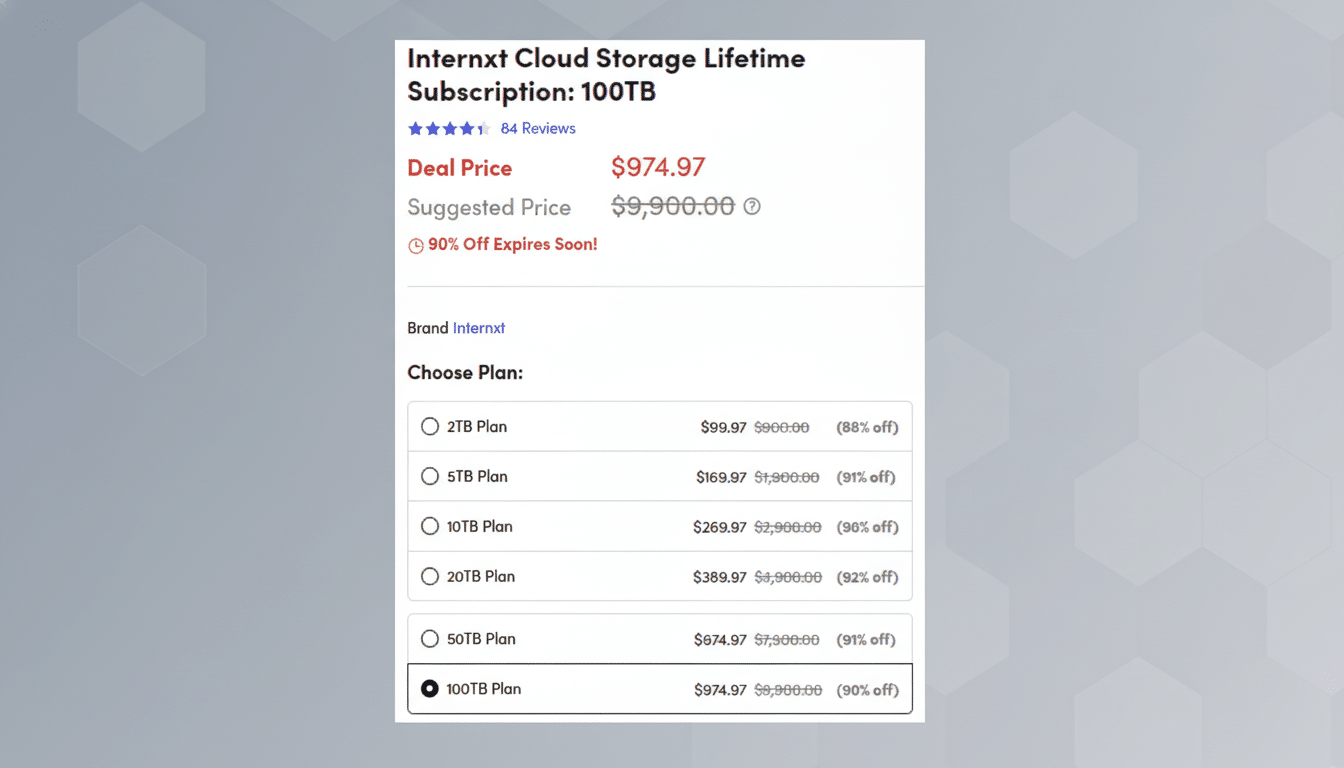
Consumers fed up with monthly cloud bills have a new option: a one-time payment for a massive 100TB of storage that lasts for life. Privacy-focused provider Internxt is pushing the boldest version of the trend, offering a lifetime plan that aims to replace recurring subscriptions with a single upfront cost.
What 100TB for Life Actually Buys You in Practice
One hundred terabytes is far beyond typical consumer allotments. For context, even with hefty 50MB RAW photos, that capacity translates to roughly two million images. If you shoot 4K video at 100 Mbps—common for high-quality mirrorless cameras—100TB works out to about 2,000 hours of footage. For creative teams, small studios, and anyone building a long-term digital archive, that headroom can eliminate the constant shuffle of deleting, offloading, and upgrading plans.
The appeal goes beyond sheer space. With a lifetime license, your storage ceiling doesn’t creep up as your library grows; you’re not forced into higher tiers just to keep up with backups, home video projects, or a decade of smartphone snaps and screen recordings.
How It Stacks Up on Price Against Competitors
Most big-name services top out well below 100TB for individual users. Apple caps iCloud+ at 12TB, and the monthly rate adds up quickly over a year. Google One’s largest consumer plan is 30TB, and Microsoft’s consumer plans are measured in single digits, not triple digits. Even if you never hit 100TB, the arithmetic behind a lifetime license is straightforward: a single payment can undercut years of recurring fees.
Object storage platforms aimed at developers, like Backblaze B2 or Amazon S3, can technically scale into the hundreds of terabytes, but they bill by the gigabyte and charge for egress, turning sustained personal use into an expensive proposition. A set-it-and-forget-it price eliminates that unpredictability—and eliminates a line item from your monthly budget.
Privacy And Compliance Take Center Stage
Internxt’s pitch hinges on security. The company touts end-to-end, zero-knowledge encryption, which means files are encrypted before they leave your device and remain unreadable to the provider. That’s a stronger stance than traditional cloud drives that may scan content to enable features like deduplication or server-side search. The service emphasizes GDPR compliance and a privacy-by-design model aimed at minimizing metadata exposure.
For regulated industries and privacy-conscious users, those assurances matter. Organizations including the European Data Protection Board have consistently underscored the importance of encryption and data minimization, and privacy-first architectures have gained momentum as more personal and professional work migrates to the cloud.
Read the Fine Print on Lifetime Cloud Storage Deals
“Lifetime” in tech is really shorthand for the lifetime of the product or company, not an eternity. Before you buy, check what lifetime means in the terms of service, whether there are fair-use policies, and how the provider handles account inactivity. Look for clear statements on file size limits, bandwidth caps for uploads and downloads, versioning, and whether features like link sharing or backup clients come with restrictions.
Sustainability matters, too. Long-term value depends on the vendor’s balance sheet, not just its encryption. Savvy buyers evaluate track records, funding, and road maps. If you plan to store irreplaceable assets, ensure there’s an exit strategy—simple exporting tools and standard file structures—so you’re not locked in if your needs change.
Who This Is For and When It Makes the Most Sense
For photographers, filmmakers, drone pilots, and creators sitting on multi-terabyte libraries, 100TB provides breathing room that mainstream plans can’t match. Small businesses with compliance-heavy archives—think legal records, architectural renders, or medical imaging—also benefit from generous, predictable capacity.
That said, no cloud should stand alone. Security agencies and backup experts often recommend the 3-2-1 rule: keep three copies of your data, on two different media, with one offsite. A lifetime cloud plan can be the offsite pillar alongside local RAID or NAS storage, reducing risk from drive failures, theft, or disasters.
The Bottom Line on 100TB Lifetime Cloud Storage
As data creation keeps climbing—industry analysts like IDC have charted relentless growth in the global datasphere—the idea of buying cloud storage once and moving on is compelling. Internxt’s 100TB lifetime offer hits a nerve for anyone tired of subscription creep, pairing large-scale capacity with a strong privacy posture. The calculus is simple: if the price of one lifetime license replaces years of monthly fees and the security model meets your standards, the economics and peace of mind might finally justify moving your entire archive to the cloud—without the meter running.